You are hereScience & Technology
Science & Technology
135 countries committed to International Year of Astronomy 2009: "The Universe, yours to discover." Began on 1 Jan

(quote)
Stargazers around the world are busy preparing for the International Year of Astronomy. A staggering 135 nations are collaborating to bring the Universe closer to Earth. Events and activities will take place over the coming 365 days and beyond, in a spectacle of cosmic proportions.
The International Year of Astronomy 2009 (IYA2009) has been launched by the International Astronomical Union (IAU) and the United Nations Educational, Scientific and Cultural Organization (UNESCO) under the theme, "The Universe, yours to discover". Thousands of IYA2009 events are described on the national websites, as well as on astronomy2009.org, and a few of the global projects are listed here.


World's tallest buildings (part i): Cheops Pyramid, Lincoln Cathedral, St. Olav, Strasbourg Cathedral, St. Nikolai

(quote)
Cheops Pyramid – Egypt, finished in 2,600 BC (481 ft - 146 m)
The Cheops Pyramid at Giza, Egypt, was finished in the year (approx) 2,600 BC and reigned as the world's tallest building / structure for another 4,000 years. How the Great Pyramid was built is a question that may never be answered. This pyramid is thought to have been built between 2589 - 2566 BC. It would have taken over 2,300,000 blocks of stone with an average weight of 2.5 tons each. These stones were brought from Aswan and Tura and the water would have brought the stones right to the pyramid. The total weight would have been 6,000,000 tons and a height of 482 feet (140m). The Great Pyramid of Cheops (Khufu) is the largest and the oldest of the Pyramids of Giza. It wasn't until the 13th Century that Egypt lost the title to a cathedral that was constructed in the U.K. at Lincoln.

Lincoln Cathedral, U.K., completed in 1311 AD (525 ft - 160 m)
Construction of the Cathedral finished in the year 1311 AD, and the Cathedral maintained the title of the world's tallest building for 238 years until 1549 AD, when the central spire was destroyed in a storm. The central spire was never re-built.

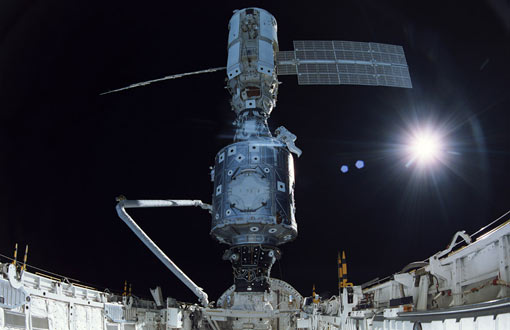
Zarya, 1st launched module of International Space Station (ISS), lifted into orbit 10 years ago on 20Nov1998
(quote)
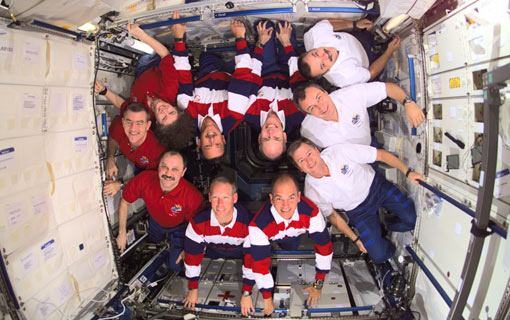
Last month marks the 10th anniversary of the first launched module of the International Space Station (ISS). The module Zarya was lifted into orbit on November 20th, 1998 by a Russian Proton rocket lifting off from Baikonur, Kazhakstan. In the decade since, 44 manned flights and 34 unmanned flights have carried further modules, solar arrays, support equipment, supplies and a total of 167 human beings from 15 countries to the ISS, and it still has a ways to go until it is done. Originally planned to be complete in 2003, the target date for completion is now 2011. Aside from time spent on construction, ISS crew members work on a good deal of research involving biology and physics in conditions of microgravity. If humans are ever to leave the Earth for extended periods, the ISS is designed to be the place where we will discover the best materials, procedures and safety measures to make it a reality.
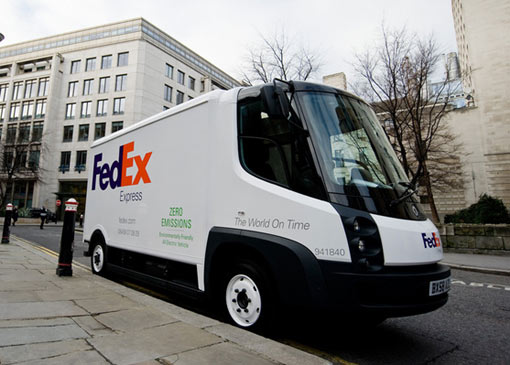
Modec electric vans in UK: FedEx Express' fleet of >170 hybrid electric vehicles - zero tailpipe emission
(quote)
12 December 2008
FedEx Express has ordered 10 Modec electric commercial vehicles for use in the United Kingdom. The zero tailpipe emission vehicles will be the first such to join the FedEx fleet in the UK and will operate in the greater London metropolitan area. The vehicles feature a large, removable battery pack and can travel up to 70 miles on one overnight charge.

The new vehicles are part of a growing fleet of more than 170 hybrid electric vehicles in the FedEx fleet worldwide - the largest hybrid fleet in the transportation industry—and support the company’s commitment to improve the fuel efficiency of its vehicle fleet by 20% by 2020. FedEx has also committed to reducing carbon dioxide emissions from its aircraft fleet by 20% per available ton mile by 2020.
Photos courtesy of greencarcongress.com and roadtransport.com
Original Source: Green Car Congress
Related Articles: FedEx Hybrid-Electric Fleet Passes Two Million Miles and FedEx Express and Iveco in joint diesel-electric hybrid Daily van trials. There's 'Green' says Biglorryblog
Where top talents go, so does Nobel Prize. Japan shares chemistry prize, splits physics award with American scientists

(quote)
The Nobel Prize (Swedish: Nobelpriset) is a Swedish prize, established in the 1895 will of Swedish chemist Alfred Nobel; in his will, he used his enormous fortune to institute the Nobel Prizes. The synthetic element nobelium was named after him. It was first awarded in Peace, Literature, Chemistry, Physiology or Medicine, and Physics in 1901. An associated prize, The Sveriges Riksbank Prize in Economic Sciences in Memory of Alfred Nobel, was instituted by Sweden's central bank in 1968 and first awarded in 1969.

10 Dec 1915: The first computer programmer, daughter of Lord Byron, Ada Lovelace born in London

(quote)
The daughter of famed poet Lord Byron, Augusta Ada Byron, Countess of Lovelace - better known as "Ada Lovelace" - was born in London on December 10, 1815. Ada was the only legitimate child of the famous poet Lord George Gordon Byron. Lord Byron's marriage to Ada's mother, Lady Anne Isabella Milbanke Byron, was not a happy one. Lady Byron separated from her husband only weeks after their daughter was born. A few months later, Lord Byron left England, and Ada never saw her father again. He died in Greece when Ada was 8 years old.
Ada had an unusual upbringing for an aristocratic girl in the mid-1800s. At her mother's insistence, tutors taught her mathematics and science. Her mother believed that engaging in rigorous studies would prevent Lovelace from developing her father's moody and unpredictable temperament. From early on, Lovelace showed a talent for numbers and language. She received instruction from William Frend, a social reformer; William King, the family's doctor; and Mary Somerville, a Scottish astronomer and mathematician. Somerville was one of the first women to be admitted into the Royal Astronomical Society.
Augusta Ada King-Noel, Countess of Lovelace (née Byron; 10 December 1815 – 27 November 1852) was an English mathematician and writer, chiefly known for her work on Charles Babbage's proposed mechanical general-purpose computer, the Analytical Engine. She was the first to recognise that the machine had applications beyond pure calculation, and published the first algorithm intended to be carried out by such a machine. As a result, she is often regarded as the first to recognise the full potential of a "computing machine" and the first computer programmer. read more »
10 Dec 1799 France adopts the metric system, first country to do so

(quote)
The metric system, that is the system of units based on the metre, was officially adopted in France on 10 December 1799 (19 frimaire An VIII) and became the sole legal system of weights and measures there from 1801.
In France, before the start of the Revolution in 1789, there had been no uniformity of weights and measures. Trading had been difficult and fraud had been easy, so in 1790 the French National Assembly called for uniform new measures to put a stop to the abuses taking place. Charles Maurice Talleyrand, Bishop of Autun, presented to the Assembly a scheme based upon “natural” measures which he proudly stated would be “for all people, for all time”. This was modified by the Academy of Science, which also strongly favoured the new measures forming a decimal system as follows. The unit of length, the metre, was to be equal to the ten-millionth part of the arc of meridian between the North Pole and the equator and passing through Paris. The gram was to be the “absolute weight” of a volume of pure water, equal to the cube of the hundredth part of the metre and at the temperature of melting ice. read more »
Contact Us

RSS feed


