You are hereBlogs / WcP.Scientific.Mind's blog / Where top talents go, so does Nobel Prize. Japan shares chemistry prize, splits physics award with American scientists
Where top talents go, so does Nobel Prize. Japan shares chemistry prize, splits physics award with American scientists

(quote)
The Nobel Prize (Swedish: Nobelpriset) is a Swedish prize, established in the 1895 will of Swedish chemist Alfred Nobel; in his will, he used his enormous fortune to institute the Nobel Prizes. The synthetic element nobelium was named after him. It was first awarded in Peace, Literature, Chemistry, Physiology or Medicine, and Physics in 1901. An associated prize, The Sveriges Riksbank Prize in Economic Sciences in Memory of Alfred Nobel, was instituted by Sweden's central bank in 1968 and first awarded in 1969.

The Nobel Prizes in the specific disciplines (Chemistry, Physics, Physiology or Medicine, and Literature) and the Prize in Economics, which is commonly identified with them, are widely regarded as the most prestigious award one can receive in those fields. The Nobel Peace Prize conveys social prestige and is often politically controversial.

This year, five Europeans, four Americans and three Japanese were selected by the Nobel Prize committees.
Japan's Osamu Shimomura and Americans Martin Chalfie and Roger Tsien shared the chemistry prize for discovering and developing a fluorescent protein. Their work has helped researchers track such processes as the development of brain cells, the growth of tumors and the spread of cancer cells.
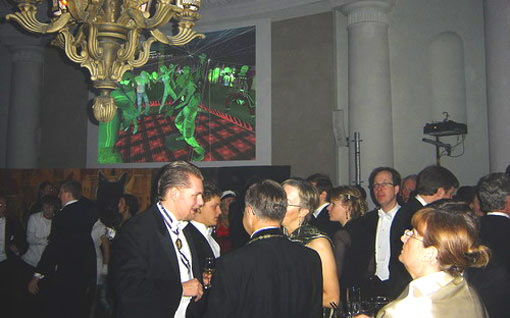
Japanese scientists Makoto Kobayashi and Toshihide Maskawa split the physics award with American Yoichiro Nambu for theoretical advances that help explain the behavior of the smallest particles of matter. Nambu, 87, canceled his trip to Stockholm for health reasons and was set to receive his award at a ceremony in Chicago.
Mainichi Daily News: “Japanese Nobel Prize winner balks at English, to make speech in mother tongue” - One of the four Japanese Nobel laureates will make his speech in his mother tongue at a function prior to the Nobel Prize award ceremony in Stockholm next week.
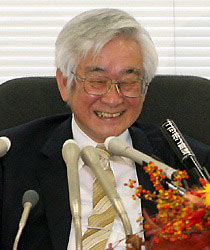
"Giving a lecture in English is impossible and improbable," Maskawa reportedly said during a meeting for the ceremony last week, according to Kyoto Sangyo University. Maskawa has never traveled abroad nor attended an international academic conference. His prize-winning thesis, written in Japanese, was translated into English by his fellow researcher and Nobel laureate, Makoto Kobayashi. Kobayashi, 64, professor emeritus at the High Energy Accelerator Research Organization, will give his award lecture in English at Stockholm University.
Over recent years, all Japanese Nobel laureates have given their award speeches in English.
(unquote)
Photos courtesy of Jonas Ekströmer, Henrik Montgomery, MindArk and Mainichi Japan
Original Source: Wikipedia, The Hindu, and Mainichi Daily News


Contact Us

RSS feed


