You are hereScience & Technology
Science & Technology
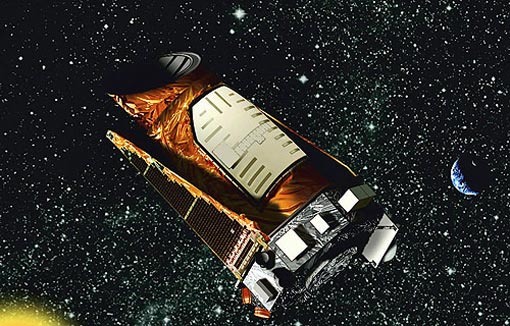
NASA's spacecraft Kepler blasts off on a three-year mission in search of Earth-like planets
(quote)
NASA's Kepler spacecraft blasted off from Kennedy Space Center in Florida on Friday on a three-year mission to find Earth's twin, a Goldilocks planet where it's neither too hot nor too cold, but just right for life to take hold.
The Delta II rocket, carrying the widest field telescope ever put in space, lifted off the launch pad at Cape Canaveral at 10:49 p.m. Eastern time. The launch vehicle headed down-range, gathering speed as its three stages ignited, one after the other, passing over Antigua Island in the Caribbean and later over tracking stations in Australia before climbing into orbit.
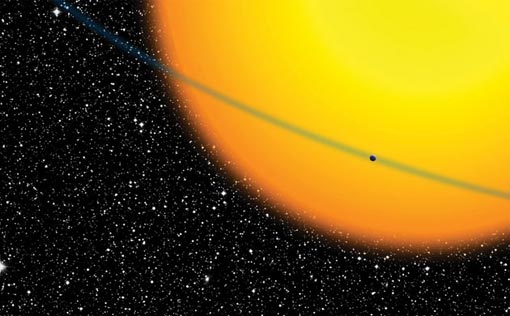
Kepler will eventually settle down to scan tens of thousands of stars near the constellations Cygnus and Lyra in search of planets where water could exist on the surface in liquid form, a key condition for life as we know it. "We have a feeling like we're about to set sail across an ocean to discover a new world," said project manager Jim Fanson of the Jet Propulsion Laboratory in La Cañada Flintridge. "It's sort of the same feeling Columbus or Magellan must have had." read more »


MIT Solar Electric Vehicle Team unveils sleek 90-mph car, will compete in World Solar Challenge in Australia

(quote)
MIT's Solar Electric Vehicle Team, the oldest such student team in the country, has just finished construction of its latest high-tech car and unveiled it to the public this Friday. "It drives beautifully," said George Hansel, a freshman physics major at the Massachusetts Institute of Technology and a member of the team. "It's fun to drive and quite a spectacle." With six square meters of monocrystalline silicon solar cells and improved electronic systems and design, the car can run all day on a sunny day at a steady cruising speed of 55 mph. The car will be competing in October in the World Solar Challenge race across Australia, and in preparation for that the team plans to drive the car across the United States over the summer. About a dozen team members are expected to go to Australia for the race, although only four will drive the solar car in the competition.

World's tallest buildings (part iii): Taipei Tower 101, Burj Dubai & 1-km High Club (projects under construction)

(quote)
The Taipei Tower 101, Taiwan, completed in 2003 (1,670 ft - 509.2 m)
The Taipei Tower 101, completed in 2003 took just 4 years to build. It is called the 101 because it has 101 floors (stories) above ground, and 5 below. From ground to tip of spire the Sears Tower is still taller than the Taipei 101, however from ground to top of roof the Taipei does win. The Taipei 101 is the first and currently only habitable building in the world to break the half-kilometer mark in height. However, a tower currently under construction known as "Burj Dubai" is going to do away with any controversy so completely that there will be no doubt as to which is the world's tallest building.

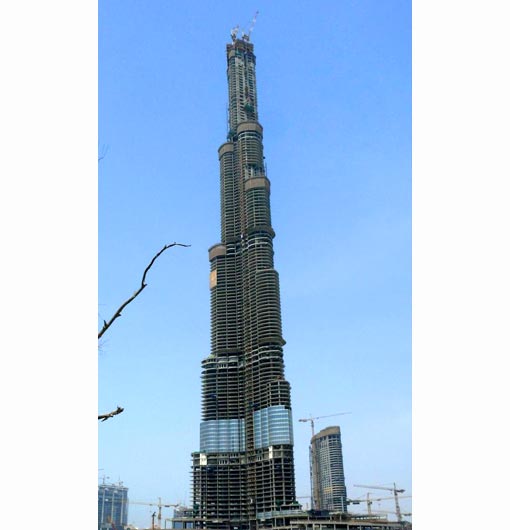
Burj Dubai, United Arab Emirates, to be completed in 2009 (2,684 ft - 818 m) read more »
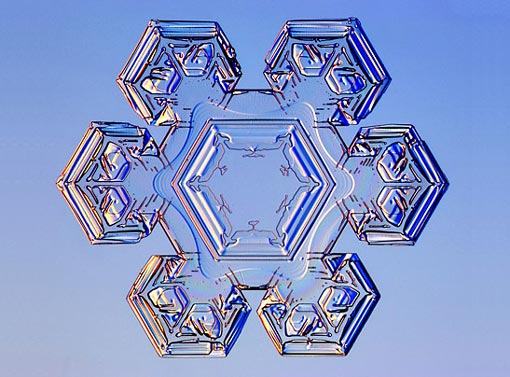
Snowflakes are science and art: see ice crystals, simple, complex, the basics behind these miniature miracles of Nature
(quote)
Caltech physics professor Kenneth G. Libbrecht has turned his passion for the study of ice crystals into an art form. In his books and website, snowcrystals.com, he breaks down some of the basics behind these miniature miracles of nature
Stellar Plates
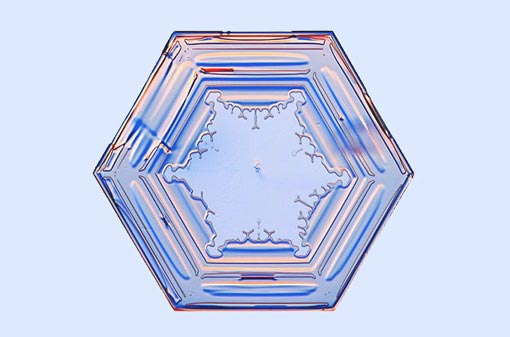
These common snowflakes (above) are thin, plate-like crystals with six broad arms that form a star-like shape. Shapes like these form around 28 degrees Fahrenheit, while columns and slender needles appear near 23 degrees. Plates and stars again form near 5 degrees Fahrenheit.
Simple Prisms
Snowflakes are not frozen raindrops (that is better known as sleet). They form when water vapor condenses directly into ice, which happens in the clouds. In their most basic form, snow crystals are hexagonal prisms like the sample, above, but other, more complex forms are famously possible.
Sectored Plates
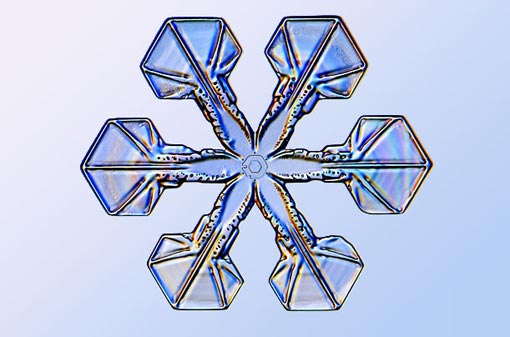
The simplest sectored plates are hexagonal crystals that are divided into six equal pieces, like the slices of a pie. More complex specimens show prominent ridges on broad, flat branches.

Science without religion is lame, religion without science is blind. - Albert Einstein
Science without religion is lame, religion without science is blind.
Man-made junk in low Earth orbit: satellite collision highlights space pollution and rising hazard from debris
(quote)
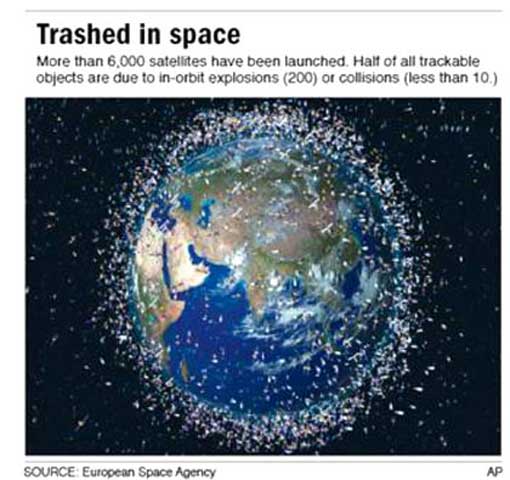
The military tracks about 18,000 pieces of orbital debris. On Tuesday, the census of space-garbage suddenly jumped by 600, the initial estimate of the number of fragments from a stunning collision of two satellites high above Siberia.
Space is now polluted with the flotsam of a satellite-dependent civilization. The debris is increasingly a hazard for astronauts and has put crafts such as the Hubble Space Telescope and communications satellites at risk of being struck by an object moving at high speed.
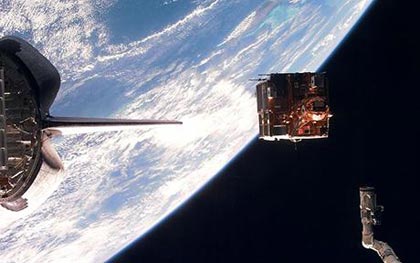
The military's radar can spot objects about four inches in diameter - roughly the size of a baseball - or larger. This collision, however, may have produced many thousands of small, undetectable pieces of debris that would still carry enough kinetic punch at orbital velocities to damage or destroy a spacecraft. read more »
Ocean Mysteries: 'Immortal' jellyfish from Caribbean capable of reverting to younger self spreading all over world

(quote)
Marine biologists say the jellyfish numbers are rocketing because they need not die. Dr Maria Miglietta of the Smithsonian Tropical Marine Institute said: "We are looking at a worldwide silent invasion."
The jellyfish are originally from the Caribbean but have spread all over the world. Found in warm tropical waters Turritopsis is believed to be spreading across the world as ships’ ballast water is discharged in ports.

Turritopsis Nutricula is technically known as a hydrozoan and is the only known animal that is capable of reverting completely to its younger self. It does this through the cell development process of transdiff- erentiation. Scientists believe the cycle can repeat indefinitely, rendering it potentially immortal.
Though solitary, they are predatory creatures and evolve asexually from a polyp stage. While most members of the jellyfish family usually die after propagating, the Turritopsis nutricula has developed the unique ability to return to a polyp state. read more »
Contact Us

RSS feed


