You are hereScience & Technology
Science & Technology
"I was like a boy playing on the sea-shore, diverting myself now and then finding a smoother pebble or a prettier shell than..."
I was like a boy playing on the sea-shore, and diverting myself now and then finding a smoother pebble or a prettier shell than ordinary, whilst the great ocean of truth lay all undiscovered before me.


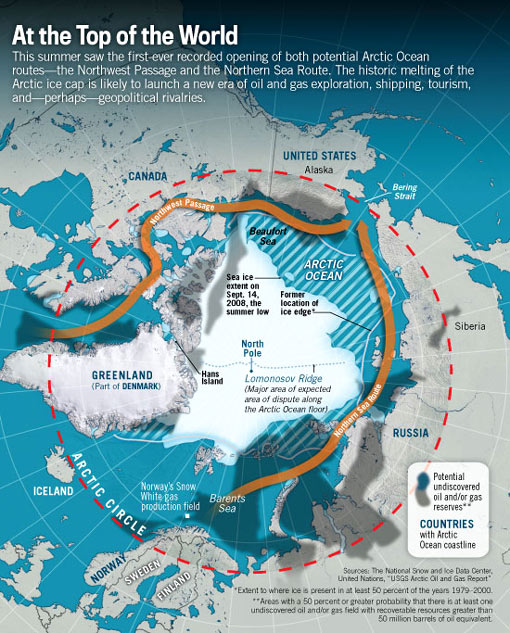
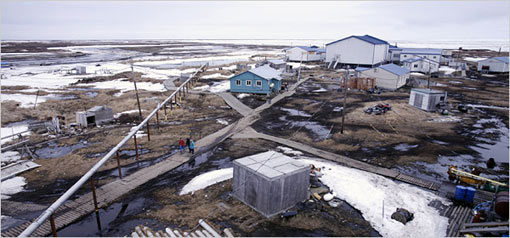
At top of Earth, Arctic ice shrunk by 25%, left islandlike ice cap surrounded by open water, 181 Alaskan villages face erosion
(quote)
This summer, for the first time, both the fabled Northwest Passage through the upper reaches of North America and the Northern Sea Route above Russia opened up, apart from drifting ice. Overall, the expanse of Arctic sea ice was the second smallest in the 30 years of monitoring (summer 2007 was the smallest), and that left an islandlike polar ice cap surrounded by open water. In just the past five years, summer ice has shrunk by more than 25 percent, and so has its average thickness. One consequence of this change is that much of the sun's heat formerly reflected back out to space by the ice sheets is now being absorbed, entrenching the warming process. The acceleration of the ice melt is outstripping earlier predictions of a basically ice-free Arctic summer by mid- or late century. NASA climate scientist H. Jay Zwally now anticipates that most of the Arctic will lose summer ice in only five to 10 years. "We appear to be going through a tipping point," he says.
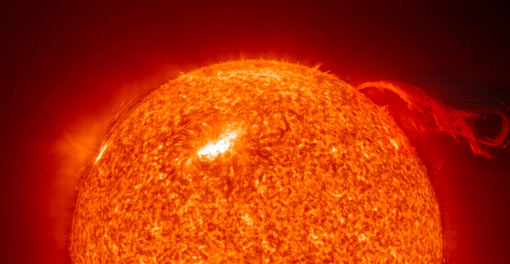
A sweeping prominence, a huge cloud of relatively cool dense plasma is seen suspended in the Sun's hot, thin corona
(quote)
A sweeping prominence, a huge cloud of relatively cool dense plasma is seen suspended in the Sun's hot, thin corona. At times, prominences can erupt, escaping the Sun's atmosphere. Emission in this spectral line shows the upper chromosphere at a temperature of about 60,000 degrees K (over 100,000 degrees F). Every feature in the image traces magnetic field structure. The hottest areas appear almost white, while the darker red areas indicate cooler temperatures.
The Sun is now in the quietest phase of its 11-year activity cycle, the solar minimum - in fact, it has been unusually quiet this year - with over 200 days so far with no observed sunspots. The solar wind has also dropped to its lowest levels in 50 years. Scientists are unsure of the significance of this unusual calm, but are continually monitoring our closest star with an array of telescopes and satellites. Seen here are some recent images of the Sun in more active times.
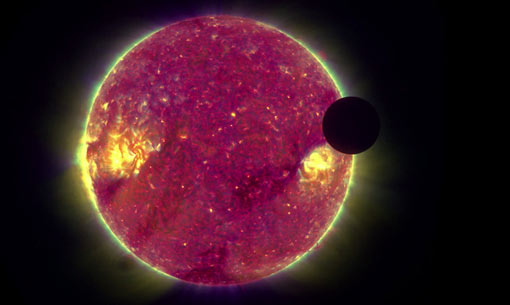
A transit of the Moon across the face of the Sun on February 25, 2007 - but not seen from Earth. This sight was visible only from the STEREO-B spacecraft in its orbit about the sun, trailing behind the Earth. NASA's STEREO mission consists of two spacecraft launched in October, 2006 to study solar storms. STEREO-B is currently about 1 million miles from the Earth, 4.4 times farther away from the Moon than we are on Earth. As the result, the Moon appears 4.4 times smaller than what we are used to. (NASA/STEREO) read more »
Senseless overfishing - world's marine fisheries losing $50 billion each year

(quote)
The world's fishing fleets are losing billions of dollars each year through depleted stocks and poor management, according to a UN report. The World Bank and the UN Food and Agriculture Organization (FAO) calculate the losses at $50bn per year. Half the world's fishing fleet could be scrapped with no change in catch.

The report was launched at World Bank headquarters in New York and has been debated here at the World Conservation Congress in Barcelona, Spain. Entitled The Sunken Billions: Economic Justification for Fisheries Reform, it argues that reforming the way fisheries are managed could restore stocks and build profits. "There are two reasons why we are experiencing the huge loss," said Rolf Willman, a senior fisheries planning officer at FAO and one of the report's authors. "One is that global fish stocks are much lower than they could be, so it is harder to catch the amount of fish that we could. "If stocks were higher we could catch the same amount at lower cost. The second reason is that where fishing is poorly regulated, we have much greater harvesting capacity than we need," he told BBC News. read more »
Turning out the lights - light pollution squanders energy, raises cancer risks, disturbs wildlife and ecosystem

(quote)
The night is not what it was. Once, the Earth was cast perpetually half in shadow. Man and beast slept beneath inky skies, dotted with glittering stars. Then came fire, the candle, and the light bulb, gradually drawing back the curtain of darkness and giving us unprecedented control over our lives. But a brighter world, it is becoming increasingly clear, has its drawbacks. A study finding that breast cancer is nearly twice as common in brightly lit communities as in dark ones only added to a growing body of evidence that artificial light threatens not just stargazing but also public health, wildlife, and possibly even safety.
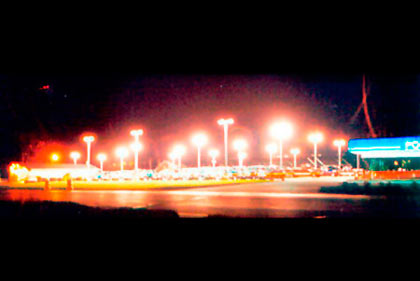
Those findings are all the more troubling considering that an estimated 30 percent of outdoor lighting - plus even some indoor lighting - is wasted. Ill-conceived, ineffective, and inefficient lighting costs the nation about $10.4 billion a year, according to Bob Gent of the International Dark-Sky Association, a nonprofit that aims to curtail light pollution, and it generates 38 million tons of carbon dioxide a year. read more »
37th Annual Albuquerque International Balloon Fiesta marks 225th anniversary of first manned balloon flight

(quote)
Launched in 1972, the Albuquerque balloon festival draws enthusiasts from all over the world. This year marks the 225th anniversary of hot air balloon flights, with participants representing 42 states and 24 countries. Ballooning has come a long way from the first "flying machines" in France in 1783, which flew a duck, a rooster and a lamb in a smoke-filled balloon. The first human passengers were carried 3,000 feet on November 21, 1783.

Amongst the most popular events is a mass ascension, in which all participants rise into the sky in two waves. During the Dawn Patrol, above, pilots take off before sunrise and appraise wind conditions for the others. The festival lasts nine days. This year it runs from October 4 through October 12. Albuquerque has a long association with ballooning, going back more than a century.

Because of a local wind phenomenon known as the "Albuquerque Box," the area is ideally suited to a balloon festival. In October of every year, the wind follows a predictable pattern, blowing northerly at higher altitudes and southerly at lower altitudes, allowing for a smooth navigation.

Getting worse: half of mammals in decline, 1 in 4 faces extinction; conservation can bring species back

(quote)
BARCELONA, Spain, October 6, 2008 (ENS) - The world's mammals are in the grip of an extinction crisis, with almost one in four at risk of vanishing forever, according to the latest scientific assessment revealed at the International Union for the Conservation of Nature's World Conservation Congress, which opened Sunday in Barcelona.
The new study conducted for the IUCN Red List of Threatened Species for the first time assessed all of the 5,487 mammals on Earth and found that at least 1,141 of them are known to be threatened with extinction. At least 76 mammals have become extinct since the year 1500.

The real situation could be much worse as 836 mammals are listed as Data Deficient. With better information, scientists may classify even more species as being in danger of extinction. "Within our lifetime hundreds of species could be lost as a result of our own actions, a frightening sign of what is happening to the ecosystems where they live," said Julia Marton-Lefèvre, IUCN director general. read more »
Contact Us

RSS feed


