You are hereScience & Technology
Science & Technology
"Land of Cheese" Asturias, Spain: thousands of caves hidden in hills used by residents for centuries to age cheese
(quote)
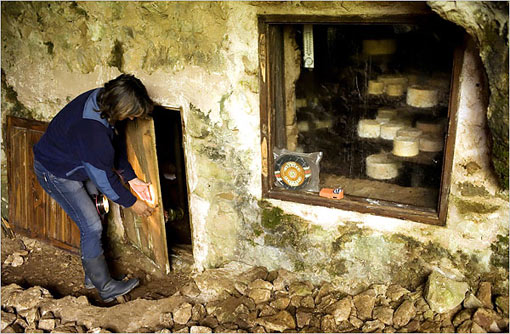
We were in Asturias, a sliver of northern Spain that rests on the Bay of Biscay, and I had been drawn there by the region’s tagline: “The Land of Cheese.”
My pilgrimage had led me to the bat cave last September where I was following Raquel Viejo, a local woman whose family has lived in Asturias for generations. The specialty of the region — and what was stored on those shelves — is Cabrales, a blue cow’s cheese named after the town in Asturias where it was first made.
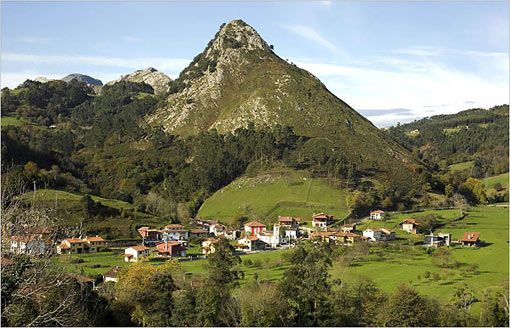
There are thousands of caves hidden in the hills here, and for centuries residents have been using them to age cheese. The specifics of each brand of cheese in various regions of Spain are regulated by a denomination of origin, or D.O., and Cabrales’s says it must be stored in cavelike conditions for at least two months so the good bacteria can kill off the bad. read more »


Portraits of wondrous Earth: ice storm glazed tree; poetic snowflakes; ice caverns; Giant's Causeway; geysers; sea unicorns
(quote)
Ice
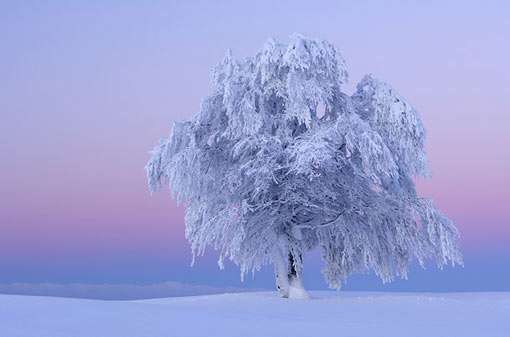
The residue of an ice storm glazes a beech tree, pushing its branches to a near-breaking point. Ice storms are formed when two layers of cold air (one near the earth's surface, another far above) sandwich between them a tier of warm air. Precipitation from the top layer starts out as snow, but when it falls into the middle, warmer belt, it melts into rain. Then, on its way through the lowest belt, it undergoes a little-understood process known as "supercooling" which causes it to chill well below the freezing point of water, yet still remain liquid. When this unnaturally cold water hits the ground, it instantaneously freezes into a translucent glaze that takes on, in intricate detail, the shape of whatever it surrounds.

Clouds
Water is a shape shifter: familiar in its liquid and frozen forms, it is invisible in its third form, as a vapor, until it coalesces into clouds overhead or shrouds us in ghostly fog. One of nature's everyday wonders, clouds hide in plain sight until they are touched with the sun's glory at sunrise and sunset or pile up to form a lightning-generating, anvil-headed cumulonimbus thundercloud.

The Sun read more »
Bread-loaf-sized satellite Firefly on lightning & gamma rays (photon of penetrating electromagnetic radiation fr atomic nucleus)

(quote)
Firefly is a new mission to study lightning and gamma rays with CubeSats, small satellites in the shape of a cube.
Firefly, it's called, this new small satellite mission sponsored by the National Science Foundation (NSF). It's designed to help solve the mystery of the most powerful natural particle accelerator in Earth's atmosphere: TGFs, or terrestrial gamma-ray flashes. TGFs likely result from thunderstorms.
The mission is the second project under the new NSF CubeSat program. A CubeSat satellite, about the size of a loaf of bread, consists of three cubes attached end to end in a rectangular shape.
(unquote)
Photo courtesy of NASA/GSFC
Original Source: National Science Foundation
"Clean City" São Paulo says no to visual pollution, 15,000 billboards, 1,600 signs, 1,300 towering metal panels removed
(quote)
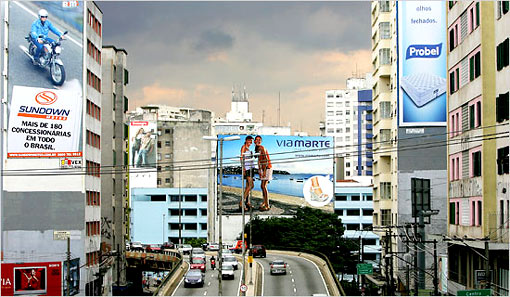
To the undiscerning eye of a visitor, there is nothing too unusual about Florêncio de Abreu Street in downtown São Paulo. The buildings, many of them noble structures with brightly painted façades and stone balconies, reflect the city's rich history, and the constant noise of commercial bustle and angry traffic are the classic sounds of a major modern metropolis. But until 2006, much of that eye-catching architecture went unseen. São Paulo is a supremely intense city whose futuristic mix of skyscrapers, helicopters, advertising and rain has earned it comparisons with the urban imagery of the sci-fi film Blade Runner. But for the longest time, the nice bits, like the buildings along Florêncio de Abreu Street, were hidden behind billboards, electronic ads, shop signs and street banners.

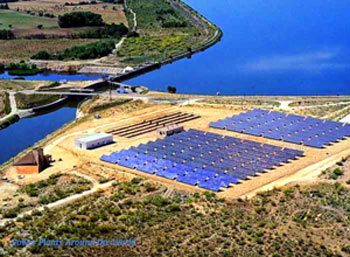
Solar Energy: Spain 4th in world, 2nd in Europe behind Germany; number of solar companies leapt from couple dozen to few hundred
(quote)
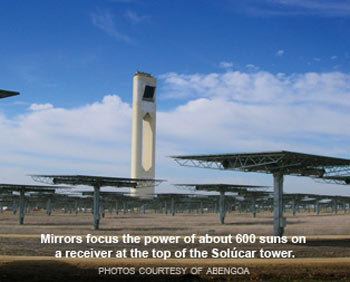
As researchers continue to explore new ways to promote and improve solar power, Spain forges ahead with plans to build concentrating solar power plants, establishing the country and Spanish companies as world leaders in the emerging field. At the same time, the number of installed photovoltaic systems is growing exponentially, and researchers continue to explore new ways to promote and improve solar power. This is the seventh in an eight-part series highlighting new technologies in Spain and is produced by Technology Review, Inc.’s custom-publishing division in partnership with the Trade Commission of Spain.
Europe loves bikes. Assembly lines of biggest facility in Europe have average output of 3000 bikes per day, 1 million in 2009
(quote)
SERZEDO, Portugal – Recently the biggest bike facility in Europe started its production. That facility is located in Portugal; is operated by a company called RTE and is to produce one million bikes in 2009.
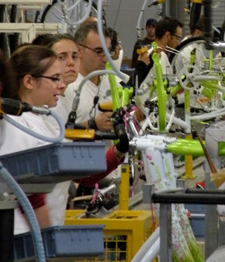
RTE’s assembly lines have an average output of 3000 bikes per day, depending on the season and the model. When a new collection is being launched or there is an urgent need for big quantities, RTE can produce 3400 units per day. Otherwise the assembly line only needs to work one 8-hour shift per day. Normally, the total daily production is shipped on the same day to a Decathlon centre of distribution.
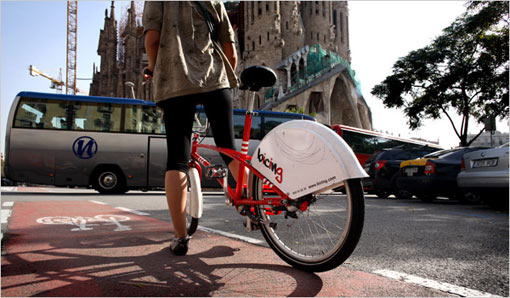
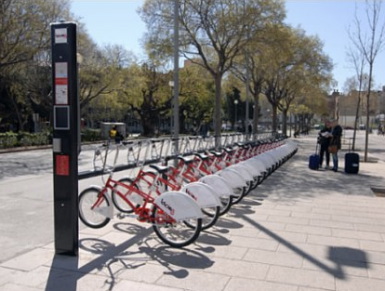
In addition to Paris' Velib bike rental program, Barcelona, Seville and Stockholm all have bike rentals available.
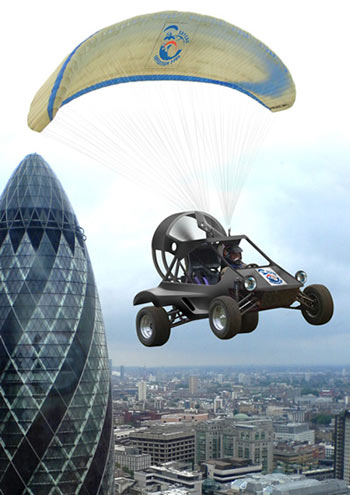
World's first biofuel-powered flying car - Parajet Skycar drives like a car and flies like a plane
(quote)
To Timbuktu by flying car: it sounds the most unlikely journey on earth; a sci-fi voyage from the pages of Jules Verne. But this is no fantasy. The car really flies. And the journey will become reality early in the new year when two explorers set off from London in a propeller-powered dune buggy heading for the Sahara.
The seed of this improbable adventure was sown four years ago when Gilo Cardozo, a paramotor manufacturer, had a eureka moment. For those not familiar with paramotors, picture a parachutist with a giant industrial fan strapped to his back, which provides forward motion and boosts lift for the parachute - or wing - during takeoff. Cardozo’s brainwave was to attach a car to the fan. “I started making a paramotor on wheels that you sit on and take off and it suddenly occurred to me, ‘Why not just have a car that does everything?’” recalls Cardozo, whose Wiltshire-based company Parajet built the paramotor that the adventurer Bear Grylls used to fly near Everest last year.

Contact Us

RSS feed


