You are hereScience & Technology
Science & Technology
Satellite solar panels in orbit to capture sun's rays 24/7 & wirelessly beam energy down to Earth

(quote)
Pacific Gas and Electric, which serves San Francisco and northern California, is to seek approval to buy 200 megawatts of energy from solar power firm Solaren. Within seven years, Solaren plans to send a satellite equipped with solar panels around 22,000 miles into space on board a conventional rocket.
Satellite solar cells would capture the sun’s rays 24 hours a day, without fear of cloudy mornings or dark nights. The orbiters then convert this solar power to radio-frequencies that transmit to ground stations in Fresno County, Calif. Once received, the radio energy would change into electricity and flow into the grid.

Sunlight in space is at least ten times more powerful than that on Earth, making orbiting solar panels far more efficient than those which are land-based. Solaren believes the technology could provide enough clean electricity to power at least 150,000 Californian homes.
(unquote)
Images courtesy of Mafic Studios and Newscom read more »


Antarctic ice shelves (some intact for 10k yrs) loss may shift axis of Earth. Wilkins Ice Shelf diminished by 30%

(quote)
The Wilkins Ice Shelf has been cracking in new places recently and images released by the European Space Agency show that it will probably very soon break off entirely. A 62 square mile piece broke off in May 2008.
Angelika Humbert of Muenster University stated, “During the last year the ice shelf has lost about 1800 square kilometers (694 square miles), or about 14 percent of its size.” The Wilkins Ice Shelf is currently about the size of Jamaica, though it has already been diminished by about 30 percent.

Photos of submarine being watched by uneasy North Polar bears - Arctic tragically losing ice, losing peace...


Photos courtesy of TreeHugger and Keetsa
Read articles: TreeHugger - Seeking Oil, Russia Claims North Pole and Keetsa - Russians dispatching a Submarine
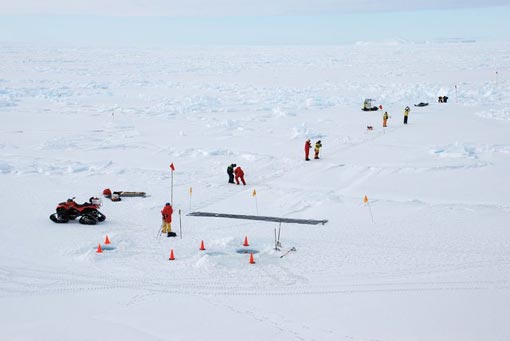
March 18, 2009. Canada marks "Oceans and Marine Life Polar Day", International Polar Year (the 1st IPY: 1882–1883) webcast event
(quote)
OTTAWA, ONTARIO - "Oceans and Marine Life Polar Day", an International Polar Year (IPY) webcast event, took place on March 18, 2009, from 1 p.m. to 4 p.m., at the theatre of the Museum of Civilization in Gatineau, Quebec. "Our Government has made a tremendous contribution to Arctic research during International Polar Year. Polar Days are a great opportunity to share the initial findings of this research with the public," said the Honourable Chuck Strahl, Minister of Indian Affairs and Northern Development. To learn more about "Oceans and Marine Life Polar Day" events in Canada and around the world, as well as other national and international initiatives related to International Polar Year, we invite you to visit www.ipy.gc.ca. read more »
130 years ago today: March 14, 1879, Birth of Albert Einstein - Emblem of Reason, Icon of Wisdom

(quote)
When Einstein was born, his mother worried that his head was too large and his grandmother exclaimed that he was "much too fat." A few years later, when Einstein was four or five, he had his first scientific experience: his father showed him a pocket compass and the young boy marveled at the fact that regardless of where the compass was turned, the needle always pointed north. The needle's invariable northward swing, guided by an invisible force, profoundly impressed the child. The compass convinced him that there had to be "something behind things, something deeply hidden."

Einstein's formal education began at age six, when he enrolled in the Petersschule on Blumen- strasse, a Catholic elementary school in Munich. Since his parents were not practicing Jews, they cared more about the school's academic standards than its religious affiliation. Einstein did well in school, but he was a quiet child and kept his distance from his peers. He was uncomfortable with the principle of absolute obedience and the military drills that dominated the school's atmosphere. read more »
On Mar 2, 1969 world's first supersonic jetliner Concorde took flight, feat of collaboration eng. & work of beauty

(quote)
It was a feat of engineering and a work of exceptional beauty and grace. It won the hearts and minds of millions of people.
Forty years ago today the supersonic Concorde took its first test flight, and a design paragon flashed across the skies over Toulouse. With its droop nose and delta wing, the Concorde was a high point of 20th century engineering (its maiden flight came three months before the first moon landing) and the kind of cooperative effort that now seems beyond us. As we enter a period of infrastructure spending, it’s worth noting what kept the Concorde aloft for 27 years.

The most beautiful experience we can have is the mysterious... the fundamental emotion which stands at the ...
The most beautiful experience we can have is the mysterious... the fundamental emotion which stands at the cradle of true art and true science.
Contact Us

RSS feed