You are hereScience & Technology
Science & Technology
In the fields of observation chance favors only those minds which are prepared. - Louis Pasteur
In the fields of observation chance favors only those minds which are prepared.


Around the world in 1460 days: Mike Horn navigates sustainable sailboat Pangaea on 4-year 7-continent eco-voyage

(quote)
For South African-born explorer Mike Horn, 42, navigating in sub-zero temperatures requires basic tools: chocolate for energy and mucus for wind-block. Horn has circumnavigated the Arctic Circle solo, circled the globe along the equator without motorized transport and completed the first-ever night expedition to the North Pole, without dogs and frequently swimming along the way.

Back in 2002, Horn's expedition around the Arctic Circle involved skiing, sailing, kayaking and trekking in temperatures as low as -76 F (-60 C). This year, Horn embarks on his most ambitious expedition to date - Pangaea. read more »
World's tallest buildings (part ii): Washington Monument, Eiffel Tower, Chrysler Building, Empire State Building..

(quote)
The Washington Monument, U.S.A., completed in 1884 (555 ft - 169.29 m)
The Washington Monument took the title as the world's tallest building in 1884 and is among the world's tallest masonry structures, standing 555 feet - 169.29 m in height, and is made of marble, granite, and sandstone. The Monument held the title for just 3 years.
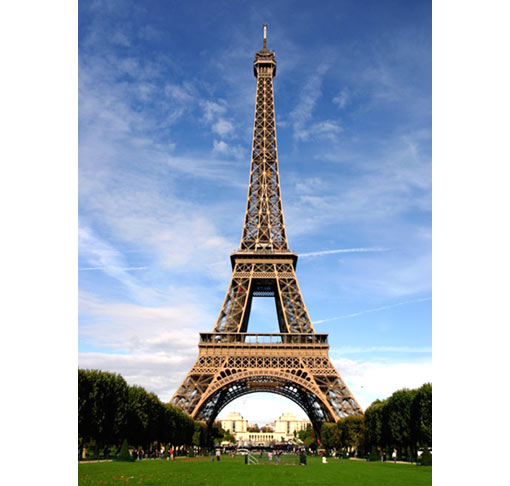
Eiffel Tower, Paris, France, completed in 1887 (1,063 ft - 324 m)
The Eiffel Tower, completed in 1887 took the title of the world's highest building not with just a few extra feet in height - it is twice the height of it's predecessor, The Washington Monument. The Eiffel Tower was to retain the world's tallest building title for another 43 years.

The Chrysler Building, New York, USA, finished in 1930 (1046 ft - 319 m)
Completed in 1930, the Chrysler Building had just 1 year of glory as the world's tallest building. You will note from it's height that it appears to be shorter than the Eiffel Tower, however this is because a new antenna was located on the Eiffel Tower in the year 2000 - before this the Eiffel Tower was some 79 ft - 24 m shorter than The Chrysler Building. read more »
Bikes incl. wooden bikes help break poverty trap - many Africans spend 4 hrs/day walking, 1/4 income on transport
(quote)
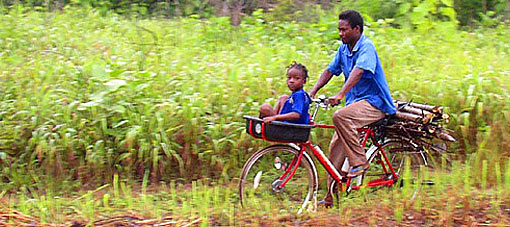
Many Africans spend 4-hours per day walking, or 1/4 of their income paying for transport. A bike can save this every day, helping to break the poverty trap.

Wooden bikes are fairly common in Rwanda and they’re used pretty much daily for transportation of goods and people. Tom Ritchey got the bright idea that the bikes should be raced as well and now the annual Wooden Bike Classic draws curious tourists from around the world for a chance to watch (and even participate).
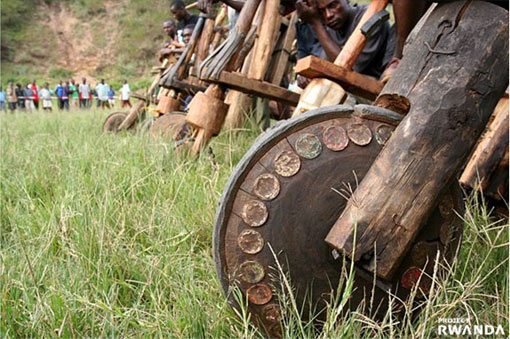
The goals of Project Rwanda are pretty simple and they all come back to cycling: building awareness for the country (through events like the Wooden Bike Classic), specialized bike design (real steel bikes for transporting coffee crops), bike distribution, and national pride (through support of the Rwandan National Cycling Team).

Solar system moving 100000 mph faster than thought; 15% speed increase translates to doubling of mass of Milky Way
(quote)
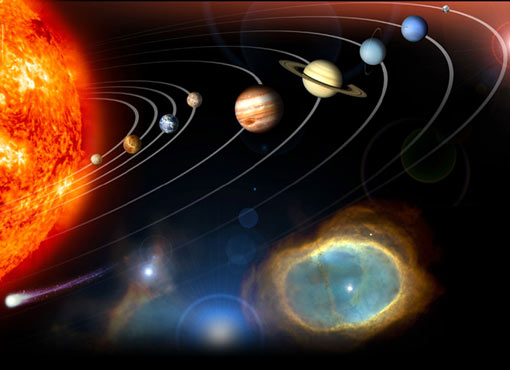
It turns out that our solar system is moving nearly 100,000 m.p.h. faster than previously thought — revolving around the center of the Milky Way at 568,000 m.p.h., announced Mark Reid of the Harvard-Smithsonian Center for Astrophysics on Monday at the American Astronomical Society's conference in Long Beach, Calif. Since velocity is related to mass, the 15% increase in solar-system speed translates into a near doubling of mass of the Milky Way, according to Reid's group — and all of that newfound bulk is composed of dark matter.
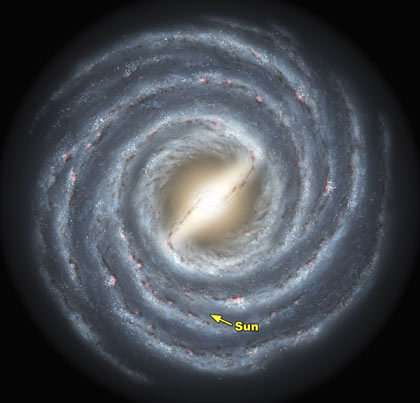
Original estimates of the solar system's speed were based on what Reid calls "one- dimensional velocity" obtained solely from Doppler shifts. "Now," he says, "we have three-dimensional velocity and more exact measurements" — a huge advancement in the field. The findings debunk the notion that the Milky Way is a little-sister galaxy to her neighbor Andromeda. "They're more like fraternal twins," Reid says. And the fact that they are of equal size increases the likelihood that the two will someday collide.
But humans needn't flee the galaxy anytime soon. First, there's so much room between stars that Earth likely wouldn't feel any effects of a galactic collision, though our constellations would certainly change. And second, a crash is still about 3 billion to 5 billion years away, by which time our sun will have transformed into a red giant and turned the Earth into a smidgen of charred dust. read more »
Jan 6, 1838, Samuel Morse 1st demonstrated electric telegraph. "What hath God wrought!" - 1st formal message sent
(quote)
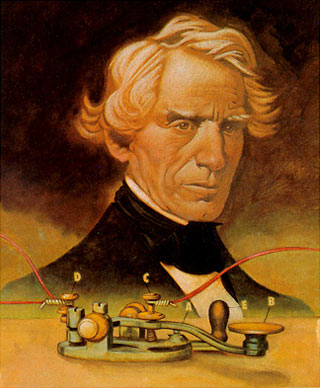
Samuel F.B. Morse
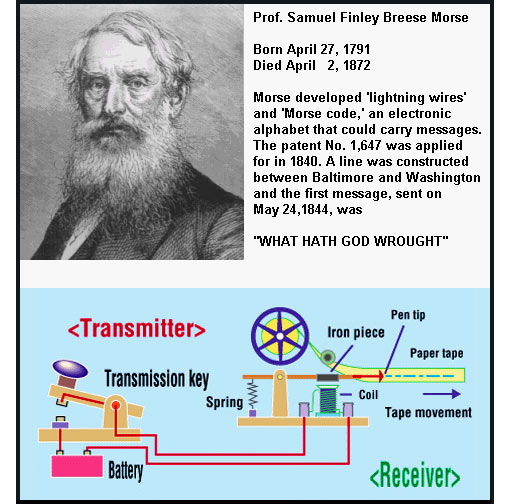
It was on this day, January 6, in the year 1838 that Samuel Morse first demonstrated the electric telegraph. The telegraph was perhaps the single largest step forward in telecommunication history, in that it allowed messages to be sent electronically for the first time. The telegraph was key in settling the west, and served as the basis for modern communication methods.
"Science and art are not opposed" - Samuel Morse.
Samuel F.B. Morse led a superbly rendered life as a painter, sculptor, professor and photographer. He became best known, however, for his invention of the telegraph. Morse used the invention of the electromagnet in 1825 to develop a way to communicate virtually instantly over long distances using his own code.
Early days
Samuel Finley Breese Morse was born on April 27, 1791, in Charlestown, just outside of Boston, Massachusetts. He was the son of Jedidiah Morse, a pastor well known for his knowledge of geography. Samuel showed an interest in electricity, but his love was art. His father opposed art as a career - not realizing how determined Samuel was to paint.
Amazing! Spirit & Opportunity, Mars rovers (expected lifespan of 90 days from Jan 3 '04), roving on into 5 yrs

(quote)
The US space agency's (NASA) Mars rovers are celebrating a remarkable five years on the Red Planet. The first robot, named Spirit, landed on 3 January, 2004, followed by its twin, Opportunity, 21 days later. Their longevity in the freezing Martian conditions has surprised everyone.
The unmanned rovers Spirit and Opportunity are showing serious signs of wear after an astounding five years roaming Mars, U.S. space agency officials say. Scientists initially thought the remote-controlled machines would last only three months in Mars' freezing climate, said John Callas, rover project manager at the National Aeronautics and Space Administration's Jet Propulsion laboratory in Pasadena, Calif.

"These rovers are incredibly resilient considering the extreme environment the hardware experiences every day," Callas said, noting information sent by the rovers have proved water existed on Mars billions of years ago. read more »
Contact Us

RSS feed


