You are hereBlogs / WcP.Scientific.Mind's blog / NASA's spacecraft Kepler blasts off on a three-year mission in search of Earth-like planets
NASA's spacecraft Kepler blasts off on a three-year mission in search of Earth-like planets
(quote)
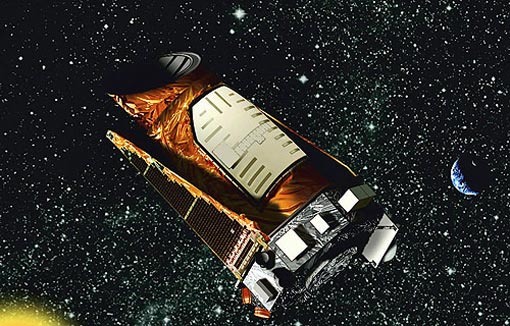
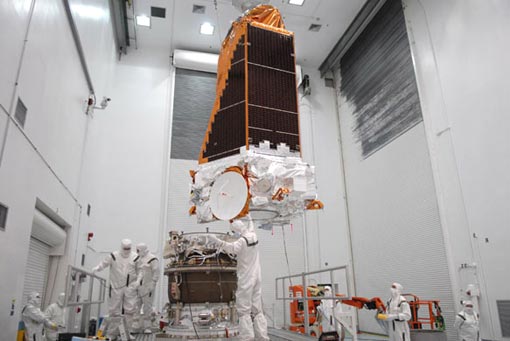
NASA's Kepler spacecraft blasted off from Kennedy Space Center in Florida on Friday on a three-year mission to find Earth's twin, a Goldilocks planet where it's neither too hot nor too cold, but just right for life to take hold.
The Delta II rocket, carrying the widest field telescope ever put in space, lifted off the launch pad at Cape Canaveral at 10:49 p.m. Eastern time. The launch vehicle headed down-range, gathering speed as its three stages ignited, one after the other, passing over Antigua Island in the Caribbean and later over tracking stations in Australia before climbing into orbit.
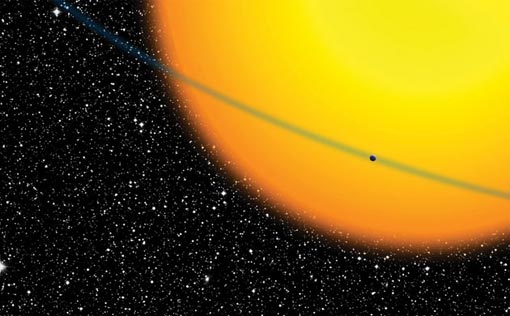
Kepler will eventually settle down to scan tens of thousands of stars near the constellations Cygnus and Lyra in search of planets where water could exist on the surface in liquid form, a key condition for life as we know it. "We have a feeling like we're about to set sail across an ocean to discover a new world," said project manager Jim Fanson of the Jet Propulsion Laboratory in La Cañada Flintridge. "It's sort of the same feeling Columbus or Magellan must have had."
The $590-million Kepler mission is jointly managed by JPL and NASA's Ames Research Center in the Bay Area. The spacecraft carries a 15-foot-long telescope with a 55-inch mirror that can scrutinize a wide star field for the telltale dimming of starlight that occurs when a planet crosses in front of it, known as a transit.

Over the past decade, scientists have employed the same technique with ground-based telescopes to discover 340 planets circling other stars. But because the optics of ground-based instruments are compromised by atmospheric interference, most of the planets found so far are gas giants that orbit so close to their parent stars that any life forms would be incinerated.

The Hubble Space Telescope, not affected by Earth's atmosphere, was designed to see deeply but very narrowly. Kepler's field of view is 33,000 times wider than Hubble's, or about the size of a human hand held up to the sky. The Cygnus-Lyra region near the plane of the Milky Way encompasses about 4.5 million stars. But most of those are too big or hot to allow a habitable zone close enough to the star for Kepler to see a transit.
The science team has preselected about 150,000 sun-like stars for Kepler to analyze. Over time, Fanson said, the number will be winnowed down to about 100,000 in three classes: G-type stars, which are similar in size and age to the sun; K- and M-type stars, which are slightly smaller and cooler; and A- and F-class stars, which are somewhat bigger. Earth is in the center of the habitable zone around the sun, but that zone would change around other classes, either moving somewhat closer to the star or farther out.
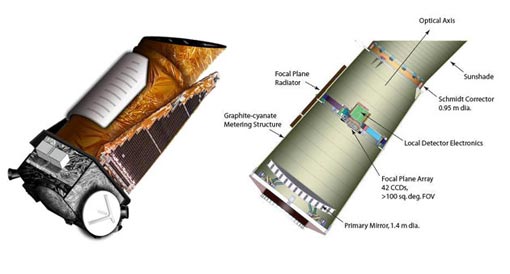
Kepler's telescope is outfitted with a sophisticated camera that will stare unblinkingly at the star field for more than three years. The whole area will be imaged every six seconds, then stored in 30-minute chunks. Once a month, Kepler will do a pirouette in space to download its stored data, Fanson said.
The scientists expect to find hundreds of planets. But even with the telescope's wide field of vision, it will be no easy task for Kepler to find Earth-like planets. Scientists have calculated that the change in brightness caused by such a planet transiting its star will be only about 0.08%, or about 84 parts per million. On top of that, there is less than one chance in 100 that the planets circling a far-off star will be aligned in just the right way for Kepler to spot a transit.

A final complication is that not all dimming is caused by transits. Sunspots on the surface of the star are cooler areas linked to an increase in magnetic activity on the star's surface. They also cause the star's light to dim. Kepler scientists said they think they understand the signature of sunspots well enough to deal with that problem, however.
For a planet to become a candidate for the first Earth-type planet around another star, Kepler must measure at least three separate transits, scientists said. If the team is uncertain about some measurements, or simply wants more observing time, the mission could be extended to six years, NASA said.
(unquote)
Photos courtesy of Ames Wendy Stenzel/NASA, Jon Lomberg/NASA, Ball Aerospace/NASA, Troy Cryder/NASA, and AP
Original Source: LA Times and The Guardian


Contact Us

RSS feed


