You are hereBlogs / WcP.Watchful.Eye's blog / Man-made junk in low Earth orbit: satellite collision highlights space pollution and rising hazard from debris
Man-made junk in low Earth orbit: satellite collision highlights space pollution and rising hazard from debris
(quote)
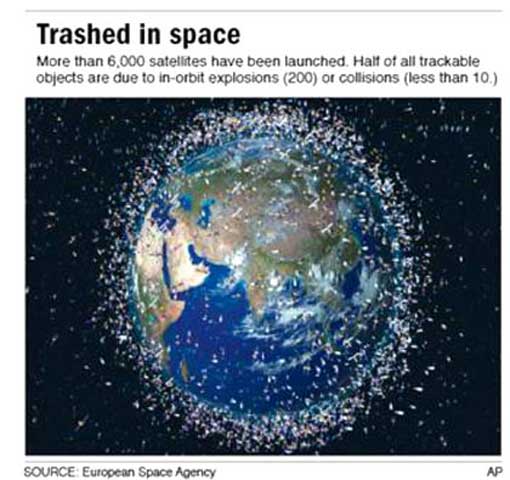
The military tracks about 18,000 pieces of orbital debris. On Tuesday, the census of space-garbage suddenly jumped by 600, the initial estimate of the number of fragments from a stunning collision of two satellites high above Siberia.
Space is now polluted with the flotsam of a satellite-dependent civilization. The debris is increasingly a hazard for astronauts and has put crafts such as the Hubble Space Telescope and communications satellites at risk of being struck by an object moving at high speed.
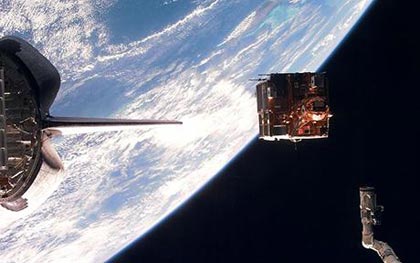
The military's radar can spot objects about four inches in diameter - roughly the size of a baseball - or larger. This collision, however, may have produced many thousands of small, undetectable pieces of debris that would still carry enough kinetic punch at orbital velocities to damage or destroy a spacecraft.
"We expect, when all is said and done, there will be hundreds if not thousands of pieces larger than the four inches. We expect there will be tens or hundreds of thousands of pieces down to a centimeter or a millimeter," said Nicholas Johnson, NASA's chief scientist for orbital debris. That's on top of material that's been accumulating in space for decades. China intentionally destroyed an aging satellite of its own in 2007 to demonstrate a new missile's capability. The obliteration of that satellite left behind 2,500 trackable fragments, Johnson said.

A bad situation got worse Tuesday. The two satellites, an American Iridium and a Russian Cosmos, came together 491 miles above the Earth, striking one another at roughly a 90-degree angle and at about 22,000 miles per hour. NASA checked Tuesday to see whether there was any danger to the International Space Station. The risk of the station being struck was determined to be "very small" but "elevated."
NASA is also concerned about the safety of its scientific satellites, including five Earth-observing spacecraft, collectively known as the A-Train, that fly in a close formation about 438 miles above the surface. A sixth satellite for that mission, the Orbiting Carbon Observatory, is to be launched Monday. The Hubble is about 350 miles above the surface; the International Space Station orbits 220 miles up. The debris could eventually spread to those orbits.
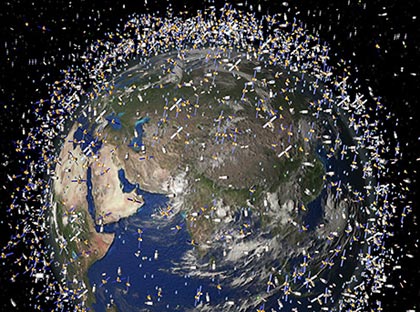
At lower orbits, in the range of 200 miles or so, the friction of air molecules reduces the speed of the objects and causes them to fall to Earth to burn up upon reentry. But 500 miles or so above the Earth, the drag is vanishingly slight. The space pollution can get worse over time, because when objects strike one another they spew out smaller fragments.
(unquote)
Images courtesy of Reuters, European Space Agency via AP, and D. Ducros / CNES via National Geographic
Original Source: Boston Globe and National Geographic


Contact Us

RSS feed


