You are hereBlogs / WcP.Scientific.Mind's blog / MIT Solar Electric Vehicle Team unveils sleek 90-mph car, will compete in World Solar Challenge in Australia
MIT Solar Electric Vehicle Team unveils sleek 90-mph car, will compete in World Solar Challenge in Australia

(quote)
MIT's Solar Electric Vehicle Team, the oldest such student team in the country, has just finished construction of its latest high-tech car and unveiled it to the public this Friday. "It drives beautifully," said George Hansel, a freshman physics major at the Massachusetts Institute of Technology and a member of the team. "It's fun to drive and quite a spectacle." With six square meters of monocrystalline silicon solar cells and improved electronic systems and design, the car can run all day on a sunny day at a steady cruising speed of 55 mph. The car will be competing in October in the World Solar Challenge race across Australia, and in preparation for that the team plans to drive the car across the United States over the summer. About a dozen team members are expected to go to Australia for the race, although only four will drive the solar car in the competition.

Vehicles competing in the endurance race may look hopelessly impractical, but the competition is a test bed for batteries, motor technology and power-management systems that may eventually appear in hybrids and electric vehicles. Like Formula 1 and other big-budget motor sports, the solar challenge helps develop some of the vehicles we see in showrooms. "It pushes the technology from the books to real life," said Spencer Quong, senior vehicles analyst with the Union of Concerned Scientists. "It opens the industry's eyes to how to build a more efficient vehicle."

The new car, called "Eleanor," is taller than earlier versions and thus allows a much more comfortable upright seating position for the driver, who was in an almost supine position in earlier models. But despite the 30 percent greater frontal area of the vehicle, the new car has exactly the same drag area — a measure of its wind resistance — as the team's older one, thanks to some very sophisticated aerodynamic design and wind-tunnel testing. Aerodynamic efficiency is paramount to extending battery range, especially when you're dealing with batteries charged by the sun. Eleanor features 580 silicon solar cells manufactured by Sun Power. They cover six square meters (about 64.5 square feet) and generate 1,200 watts — enough to run a hair dryer or a pair of desktop computers. The juice is stored in a 6-kilowatt-hour Genasun battery pack comprising 693 lithium-ion cells. The battery weighs 32 kilograms (about 71 pounds) and provides sufficient range — even without sunlight — to get the car from Boston to New York.

Propulsion comes from a 10-horsepower hub-mounted motor driving the lone rear wheel. "A three-wheel vehicle simplifies suspension design," Hansel said. "It's also traditional." Everything is packaged in a chrome-moly steel frame wrapped in carbon-fiber-and-Kevlar bodywork. The car weighs just under 500 pounds, and the top half of the body weighs just 40 pounds — with the solar cells. It's also equipped with wireless links so that the lead and chase vehicles during the race will be able to monitor every aspect of the car's electrical performance in real time.
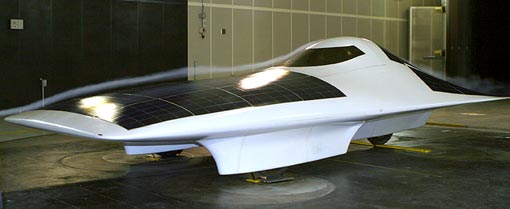
Eleanor will run all day at 55 mph, and although no one's put the pedal to the metal yet, Hansel says the math suggests Eleanor is capable of 90 mph. Not that anyone will push her that hard. With their stiff suspensions and hollow bodies, solar race cars tend to resonate like drums at high speeds, creating a rumble that can be disconcerting in the driver's seat. "Our previous car, Tesseract, was very fast. It was taken up to 85 mph before the driver got terrified," he said. "You reach the driver limit before you reach the motor limit."
(unquote)
Photos courtesy of MIT Solar Electric Vehicle Team
Original Source: MIT News Office and Wired


Contact Us

RSS feed


Now that design is on another level, it is very nice, very creative
The design is very classic. It displays a lot of creativity https://getperfectpapers.com/articles/statistics-assignment-help.php">statistics help
MIT students are really talented. How do you build such a breath taking gadget. One this I know for sure is that whenever they need https://www.lastminuteassignmenthelp.com/">spss homework help, they turn to us for assistance
The whole new solar car Eleanor is very much efficient in it's running condition as well as it's appearance. I truly appreciate the whole team who have designed this car.
The current designs of solar cars are still mostly wide and flat. I understand that the engineers need to work under the limitations of today's technology, but is there anyway to make a solar car more pleasing to the eye? Kudos to them for setting a good speed, but I think aesthetics need to be considered too.
This is very interesting.The solar power represents the future.I heared about it at a https://www.donatecarusa.com/">car donation event and everybody was so captivated.
This race car looks more like a spacecraft than an actual car and I appreciate very much their work. I would like to buy a car that is more Eco-friendly, one that runs on electric batteries, but I think that the new technology will be very competitive on the market in few years as well as expensive.
The design is very futuristic.The solar power represents the future and it will help to reduce the poluation. Maybe in the future we`ll have to give away our old cars and buy this one and we`ll get rid of headache caused by searching diferent auto parts such as https://www.partsgeek.com/parts/alternator.html">car alternator.
I agree with you, the design still looks good. https://getperfectpapers.com/articles/statistics-assignment-help.php">statistics help
I believe such competitions display the abilities of the solar powered electrical vehicle, in terms of speed and efficiency. Though the designs here are for competition purposes, some elements can be used for street cars, and someday we might see solar powered vehicles all over the world.
I think this is the first solar car that runs like this? 90mph? That is very impressive considering the other solar cars. you think that this car is the solution on the ever changing auto industry?
The MIT team has always been very innovative and I look forward to seeing more of their designs at these challenges.
They need therapy sessions not to panic about the security holes they have. This car was built for one purpose,to race in Australia!That's it!!
I know little bit Solar cars combine technology typically used in the aerospace, bicycle, alternative energy and automotive industries. The design of a solar vehicle is severely limited by the energy input into the car (batteries and power from the sun). Virtually all solar cars ever built have been for the purpose of solar car races (with notable exceptions).
Yes, you are right. It's based on the mechanism of spaceships. I mean in spaceship, solar energy is also used. But I'm suspicious about the overall effectiveness of this car as would it be able to get energy at a cloudy day? Probably it's also not totally https://www.squidoo.com/advantages-of-solar-pool-heater">solar energy based car.