You are hereBlogs / WcP.Scientific.Mind's blog / On Mar 2, 1969 world's first supersonic jetliner Concorde took flight, feat of collaboration eng. & work of beauty

On Mar 2, 1969 world's first supersonic jetliner Concorde took flight, feat of collaboration eng. & work of beauty


By WcP.Scientific.Mind - Posted on 10 March 2009

A cluster of Concordes gather nose-to-tail at London's Heathrow airport. Air France and British Airways ran a regular transatlantic service to New York with an average flight time of just 3 and a half hours.

(quote)

It was a feat of engineering and a work of exceptional beauty and grace. It won the hearts and minds of millions of people.

Forty years ago today the supersonic Concorde took its first test flight, and a design paragon flashed across the skies over Toulouse. With its droop nose and delta wing, the Concorde was a high point of 20th century engineering (its maiden flight came three months before the first moon landing) and the kind of cooperative effort that now seems beyond us. As we enter a period of infrastructure spending, it’s worth noting what kept the Concorde aloft for 27 years.

Capable of twice the speed of sound, Concorde remains an object of aesthetic streamlined beauty. The long nose and swept back wings were made for speed. It was a design so distinctive that it turned heads whenever it flew and it flew so high you could see the curvature of the earth from within the sleek interior.

"One reason for its longevity is that the Concorde's design is so idiosyncratic--and so tightly defined by function--that it is impossible to date, and would seem just as inspiring and surprising if it were unveiled today,” Alice Rawsthorn wrote last month in the International Herald Tribune.

For nearly three decades, the Concord delivered rock stars, models and other members of the limousine fraternity across the Atlantic for a round-trip price of $13,500. It was clubby: Madonna flew it. So did Tyler Brûlé, and Heidi Klum. It was not unusual for passengers to visit the cockpit with glasses of champagne. Flying at an average speed of Mach 2.02 (1,330 mph), it cut the flight time from Europe to New York and Washington by more than half (its record time: 2 hours, 52 minutes).
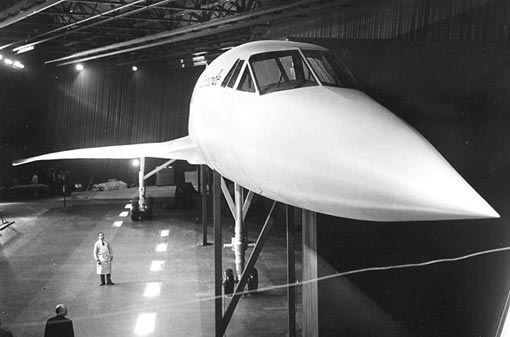
A full scale mock up of the Anglo-French supersonic passenger jet is prepared in Filton, England, for presentation to customer airlines. The seeds for Concorde were sown in the late 1950s when the United Kingdom, France, United States and the Soviet Union first considered developing supersonic transport.

For a certain kind of passenger it marked the high tide of high-tech travel luxury. For the rest of us, it was the first in a series of technologies that would shrink the world: for the first time it was possible to breakfast on croissants in the 16th arrondissement and catch lunch on Madison Avenue the same day (thanks in part to the time difference).

How could something concurrent with Creedence Clearwater Revival look so timelessly cool today? The delta wing, in the shape of a triangle, was developed in Germany before WWII, but it could pass for a 2009 design. It was much stronger than a conventional swept wing and made room for fuel and other storage. Most importantly, it stayed behind the supersonic shock wave precipitated by the long narrow aircraft nose, which hydraulically lowered itself, or "drooped," so that pilots could have an unobstructed view for landing and takeoff.
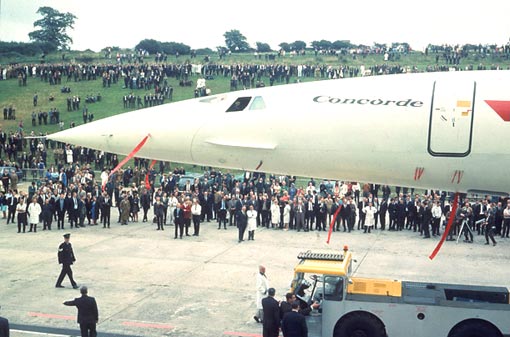
Concorde 002 rolls out of the British Aircraft Corporation's assembly line at Filton in 1968. Later that year the Russian Tupulev Tu-144 became the first supersonic airliner to fly. It was named 'Concordski' because of its resemblance to Concorde. The adjustable nose became its most famous asset, improving the view on take off and landing. As for Concorde 002, it made the first visit to the U.S. in 1973, landing at the new Dallas-Fort Worth Airport to mark its opening.

The Concorde’s fuselage flexed more than conventional jets, and as a result the pilots could see the floor bend as they looked back through the length of cabin. The cruising altitude of 60,000 feet exposed passengers to almost twice as much solar radiation as a normal flight, and for this reason the pilots had a radiometer. If they detected unusually high readings they descended below 47,000 feet.

The much talked about sonic boom was considered socially unacceptable and meant Concorde was restricted to flying supersonic over the ocean.

The Concorde was the product of elaborate government cooperation. Aérospatiale and British Aircraft Corporation needed heavy underwriting from their respective governments to build the fleet of 20. The project was the subject of a special treaty between the two countries, which didn’t stop them from quarreling over every detail--right down to the Gallic 'e' on the end of its name. Their collaboration was spurred by Cold War anxiety. A Soviet competitor, nicknamed the "Concorski" for its suspicious resemblance to the Concorde, may or may not have resulted from Soviet espionage. Boeing developed a supersonic jet with titanium wings and a cruising speed of 1,800 mph, but the U.S. government chose not to subsidize it, and the project died.
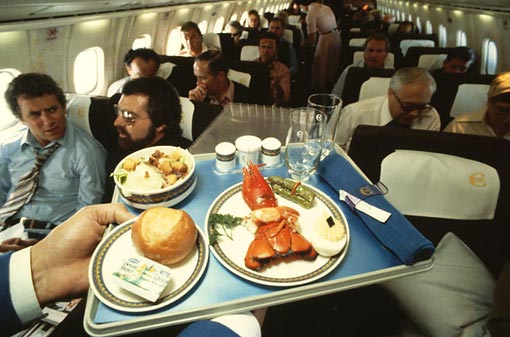
A passenger gets set for a lobster dinner on board. Concorde could never be called a cheap way to fly, but you were able to beat time itself by arriving in New York an hour earlier than you left London, and enjoy some fine dining in the process. The food was served on Wedgwood crockery with short silver cutlery.

On July 25th 2000, a Concorde crashed in suburban Paris, killing 113 people. The crash, combined with 9/11 and the travel slump that followed, spelled the end. The Concorde made its last flight in 2003 with a passenger list that included Joan Collins, Christie Brinkley and David Frost.

"Never has such a beautiful object been designed and built by man," Air France's chairman, Jean-Cyril Spinetta, said at the time of its grounding. "…It continues to live on in the human imagination."
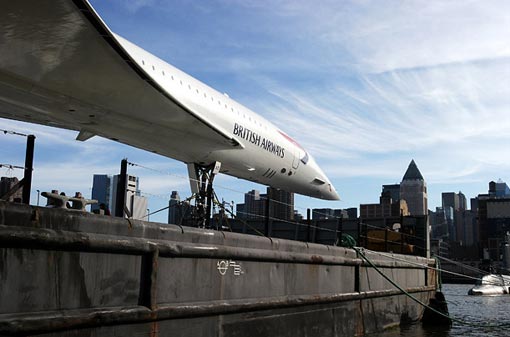
One of the British Airways jets becomes the newest addition to the Intrepid Sea Air Space Museum in New York.

(unquote)

Photos courtesy of Central Press / Getty, Keystone / Getty, AP, Jim Sugar / Corbis, AFP, Reuters / Corbis, Richard Cohen / Corbis

Original Source: Time and Fast Company

RSS feed

Subscribe to WcP Blog RSS feed

Twitter

WcP Blog on Twitter

Facebook

WcP Blog on Facebook

Custom Search


Random image

LuCxeed Photography: Pianist in Purple

Search the Web

Custom Search

Archive Calendar

February 2012
SunMonTueWedThuFriSat
1234
567891011
12131415161718
19202122232425
26272829

Featured Videos

Latest Quote

What is evil? Killing is evil, lying is evil, slandering is evil, abuse is evil, gossip is evil: envy is evil, hatred is evil, to cling to false doctrine is evil; all these things are evil. And what is the root of evil? Desire is the root of evil, illusion is the root of evil.

— Founder of Buddhism

Featured Ads & Links

Recent comments

Reader Reviews

  • "It must be very rewarding to have a long term project like this and too see the progress being made! Thanks for sharing it." - Mika (Jan. 18, 2012)
  • "This was a very eye opening video. It's made an impact on me. We're so unaware of the things that we do every day can destroy our ecosystem. The statistics are mind blogging especially the fact that 90% of big fish are gone. We need to stop this somehow. I'm going to spread this page to my mutual friends. Thanks for this." - Joseph (Jan. 15, 2012)
  • "I enjoy this blog a lot." - Liz (California, USA; Oct. 17, 2011)
  • "Keep up the good work you're doing." - Casper (Melbourne, Australia)
  • "Thanks for sharing some great content through your blog. It has been a sincere pleasure to read." - Anonymous
  • "Always fresh and fascinating." - Anonymous
  • "Cool bio[mission statement]." - Darin (California, USA)
  • "You have some beautiful images. Love your site!" - Susan (Washington DC, USA)
  • "I love your Blog." - Kate (Ireland)
  • "A great site highlighting many important issues." - Bob (New Zealand; Feb. 20, 2010)
  • "Love the images on this blog..there are some interesting articles about health I noticed...we tend to run a 50/50 risk of a heart attack...I noticed when in the USA recently everyone seemed huge..they ate massive meals...I reckon that is one cause of heart failure...just my opinion..but yeah these articles can be worrying to some folk so just heed the advice...I know I will." - Mick (The Sunshine Coast, Australia; Aug 29, 2009)
  • "Excellent blog." - Bill (Vancouver Island, Canada)
  • "Fantastic blog and educational articles, much enjoy visiting...Thank you!" - Lotus1150 (Alberta, Canada; Aug 28, 2009)
  • "Great site and awesome photos." - David (Washington DC, USA)
  • "I loved your website. Even finding some news about Turkey made me surprised." - Anonymous (Turkey)
  • "Gorgeous site ... the kind of place you could lose yourself for hours (suppose that was intentional?). Also, cartoons, commentary on the events of the times, etc. Great stuff." - Daniel (Nevada, USA; Jan. 03, 2009)
  • "...may your blog, ideas and efforts help many more people." - Anonymous (New Mexico, USA)
  • "Very cool site..." - Anonymous
  • "Amazing site, worth the visit every time... enjoy." - Sam (Saudi Arabia)
  • "Easy to read and well-designed." - Colin (Arizona, USA; Apr. 22, 2009)
  • "Unique mix of news, photos and poetry." - Frasier (Virginia, USA)
  • "Worldculturepictorial.com/blog is an extremely interesting collection of news articles. It calls itself "A Window On the World". The site contains a wide variety of topics, all very informative and pertinent to life in today's world." - Cynthia (Massachusetts, USA; Aug. 07 2008)
  • "Wow. Cool." - Christopher (Melbourne, Australia; Dec. 10 2008)
  • "An interesting way to check out the wonders of our world." - Anthony (Ohio, USA)
  • "Nice site, especially the rss icon." - Daniel (California, USA; Sep 10, 2008)
  • "Good blog - Everything from news to photography. Very informative." - "explicitmemory" (Texas, USA)
  • "Very informative site by prose and picture..." - Jeff (Michigan, USA)