You are hereBlogs / WcP.Scientific.Mind's blog / Aircraft & spacecraft once swiftest or slowest, graceful or ungainly, at standstill as if plucked from sky: Air and Space Museum
Aircraft & spacecraft once swiftest or slowest, graceful or ungainly, at standstill as if plucked from sky: Air and Space Museum

(quote)
The first thing visitors encounter in the main display area of the Udvar-Hazy Center, the National Air and Space Museum annex near Dulles airport in the Virginia countryside, is a huge black spy plane. It’s an SR-71A Blackbird, the ultimate hot-rod aircraft, one of about 30 built at the Lockheed Skunk Works in California in the 1960s. This one last flew in 1990, traveling the 2,300 miles between Los Angeles and Washington in 1 hour 4 minutes 20 seconds - a transcontinental blur.
But now it’s at a standstill, giving visitors the chance to appreciate its outrageousness. There are the two massive engines on short, stubby wings; the tiny cockpit where the two-man crew was shoehorned in wearing bulky pressure suits; and the sweeping titanium fuselage that was built so loosely, to allow for expansion in the heat of supersonic flight, that the fuel tanks that made up the bulk of the plane routinely leaked, losing as much as 600 pounds of fuel taxiing to the runway.

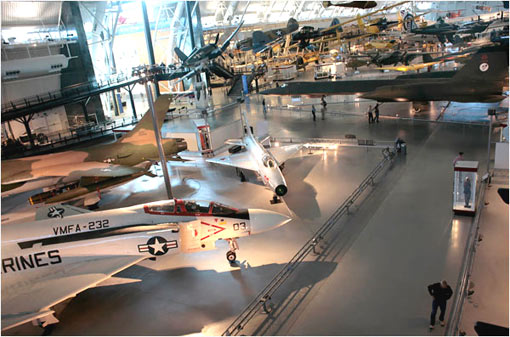
The Steven F. Udvar-Hazy Center in Chantilly, Va., is about air and space, yes, but as the Blackbird shows, it’s also about frozen time. More than 150 aircraft and spacecraft that in their day were among the swiftest or slowest, most graceful or ungainly, most useful or useless, sit on the floor and hang among the catwalks of this giant hangar of a museum as if plucked from the sky.
For Washington visitors whose encounters with the Air and Space Museum have been limited to the original 1976 building some 30 miles away on the National Mall, the Udvar-Hazy Center, which opened in 2003 and is named for a major donor, an aviation industry executive, can be quite a different experience. There are fewer “name” aircraft like the Spirit of St. Louis to gawk at, no moon rocks to touch, and while as in the Mall building there can be hordes of schoolchildren, their noise tends to dissipate in the cavernous arched structure. Over all, with more than twice the exhibition space and about one-fifth the visitors, the Virginia museum has a quieter, more worshipful feel.
The Udvar-Hazy Center is really about aircraft - and more aircraft. There are some of the earliest, including a replica of a Wright Flyer (the only nonoriginal plane in the place) and some of the latest, including the military’s Joint Strike Fighter. There are small propeller-driven acrobats, commercial behemoths, carrier jets, pontoon planes, flying wings, helicopters and gliders. All the major World War II fighters are here, as are several German and Japanese warplanes of the same era, including the Aichi M6AI Seiran, which was intended to be carried inside a huge Japanese submarine but was never used in that way.

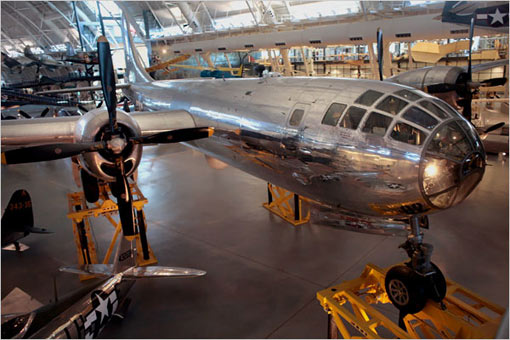
Visitors can gaze down into the glass-enclosed cockpit of one of the center’s few celebrity aircraft, the Enola Gay, the mammoth B-29 that dropped the atomic bomb on Hiroshima; study a landing gear of an Airbus 330 that sits like a giant turkey leg on the exhibition floor; or examine the patched exterior of a Huey helicopter, testament to its service with the 229th Assault Helicopter Battalion in Vietnam. There’s a Bellanca CF, a prototype of the earliest passenger planes, with mahogany plywood panels and bench seating, a Grumman Goose “air yacht” and a Boeing 307 Clipper, the first pressurized passenger liner, its gleaming aluminum fuselage attached to wings and a tail section adapted from the B-17 Flying Fortress.
Over in the space gallery, the main attraction is the shuttle Enterprise, which was designed solely for flight testing in the atmosphere and will eventually be replaced by one of the spaceworthy shuttles when they are retired. The Enterprise proved its value many times over, most recently after the shuttle Columbia disintegrated during re-entry in 2003. Investigators used wing panels from the Enterprise in tests that helped prove that the impact of pieces of insulating foam during launching doomed the Columbia. The testing scars are visible on the Enterprise’s left wing.
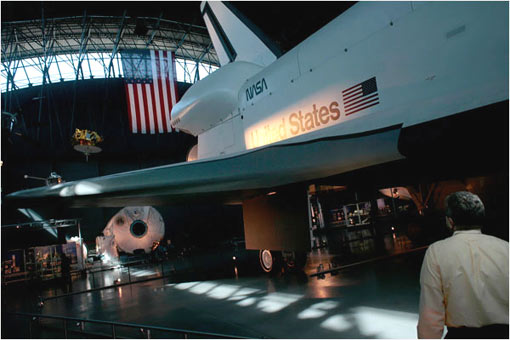
The space gallery holds some of the more unusual items. There are rocket engines with exquisitely tooled ductwork and bell-shaped nozzles and an old Univac 1232 computer, used by the Air Force to control satellites for more than two decades (and originally equipped with a paltry 120 kilobytes of memory). Hanging from the ceiling is a replica of a Tracking and Data Relay Satellite, a sprawling piece of hardware with solar panels and a couple of what appear to be giant mesh umbrellas. Odder still is the wheel-less Airstream trailer with the olive-drab interior, which the Apollo 11 astronauts stayed in for three days after their return from the moon out of concern they might have picked up an alien bug. NASA called this trailer, one of four, a “Mobile Quarantine Facility.” That bureaucratic love of euphemism is also on display in a nearby glass case, where an astronaut diaper is described as a “Disposable Absorption Containment Trunk.” There’s space food as well, including borscht and cottage cheese for Russian cosmonauts that look like old tubes of Brylcreem, and probably didn’t taste much better.
There is a collection of aircraft engines tucked away in a corner of the main exhibition hall. Among these are the tiny Heath-Henderson B-4, a 30-horsepower motorcycle engine that was converted for use in a small plane, the Parasol, which was sold in the 1920s and 30s. At the other end of the scale is the Lycoming XR-7755, a 36-cylinder, 5,000-horsepower, 6,000-pound monster designed in 1944 for use in a heavy bomber that was never built. Unlike almost everything else at the Udvar-Hazy Center, that engine never reached the sky.
The Steven F. Udvar-Hazy Center, a part of the Smithsonian Institution, is near Dulles International Airport in Chantilly, Va., about 30 miles from central Washington. More information is at www.nasm.si.edu/museum/udvarhazy .
(unquote)
Photos courtesy of Andrew Councill / The New York Times
Original Source: NY Times


Contact Us

RSS feed


I am very glad that I have come across to your blog because you have shared a one of a kind blog which has all the things in a very pleasant manner. The information you shared here is unique and informative which is very rear to see nowadays. I would have missed the useful information if I didn't find your site. So keep on sharing hope to see more from you.