You are hereBlogs / WcP.Scientific.Mind's blog / Jan 6, 1838, Samuel Morse 1st demonstrated electric telegraph. "What hath God wrought!" - 1st formal message sent
Jan 6, 1838, Samuel Morse 1st demonstrated electric telegraph. "What hath God wrought!" - 1st formal message sent
(quote)
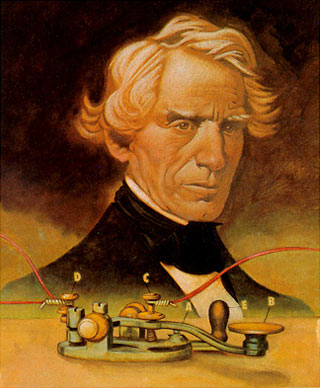
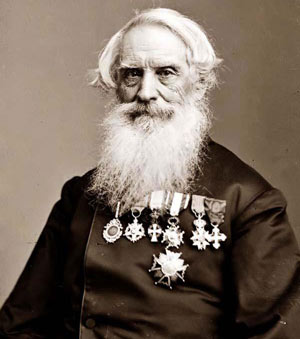
Samuel F.B. Morse
It was on this day, January 6, in the year 1838 that Samuel Morse first demonstrated the electric telegraph. The telegraph was perhaps the single largest step forward in telecommunication history, in that it allowed messages to be sent electronically for the first time. The telegraph was key in settling the west, and served as the basis for modern communication methods.
"Science and art are not opposed" - Samuel Morse.
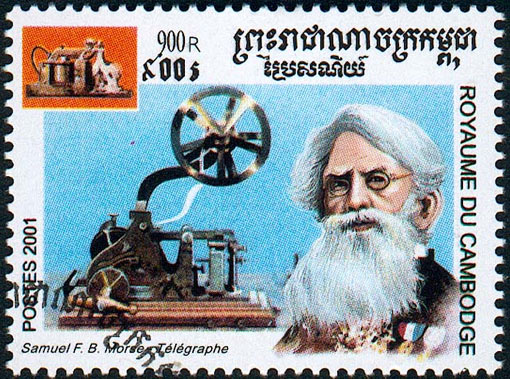
Samuel F.B. Morse led a superbly rendered life as a painter, sculptor, professor and photographer. He became best known, however, for his invention of the telegraph. Morse used the invention of the electromagnet in 1825 to develop a way to communicate virtually instantly over long distances using his own code.
Early days
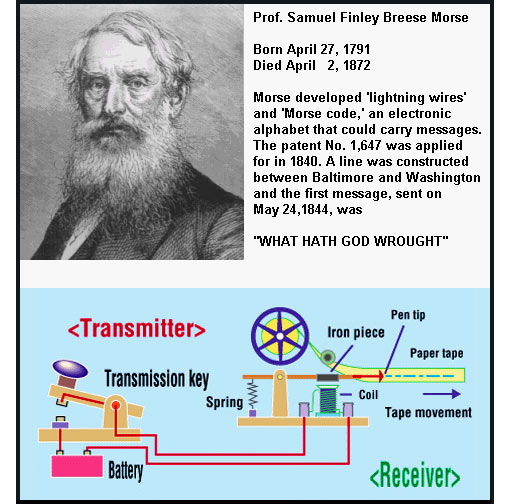
Samuel Finley Breese Morse was born on April 27, 1791, in Charlestown, just outside of Boston, Massachusetts. He was the son of Jedidiah Morse, a pastor well known for his knowledge of geography. Samuel showed an interest in electricity, but his love was art. His father opposed art as a career - not realizing how determined Samuel was to paint.
Education
Educated at Phillip’s Academy at Andover, then Yale, he graduated in 1810. After Yale, Morse moved to England and lived there from 1811 to 1815, managing to exhibit his work at the Royal Academy of Arts in 1813. He spent the next 10 years as an itinerant artist with a particular interest in portraiture.
Then Morse returned to America in 1832, having been appointed Professor of Painting and Sculpture at the University of the City of New York. While on his way back to America, aboard the ship Sullyon, he heard a conversation regarding the newly developed electromagnet and conceived of the idea of an electric telegraph. This was the starting point from which the electric telegraph would become reality.

Morse also entered politics when he was at the university. He unsuccessfully ran for mayor of New York on the Nativist ticket, and ended up rethinking his career options. He then set a new goal for himself, to become an inventor.
Telegraph
In 1838, at the age of 47, Samuel F. B. Morse, one of the country's leading portraitists, put aside his palette and brushes to devote all his time to developing the telegraph.
While displaying his invention at an 1838 exhibition in New York, Morse transmitted 10 words per minute. He had retired his number-word dictionary, using instead the dot-dash code directly for letters. Although other changes would eventually be made, the Morse Code that would become standard throughout the world had been born.
On May 24 of 1844, Morse sent a Biblical quotation as the first formal message on the first electromagnetic telegraph line in the world from the Capitol building in Washington to Baltimore, stating, "What hath God wrought!"
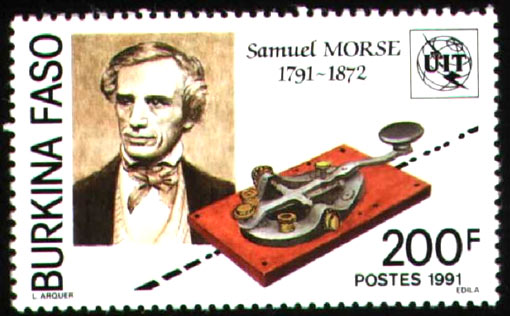
With handsome revenue from his invention, Morse was able to bring together his family into a huge country home. His new house and ranch, named Locust Grove (now the Samuel Morse Historic Site), included 100 stunning acres of land just outside of Poughkeepsie, New York.
Morse married a poor cousin in 1848. At only 26 years of age, his newlywed was hearing impaired and could not speak. Morse believed that their compatibility was based on her dependence upon him.
Given 12 years in the making, most Americans had ignored Morse's efforts to develop his technological wonder. Morse had finally become an American celebrity.
Success bring riches
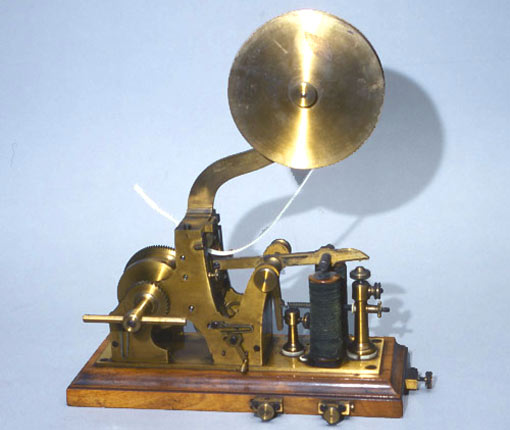
By 1846, private companies using Morse's patent had constructed telegraph lines from Washington reaching to Boston and Buffalo, and were extending boundaries even farther.
An end to greatness
During the later years of his productive life, Morse, a national figure, attained worldwide recognition as a philathropist. As a wealthy man, he was generous with his enormous pocket book — giving funds to poor artists, colleges, including Yale and Vassar, and charitable organizations.
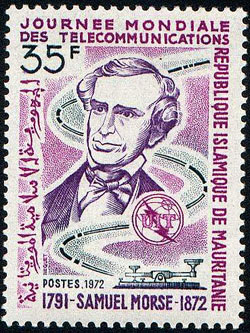
The Telegraph is the single foundation of modern computer networking and the Morse Code is the foundation for symbolic computer programming. Further, Morse Code is still in use today.
Samuel Finley Breese Morse died of pneumonia in New York City on April 2, 1872, at the age of 80. He is buried in Brooklyn's Greenwood Cemetery.
An Idea is Conceived
In the winter of 1832 during a trip from Havre to New York, Samuel Morse found himself in conversation with Jackson, a fellow-passenger on the ship, the conversation eventually moved on to electrical developments on both sides of the Atlantic, Morse came to the conclusion that information should be able to be transmitted instantaneously over wires a considerable distance, he immediately set himself the task of developing such a system. 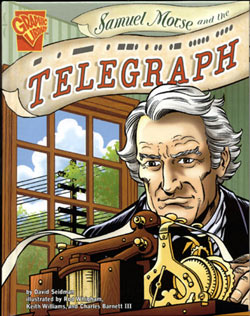 The following day he conceived and sketched a basic system for recording electric impulses representing data. He relentlessly worked on his idea for the remainder of the voyage, and on arrival in New York attempted the construction of a prototype apparatus.
Morse, writes to a friend:
"Up to the autumn of 1837 my telegraphic apparatus existed in so rude a form that I felt reluctance to have it seen. My means were very limited, so limited as to preclude the possibility of constructing an apparatus of such mechanical finish as to warrant my success in venturing upon its public exhibition. I had no wish to expose to ridicule the representative of so many hours of laborious thought. Prior to the summer of 1837 I depended upon my pencil for subsistence. Indeed, so straitened were my circumstances that in order to save time to carry out my invention and to economize my scanty means I had for months lodged and eaten in my studio, procuring food in small quantities from some grocery, and preparing it myself. To conceal from my friends the stinted manner in which I lived, I was in the habit of bringing food to my room in the evenings; and this was my mode of life for many years".
An idea from England
Samuel Morse finally visited the site where the pipe-laying was still proceeding, and, calling the superintendent aside, confided in him the fact that cable was a failure, and that to conserve the remaining money all work must be stopped, but without the newspapers finding out the true reason for its suspension. The quick-witted superintendent immediately proved his loyalty, re-starting the powerful ploughing machine, "Accidentally" ran in to a large rock breaking the plough. The newspapers published sensational accounts of the accident and announced that it would require several weeks to repair. The real trouble was kept from the public giving Morse time to look for a solution. After long and careful consideration, and after learning that overhead cables were being used in England, using the air gap as an insulator, Samuel Morse reluctantly decided to erect his telegraph wires on poles.
May 24st 1844 - Success!
The line was was finally completed between Washington and Baltimore, it proved to be both effective, and within budget! The first message sent was "What hath God wrought!"
The First Nationwide instant Communication System is born!
During 1846 incorporated companies were formed, who extended the telegraph lines from New York to Boston, Buffalo, and Pittsburgh, and within the next three years nearly every important town in the United States and Canada, from St. Louis and New Orleans to Montreal and Halifax, benefited from instant telegraphic communication. After fifteen years of hardship, often finding it difficult to afford food, Samuel Morse had the satisfaction, of knowing that the telegraph system had finally achieved, not only scientific success, but financial success as well!
(unquote)
Photos courtesy of etsu.edu, Ham Radio Software / Norbert Pieper, hoodmuseum.dartmouth.edu, gourt.com, National Museum of American History, th.physik.uni-frankfurt.de, University of Aberdeen, chss.montclair.edu, and old-picture.com
Original Source: Old Picture of the Day, U-S-History.com, and Facts About...
Related Site: Library4History - American History


Contact Us

RSS feed


It is really a nice and helpful piece of information. I am satisfied that you just shared this useful info
with us. Please keep us informed like this.
Thanks for sharing.
I found this blog to be very interesting and helpful as the fact it helped me to see how far along technology had come along since the beginning in term of how financially rewarding it was as well
Many thanks for sharing with us, I always find out something new from your posts.
https://100.burg-halle.de/assist-with-composing-a-dissertation-www/
I’m an expert writer who loves to bring smiles to people's face.
Writing is what I do for a living and I am so passionate about this. I have worked with several organizations whose goal is to help people solve problems.
I love traveling and have visited several countries in the past few years.
I’m happy to have written several books that have contributed positively to the lives of many. My books are available in several parts of the world. And I’m currently working with companies that help people save time. Being a part of this team has open more opportunities for me to excel as a writer. I have worked with different people and met many clients as a professional.
I can handle any kind of writing and provide nothing but the best. People come to me all the time to ask if I can solve their writing problems and I accept. I find pleasure in helping them to solve their problems as a professional.
Academic Writer – Sean - [url=https://columbusdiscountrecords.com/]Columbus Discount Records[/url] Company
Many communication systems and devices can owe their start to Samuel Morse. I think he was the first one that demonstrated that messages can be transmitted almost instantaneously. This idea translated into the mobile phones, text messages and emails that we know of today.
That's very true, if it wasn't for the creation of the electrical telegraph we might not even have landlines let alone mobile phones!
This is the same for many first inventions, if it wasn't for those inventors - whom many people thought where crazy at the time - we might not be where we are with today's technology, just think how much better off we all are now thanks to so many inventors!
It must have been quite a technological leap at that time for telecommunication. Before the telegraph, detailed messages could not be sent between two distances in such a short time. People relied on horseback delivery or even homing pigeon to transmit messages. All telephones and even mobile phones owe their start to that humble device.
History gives us a lot of lessons. I think that our task is to study it and to understand the reasons and consequences. Thank you for this amazing article. I enjoyed reading it.