You are hereglobal-warming
global-warming
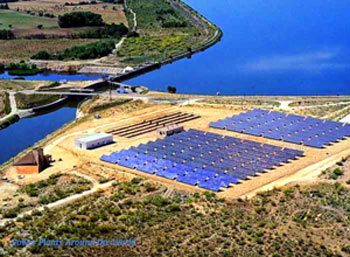
Solar Energy: Spain 4th in world, 2nd in Europe behind Germany; number of solar companies leapt from couple dozen to few hundred
(quote)
As researchers continue to explore new ways to promote and improve solar power, Spain forges ahead with plans to build concentrating solar power plants, establishing the country and Spanish companies as world leaders in the emerging field. At the same time, the number of installed photovoltaic systems is growing exponentially, and researchers continue to explore new ways to promote and improve solar power. This is the seventh in an eight-part series highlighting new technologies in Spain and is produced by Technology Review, Inc.’s custom-publishing division in partnership with the Trade Commission of Spain.



Europe loves bikes. Assembly lines of biggest facility in Europe have average output of 3000 bikes per day, 1 million in 2009
(quote)
SERZEDO, Portugal – Recently the biggest bike facility in Europe started its production. That facility is located in Portugal; is operated by a company called RTE and is to produce one million bikes in 2009.
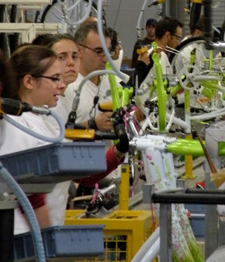
RTE’s assembly lines have an average output of 3000 bikes per day, depending on the season and the model. When a new collection is being launched or there is an urgent need for big quantities, RTE can produce 3400 units per day. Otherwise the assembly line only needs to work one 8-hour shift per day. Normally, the total daily production is shipped on the same day to a Decathlon centre of distribution.
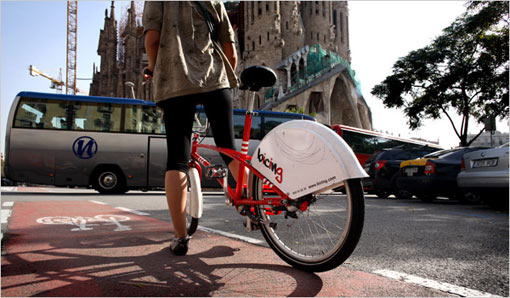
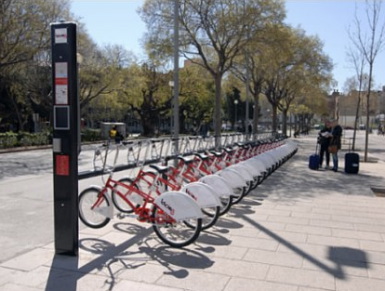
In addition to Paris' Velib bike rental program, Barcelona, Seville and Stockholm all have bike rentals available.
World's first biofuel-powered flying car - Parajet Skycar drives like a car and flies like a plane

(quote)
To Timbuktu by flying car: it sounds the most unlikely journey on earth; a sci-fi voyage from the pages of Jules Verne. But this is no fantasy. The car really flies. And the journey will become reality early in the new year when two explorers set off from London in a propeller-powered dune buggy heading for the Sahara.
The seed of this improbable adventure was sown four years ago when Gilo Cardozo, a paramotor manufacturer, had a eureka moment. For those not familiar with paramotors, picture a parachutist with a giant industrial fan strapped to his back, which provides forward motion and boosts lift for the parachute - or wing - during takeoff. Cardozo’s brainwave was to attach a car to the fan. “I started making a paramotor on wheels that you sit on and take off and it suddenly occurred to me, ‘Why not just have a car that does everything?’” recalls Cardozo, whose Wiltshire-based company Parajet built the paramotor that the adventurer Bear Grylls used to fly near Everest last year.

World first. Ever-restless ocean wave farm generates electricity for 1,500 homes on shore: Pelamis in Portugal

(quote)
Three red snakelike devices bobbing in the waves three miles (4.8 kilometers) off the coast of Agucadoura, Portugal, represent the first swell of what developers hope will be a rising tide of wave power projects. These big metallic sea snakes bobbing in the ever-restless waves of the North Atlantic are generating electricity for over a thousand homes on shore. The world’s most ambitious, working wave farm for generating electricity, it is part of Portugal’s national effort to become energy self-sufficient as Denmark has done since the 1970s oil crisis. Portugal is not a wealthy nation and has no coal or petroleum. So wind and water and sunshine are their favored sources of energy. Portugal is also one nation encouraging local cities to become zero emission communities.

First international photography prize Prix Pictet: camera to communicate vital dispatch most serious issues facing us all

(quote)
What is photography for? Can it change our minds? An exhibition just opened at Paris’s Palais de Tokyo, of the 18 photographers short listed for the first Prix Pictet, poses these questions loud and clear.
The Pictet prize, established this year by Pictet & Cie, one of Switzerland’s largest private banks, and co-sponsored by the Financial Times, is the only international photography prize that concerns itself directly with sustainable development and environmental issues. In that sense it isn’t quite a conventional art prize but an award – of 100,000 Swiss francs (SFr) – to be given annually to the artist who best uses the power of the camera to communicate a vital dispatch on one of the most serious issues facing us all.

A greenhouse gas 17000 times more potent than CO2: NF3 gas used in making flat panel TVs, computer displays, microcircuits
(quote)
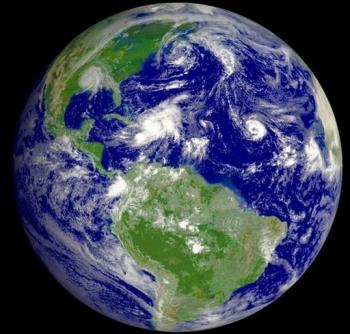
A gas used in manufacture of flat panel televisions, computer displays, microcircuits, and thin-film solar panels is 17,000 times more potent a greenhouse gas than carbon dioxide, and it is four times more prevalent in the atmosphere than previously estimated, according to a study released Thursday. Researchers using a new NASA-funded measurement network discovered there was 4,200 metric tons of the gas nitrogen trifluoride in the atmosphere in 2006, not 1,200 tons as previously estimated for that year.
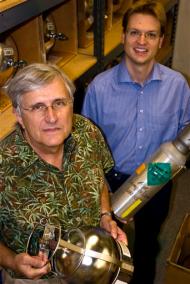
In 2008 there are 5,400 metric tons of the gas in the atmosphere, an average of an 11 percent tonnage increase per year, said Ray Weiss, head of the research team from the Scripps Institution of Oceanography in La Jolla, California. Nitrogen trifluoride, which could not be detected in the atmosphere using previous techniques, is 17,000 times more potent as a global warming agent than a similar mass of CO2. The rate of increase means that about 16 percent of the amount of the gas produced globally is being emitted into the atmosphere, the researchers estimate.
Inventors in 800mi car race run on wood chips, cow dung, veg oil, no gas! Jagged Sierra Nevada, bleak flatness of Death Valley

(quote)
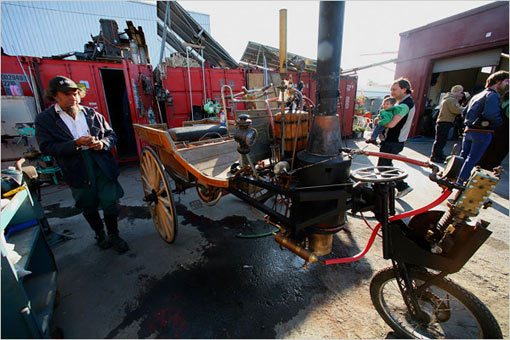
Wayne Keith, a hay farmer from Springville, Ala. (population 3,000), pulled into Berkeley last week driving a lime-green pickup truck that runs mostly on wood chips but sometimes cow dung, too. Keith, who wore dirt-flecked overalls and a trucker's cap, was in town to compete in the first Escape from Berkeley race, a kind of mini Cannonball Run to Las Vegas for drivers of vehicles that run on anything but petroleum. Two other racers relied on vegetable oil, one on alcohol and one on steam power to run his carriage (mostly for show; after a few miles, it was put on a trailer to traverse some of the dicier terrain).
Contact Us

RSS feed


