You are hereBlogs / WcP.Scientific.Mind's blog / World first. Ever-restless ocean wave farm generates electricity for 1,500 homes on shore: Pelamis in Portugal
World first. Ever-restless ocean wave farm generates electricity for 1,500 homes on shore: Pelamis in Portugal

(quote)
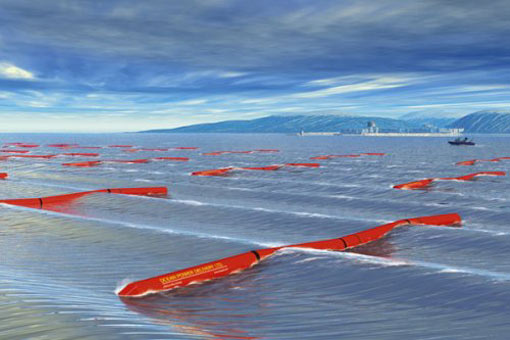
Three red snakelike devices bobbing in the waves three miles (4.8 kilometers) off the coast of Agucadoura, Portugal, represent the first swell of what developers hope will be a rising tide of wave power projects. These big metallic sea snakes bobbing in the ever-restless waves of the North Atlantic are generating electricity for over a thousand homes on shore. The world’s most ambitious, working wave farm for generating electricity, it is part of Portugal’s national effort to become energy self-sufficient as Denmark has done since the 1970s oil crisis. Portugal is not a wealthy nation and has no coal or petroleum. So wind and water and sunshine are their favored sources of energy. Portugal is also one nation encouraging local cities to become zero emission communities.

Edinburgh- based Pelamis Wave Power, Ltd., (PWP) has since September been working with asset manage- ment firm Babcock & Brown, energy provider Energias de Portugal, and Efacec (a Portugese maker of electromechanical devices) on the Agucadoura project. This first phase will cost about $13 million and generate up to 2.25 megawatts. The company hopes to by early next year begin building installing another 25 wave-energy converters to increase the output to 21 megawatts, which is expected to serve the electricity needs of more than 15,000 Portuguese households.
Earth's oceans and rivers, pushed by wind and tugged by the moon and sun, ebb and flow over more than 70 percent of the planet, but only recently have researchers and scientists developed the materials and methods to finally harness some of that kinetic energy. There may not yet be a market for underwater turbines or wave-riding electrical generators designed to use ocean turbulence as a source of renewable energy, but that has not stopped a handful of entrepreneurs from trying to create one.
Although all renewable energy sources—sun, water and wind—suffer from peaks and troughs in productivity, "we consider wave energy to be more predictable than wind," says PWP CEO Phil Metcalf. "You look at the ocean 1,000 miles [1,600 kilometers] out, you'll get a good idea of what to expect over the next 24 to 48 hours. We think it's actually going to be easier to dispatch to the grid."
Pelamis's devices are big red cylindrical tubes, each 426.5 feet (130 meters) long, 13 feet (four meters) in diameter, weighing around 750 tons (635 metric tons), and with a life expectancy of up to 20 years. The tubes are connected by hinges so that they float like a snake in the water. As the tubes' sections rise up and down on the passing waves they tug on the hinges, which are resisted by hydraulic rams that pump high-pressure fluid through hydraulic motors and turn electrical generators to produce electricity. Power derived from the joints on each wave-energy conversion is fed down via a cable to a central undersea export cable, which carries the collective power generated from site to shore.

"Our machine works by reacting against itself," says Max Carcas, Pelamis's business develop- ment director. Most other technology developed for harvesting wave power—including Finerva Renewables's AquaBuOY, WaveBob Ltd.'s wave-absorbing buoy and another buoy-mounted generator made by SRI International—absorbs energy from riding the waves as they bob up and down.
Pelamis's tubes work best at a depth of more than 165 feet (50 meters) and roughly 3.7 miles (six kilometers) from the shore, where the waves are strong but a crew can still connect a cable from the tubes to the shore. "Waves lose energy once you get to get to less than half a wavelength depth—typically deep swell waves are 100 to 140 meters (330 to 460 feet) in wavelength—hence why we focus on being out above 50 to 70 meters (165 to 230 feet) of water," Carcas says. The distance off the coastline to get to this depth contour will vary from place to place but typically is two to 15 kilometers (1.2 to 9.3 miles), he adds.
(unquote)
Photos courtesy of BusinessWeek, Ocean Power Delivery Ltd., DVICE and Pelamis
Original Source: Scientific American and ZDNet
Related Articles: The race begins for tide power bonanza, Pelamis plugs Portugal into wave power and Surf's up at Portugal's wave farm - VIDEO
Official Site: Pelamis


Contact Us

RSS feed



This is very much interesting. Thanks for sharing this useful information.
Hydrophis belcheri
One of the fears I have is that if such a technology is refined and becomes massively popular, more ad more countries living close to the sea will start to implement this wave farm to generate their electrical energy. Will we see our shores filled with these wave farms? Would this affect the marine life in anyway?
This is an interesting technology indeed. The current version of this technology is not yet at its most efficient, but I am sure science as it ways to make it so. However, if Portugal decides to fully rely on this wave energy, wouldn't it deface the beautiful seas with those machines?
The earth itself provides so many ways to capture energy, from wind to sun to tides. The forces of nature, based on gravity and attraction of celestial objects, are waiting for us to harness. Much more respectful of the planet than burning fuel.