You are hereglobal-warming
global-warming
Convenience at a cost. Bottled water no less polluted than kitchen tap, in addition to plastic pollution

(quote)
Bottled water sold in markets and convenience stores may be no more free of pollutants than the water that pours from the kitchen tap at a fraction of the cost, said an environmental group that tested samples. Ten top-selling brands of bottled water contained a total of 38 pollutants including fertilizer, industrial chemicals, bacteria and the residue of drugs such as Tylenol, according to a report by the Environmental Working Group based in Washington, D.C. The bottled water showed an average of eight pollutants in each sample.
Americans drank more than twice as much bottled water in 2007 as they did in 1997, guzzling 8.8 billion gallons at a cost of $10.3 billion in 2007, according to the Beverage Marketing Corp., a research and consulting firm based in New York. Although commercials often show pristine mountain springs, the reality is that bottled water often comes from city water supplies, said Renee Sharp, an Environmental Working Group senior scientist. "If you're going to pay 1,500 times more for bottled water than for tap you'd expect that you'd be getting a cleaner, better product," said Sharp. "And that's not necessarily true."


Jet plane to fly on algae-based fuel by 2010? Europe’s algae bloom aims for feasible alternative to fossil fuel

(quote)
"It's exciting because it's achievable," says Peter van den Dorpel, as he looks over the big plastic tubes full of various shades of green algae. His company has designed, produced and marketed the crop in its bid to be the first to provide the aviation industry with a feasible alternative to fossil fuel. In an enormous greenhouse near Roosendaal in the south of The Netherlands, most of the greenhouse is growing tomatoes with impressive efficiency, with one corner dedicated to the cultivation of algae - in a similarly efficient way, according to Mr van den Dorpel. "It's actually like growing tomatoes; the algae need similar things," he says.

This crop uses the warmth, light and a steady feed of carbon dioxide and nutrients to reproduce faster than any other plant on earth. The amount of algae in these tubes can double daily. And that is both the attraction and the problem with algae as a commercial crop. What Algae-Link's system claims to crack, possibly for the first time, is the problem of clogging. A patented internal cleaning system keeps the set-up harvesting twenty-four hours a day.

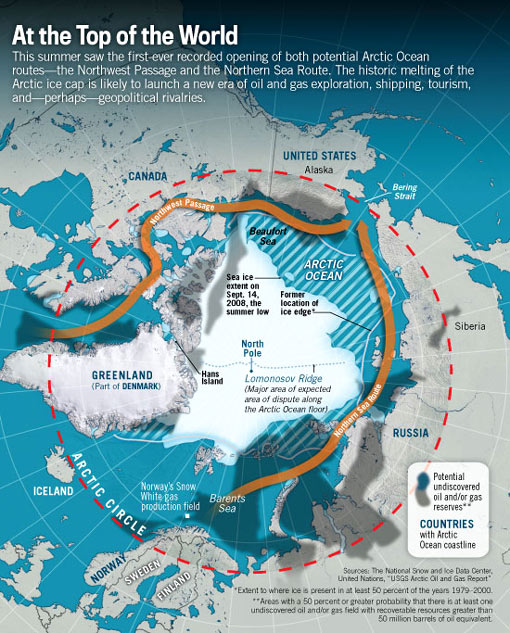
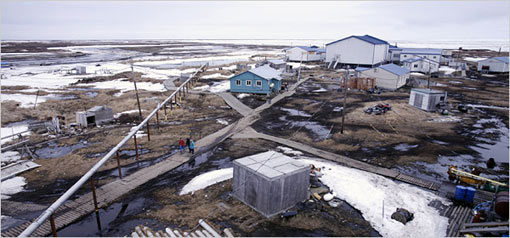
At top of Earth, Arctic ice shrunk by 25%, left islandlike ice cap surrounded by open water, 181 Alaskan villages face erosion
(quote)
This summer, for the first time, both the fabled Northwest Passage through the upper reaches of North America and the Northern Sea Route above Russia opened up, apart from drifting ice. Overall, the expanse of Arctic sea ice was the second smallest in the 30 years of monitoring (summer 2007 was the smallest), and that left an islandlike polar ice cap surrounded by open water. In just the past five years, summer ice has shrunk by more than 25 percent, and so has its average thickness. One consequence of this change is that much of the sun's heat formerly reflected back out to space by the ice sheets is now being absorbed, entrenching the warming process. The acceleration of the ice melt is outstripping earlier predictions of a basically ice-free Arctic summer by mid- or late century. NASA climate scientist H. Jay Zwally now anticipates that most of the Arctic will lose summer ice in only five to 10 years. "We appear to be going through a tipping point," he says.
A sweeping prominence, a huge cloud of relatively cool dense plasma is seen suspended in the Sun's hot, thin corona

(quote)
A sweeping prominence, a huge cloud of relatively cool dense plasma is seen suspended in the Sun's hot, thin corona. At times, prominences can erupt, escaping the Sun's atmosphere. Emission in this spectral line shows the upper chromosphere at a temperature of about 60,000 degrees K (over 100,000 degrees F). Every feature in the image traces magnetic field structure. The hottest areas appear almost white, while the darker red areas indicate cooler temperatures.
The Sun is now in the quietest phase of its 11-year activity cycle, the solar minimum - in fact, it has been unusually quiet this year - with over 200 days so far with no observed sunspots. The solar wind has also dropped to its lowest levels in 50 years. Scientists are unsure of the significance of this unusual calm, but are continually monitoring our closest star with an array of telescopes and satellites. Seen here are some recent images of the Sun in more active times.

A transit of the Moon across the face of the Sun on February 25, 2007 - but not seen from Earth. This sight was visible only from the STEREO-B spacecraft in its orbit about the sun, trailing behind the Earth. NASA's STEREO mission consists of two spacecraft launched in October, 2006 to study solar storms. STEREO-B is currently about 1 million miles from the Earth, 4.4 times farther away from the Moon than we are on Earth. As the result, the Moon appears 4.4 times smaller than what we are used to. (NASA/STEREO) read more »
Homeless: lost penguins stranded on Brazilian beaches get lift home from air force

(quote)
In between the bronzed bodies in skimpy thongs soaking up the rays on Copacabana beach, a tiny black and white bundle of feathers struggles to emerge from the surf. Exhausted and emaciated, its bones poking through the blubber, the young penguin finally collapses on the sand. It has strayed thousands of miles from home, one of more than 1,000 penguins to have washed up on the Brazilian coast this year, some of which have died along the way.
They have come ashore further north than ever before, with some making landfall just 400 miles from the Equator. Brazilian coastguards have found themselves acting as penguin first-aiders, protecting them from an over-enthusiastic public whose first instinct is often to stick the birds in an ice bucket. Hundreds of penguins have been returned to their native territory in the south Atlantic ocean by an air force plane after being found along Brazil's coast.

All-electric car, 240+ miles per charge, 0 to 60 mph in under six seconds, to be built in San Jose Tesla factory

(quote)
The specs for Tesla Motor's new car are in: an all-electric, four-door, five-seat sedan that gets in excess of 240 miles per charge and accelerates from 0 to 60 mph in under six seconds. It will be built in what the company is calling the "greenest auto manufacturing plant in the world" on the outskirts of San Jose, Calif., the self-proclaimed world headquarters of clean technology. In other words, the car of the future is on its way here. Eventually.

Winning a $250m (£139m) deal with electric car maker Tesla to base its new factory there, the city beat other contenders to secure a project that will bring more than 1,000 jobs to the area. "This is a big step toward being the center of world cleantech innovation," said San Jose Mayor Chuck Reed. Tesla boss Ze'ev Drori said that "this is proof the time has come for the electric car."

The company plans to produce an all-electric luxury sedan, called the Model S, at the plant with a retail price of around $60,000 (£33,000.) It already manufactures a two seater zero emission Roadster which sells for $109,000 (£61,000) and is built by Lotus in England. read more »
World first fuel-saving carbon-cutting program: Air New Zealand passengers take a ride on the 'perfect flight'

(quote)
Air New Zealand's "perfect flight" using optimal flying conditions and the co-operation of US, New Zealand and Australian aviation authorities, was hailed as a success in San Francisco on Friday. Using new technologies and procedures on a flight from Auckland, Air New Zealand cut waiting time, trimmed flying time, saved 1,200 gallons of fuel (around 4% less fuel than normally used), eliminated 30,000 pounds of harmful carbon emissions and took a quieter approach on arrival at San Francisco International Airport.

The normal commercial flight NZ8, dubbed ASPIRE 1 (Asia and South Pacific Initiative to Reduce Emissions) is the first tailored test flight on the Pacific using technology and cleared gates at each end, eliminating air traffic congestion to test flight and fuel efficiency. It is part of a worldwide drive to make the aviation industry more environmentally friendly. read more »
Contact Us

RSS feed


