You are hereglobal-warming
global-warming
Our planet would be less burdened if everyone can use 10 fewer bags per month, reuse 10 plastic beverage bottles

(quote)
Facts -
Our planet is choking on plastic and plastic bags are a huge part of the problem. Shoppers worldwide are using 500 billion to 1 trillion plastic bags per year. This translates to about a million bags every minute across the globe, or 150 bags a year for every person on earth. You can make a difference by pledging to be plastic bag free. Sign this pledge at Leonardo Dicaprio : Eco-Site and learn about how plastic is affecting our planet and how you can make a difference.
Plastic Bags
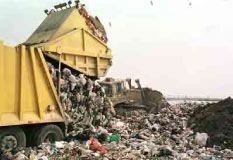
Shoppers worldwide are using 500 billion to 1 trillion plastic bags per year. This translates to about a million bags every minute across the globe, or 150 bags a year for every person on earth. And the number is rising.
Plastic bags are made of polyethylene - more commonly known as polythene - they are hazardous to manufacture and are said to take up to 1,000 years to decompose.
Every year, Americans throw away some 100 billion plastic bags.

The energy needed to manufacture and transport disposable bags eats up more resources and creates global warming emissions. read more »


Amazing photos from Greenland, where unfortunately ice runs away by hundreds of billions of tons a year

(quote)
Ice sculptures constructed from the spare core samples by the scientists working on the North Greenland Eemian Ice Drilling project.

The ice samples, which the researchers analyze for clues to the temperature and concentration of greenhouse gases of the ancient atmosphere, are collected using this drill.

The visiting group of scientists, journalists and Danish environmental officials land at NEEM, the North Greenland Eemian Ice Drilling project. NEEM had arranged for the visitors to examine their research, which focuses on the climatic conditions which shaped the warm geologic period before the earth's last Ice Age, an important clue in understanding global warming. The camp is located approximately 600 miles north of the Arctic Circle. read more »
Most threatened species on earth: one third of world’s coral reefs on verge of extinction due to ocean pollution, over-fishing

(quote)
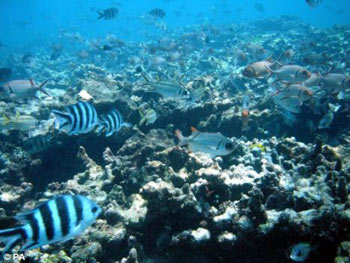
July 10 (Bloomberg) -- A third of the world's corals could be dead within a few years, a shocking new report warns today. The biggest study of its kind has found that 200 out of 700 species of coral are on the brink of extinction - far more than was previously thought. If they die, some of the most beautiful and colourful reefs - home to millions of species of marine life - could be devastated. The speed of decline has shocked the 39 scientists who carried out the survey. Just 10 years ago only 13 species of coral were endangered. Researchers, who published their findings in the journal Science, say they have been badly hit by climate change, coastal development and overfishing.
A team of 39 researchers assessed the state of 704 coral species and found 32.8 percent are threatened with extinction. The study results, published today in the journal Science, are "worse than expected," said co-author Suzanne Livingstone, a marine biologist at Old Dominion University in Norfolk, Virginia. "When we began this process, we didn't think it would be anywhere near as high as that," Livingstone, also a marine species assessor for the International Union for Conservation of Nature, said yesterday in a telephone interview. "Climate change is the overarching threat which comes in on a much larger, global scale," adding to localized disturbances, she said. Death of corals can lead to the collapse of entire ecosystems.

Rising Acidity in World’s Ocean Waters 100 Years Earlier than Predicted
(quote)
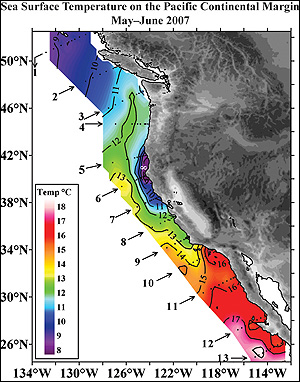
Climate models predicted it wouldn't happen until the end of the century. So Seattle researchers were stunned to discover that vast swaths of acidified sea water are already showing up along the Pacific Coast as carbon dioxide from power plants, cars and factories mixes into the ocean. In some places, including Northern California, the acidified water was as little as four miles from shore.
"What we found ... was truly astonishing," said oceanographer Richard Feely, of the National Oceanic and Atmospheric Administration's Pacific Marine Environmental Laboratory in Seattle. "This means ocean acidification may be seriously impacting marine life on the continental shelf right now." The phenomenon is an aspect of global warming scientists are just beginning to understand.
Acidified ocean water can be fatal to some fish eggs and larvae. It also interferes with the formation of shells and skeletons, harming corals, clams, oysters, mussels and the tiny plankton that are the basis of the marine food web. "Their shells dissolve faster than they are able to rebuild them," said Debby Ianson, an oceanographer at Fisheries and Oceans Canada and a co-author of the study published today in the online journal Science Express.
Since the Industrial Revolution, when humans began pumping massive amounts of carbon dioxide into the atmosphere, the oceans have absorbed 525 billion tons of the greenhouse gas, Feely estimates. That's about a third of the man-made emissions during that time. By reducing the amount of carbon dioxide in the atmosphere, the oceans have blunted the temperature rise due to global warming. But they've suffered for that service, with a more than 30 percent increase in acidity.
"This is another example where what's happening in the natural world seems to be happening much faster than what our climate models predict," said Carnegie Institution climate scientist Ken Caldeira, whose work suggested it would be nearly 100 years before acidified water was common along the West Coast. And there's worse to come, the scientists warn. The acidified water upwelling along the coast today was last exposed to the atmosphere about 50 years ago, when carbon-dioxide levels were much lower than they are now. That means the water that will rise from the depths over the coming decades will have absorbed more carbon dioxide, and will be even more acidic. "We've got 50 years' worth of water that's already left the station and is on our way to us," study co-author Hales said. "Each one of those years is going to be a little bit more corrosive."
(unquote)
Images courtesy of Dana Greeley & Simone Alin, PMEL, and Daily Mail
Original Source: Seattle Times

Nearly One Third of World's Species Extinct Since 1970
Original Source: BBC News
(quote)
Between a quarter and a third of the world's wildlife has been lost since 1970, according to data compiled by the Zoological Society of London. Populations of land-based species fell by 25%, marine by 28% and freshwater by 29%. Humans are wiping out about 1% of all other species every year, and one of the "great extinction episodes" in the Earth's history is under way, it says. Pollution, farming and urban expansion, over-fishing and hunting are blamed.
The Living Planet Index, compiled by the society in partnership with the wildlife group WWF, tracks the fortunes of more than 1,400 species of fish, amphibians, reptiles, birds and mammals, using scientific publications and online databases. It said numbers had declined by 27% in the 35 years from 1970 to 2005. Some of the worst hit are marine species which saw their numbers plummet by 28% in just 10 years, between 1995 and 2005. Populations of ocean birds have fallen by 30% since the mid 1990s, while land-based populations have dropped by 25%.
The WWF said that over the next 30 years, climate change was also expected to become a significant threat to species. Director general James Leape said: "Reduced biodiversity means millions of people face a future where food supplies are more vulnerable to pests and disease and where water is in irregular or short supply. "No-one can escape the impact of biodiversity loss because reduced global diversity translates quite clearly into fewer new medicines, greater vulnerability to natural disasters and greater effects from global warming."
The WWF is calling on governments meeting in Bonn to honour their commitments to put in place effective protected areas for wildlife and to adopt a target to achieve net annual zero deforestation by 2020. The UK's Biodiversity Minister, Joan Ruddock, said the report showed that the international community had to work together to stem the decline. "The fact that human activities have caused more rapid changes in biodiversity in the last 50 years than at any other time in human history should concern us all," she said. "Supporting wildlife is critical to all our futures."
(unquote)
Images courtesy of BBC News and WWF


Polar Bear Declared Endangered Species

(quote)
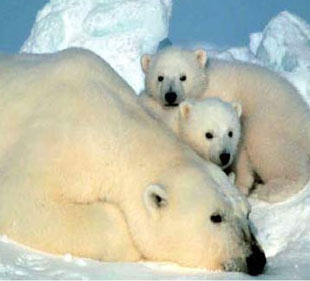
The U.S. Department of the Interior Wednesday listed the polar bear as a threatened species under the Endangered Species Act (ESA) of 1973 based on evidence that the animal's sea ice habitat is shrinking and is likely to continue to do so over the next several decades. Interior Secretary Dirk Kempthorne, however, made clear several times during a press conference announcing the department's decision that, despite his acknowledgement that the polar bear's sea ice habitat is melting due to global warming, the ESA will not be used as a tool for trying to regulate the greenhouse gas emissions blamed for creating climate change.
The decision was based on evidence that sea ice is vital for polar bear survival, that this sea ice habitat has been reduced, and that this process is likely to continue; if something is not done to change this situation, the polar bear will be extinct within 45 years, Kempthorne said. He pointed to computer models he and his colleagues studied that project a 30 percent decline in sea ice by 2050. read more »
Contact Us

RSS feed


