You are herescience
science
Most threatened species on earth: one third of world’s coral reefs on verge of extinction due to ocean pollution, over-fishing

(quote)
July 10 (Bloomberg) -- A third of the world's corals could be dead within a few years, a shocking new report warns today. The biggest study of its kind has found that 200 out of 700 species of coral are on the brink of extinction - far more than was previously thought. If they die, some of the most beautiful and colourful reefs - home to millions of species of marine life - could be devastated. The speed of decline has shocked the 39 scientists who carried out the survey. Just 10 years ago only 13 species of coral were endangered. Researchers, who published their findings in the journal Science, say they have been badly hit by climate change, coastal development and overfishing.
A team of 39 researchers assessed the state of 704 coral species and found 32.8 percent are threatened with extinction. The study results, published today in the journal Science, are "worse than expected," said co-author Suzanne Livingstone, a marine biologist at Old Dominion University in Norfolk, Virginia. "When we began this process, we didn't think it would be anywhere near as high as that," Livingstone, also a marine species assessor for the International Union for Conservation of Nature, said yesterday in a telephone interview. "Climate change is the overarching threat which comes in on a much larger, global scale," adding to localized disturbances, she said. Death of corals can lead to the collapse of entire ecosystems.


Breakthrough: MIT researchers turn windows into solar panels, 10 times more effective solar power may be available in 3 years

(quote)
Researchers at MIT have created a new way to harness the sun's energy - by turning windows in big buildings into solar panels. The new technology, dubbed solar concentrators, harvests light over a wide area such as a window pane and then concentrates or gathers it at the window's edges, said Marc Baldo, a professor at MIT and head of the effort. Three members of the research team, which is publishing its findings in Friday's edition of Science, are in the process of incorporating a startup called Covalent Solar to develop the technology. The team has spent two years identifying organic dyes, painted onto glass or plastic, that can effectively concentrate the sun’s light onto solar cells, enabling them to produce more electricity from fewer cells.
The dyes basically reflect the light (technically, it’s actually absorbed and then sent back out), so that some of it is trapped inside the plane of glass, said Jon Mapel, a member of the research team. With the help of a scientific principal called "internal refraction," which is the same principal that keeps light trapped in optical fibers, the light bounces to the edges of the glass, which have been equipped with strips of solar cells that convert it into electricity. read more »
Up and away in 150 beautiful balloons: US lawn-chair aviator succeeds in 235-mile flight of fancy

(quote)
CAMBRIDGE, Idaho (AP) — Using his trusty BB gun to help him return to Earth, a 48-year-old gas station owner flew a lawn chair rigged with helium-filled balloons more than 200 miles across the Oregon desert Saturday, landing in a field in Idaho. Kent Couch created a sensation in this tiny farming community, where he touched down safely in a pasture after lifting off from Bend, Ore., and was soon greeted by dozens of people who gave him drinks of water, local plumber Mark Hetz said.
"My wife works at the City Market," Hetz said. "She called and said, 'The balloon guy in the lawn chair just flew by the market, and if you look out the door you can see him. "We go outside to look, and lo and behold, there he is. He's flying by probably 100 to 200 feet off the ground. "He takes his BB gun and shoots some balloons to lower himself to the ground. When he hit the ground he released all the little tiny balloons. People were racing down the road with cameras. They were all talking and laughing."
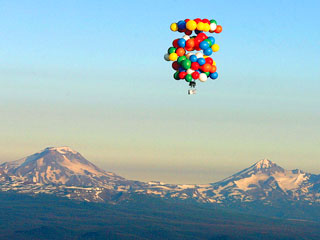
Couch covered about 235 miles in about nine hours after lifting off at dawn from his gas station riding in a green lawn chair rigged with an array of more than 150 giant party balloons.
Sandi Barton, 58, who has lived her whole life in this town of about 300, said she and her brother-in-law were the first ones to reach Couch and shook his hand. "Not much happens in Cambridge," she said, adding that about half the town turned out. "He came right over our pea field," she said. "He was coming down pretty fast." She said Couch gave some of his balloons to local children. It was not clear where Couch went after he landed.

It began after Couch, clutching a big mug of coffee, kissed his wife and kids goodbye, then patted their shivering Chihuahua, Isabella, on the head. After spilling off some cherry-flavored Kool-Aid that served as ballast, Couch got a push from the ground crew so he could clear light poles and soared over a coffee cart and across U.S. Highway 20 into a bright blue sky.
"If I had the time and money and people, I'd do this every weekend," Couch said before getting into the chair. "Things just look different from up there. You've moving so slowly. The best thing is the peace, the serenity... Originally, I wanted to do it because of boyhood dreams. I don't know about girls, but I think most guys look up in the sky and wish they could ride on a cloud." Couch's wife, Susan, called him crazy: "It's never been a dull moment since I married him."
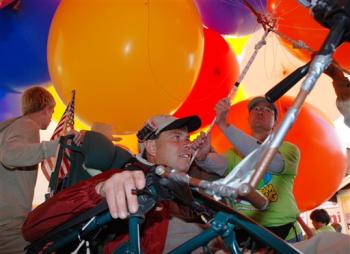
This was Couch's third balloon flight. He realized it would be possible after watching a TV show about the 1982 lawn chair flight over Los Angeles of truck driver Larry Walters, who gained folk hero fame but was fined $1,500 for violating air traffic rules. In 2006, Couch had to parachute out after popping too many balloons. And last year he flew 193 miles to the sagebrush of northeastern Oregon, short of his goal. "I'm not stopping till I get out of state," he said. To that end, he ordered more balloons. Dozens of volunteers wearing fluorescent green T-shirts that said "Dream Big" filled latex balloons 5 feet in diameter, attached them to strings and tied clusters of six balloons each to a tiny carabiner clip. Each balloon gives four pounds of lift. The chair was about 400 pounds, and Couch and his parachute 200 more. "I'd go to 30,000 feet if I didn't shoot a balloon down periodically," Couch said.
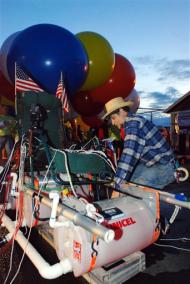
For that job, he carried a Red Ryder BB gun and a blow gun equipped with steel darts. He also had a pole with a hook for pulling in balloons, a parachute in case anything went wrong, a handheld Global Positioning System device with altimeter, a satellite phone, and two GPS tracking devices. One was one for him, the other for the chair, which got away in the wind as he landed last year. For food he carried some boiled eggs, jerky and chocolate. Couch flew hang gliders and skydived before taking up lawn-chair flights. He estimated the rig cost about $6,000, mostly for helium. Costs were defrayed by corporate sponsors.
(unquote)
Photos courtesy of AAP, Aero-News Network, Inc., and AP Photo/Jeff Barnard
Original Source: AP
Fuel change breakthrough: biodiesel-powered speedboat Earthrace, around world in 60 days, beats record set in 1998 by 14 days

*Update Jan 6 2010* - Blue Roses to Earthrace Ady Gil: 100% biofuel, spirit of ocean, stands for life, saves crew, sunk by whaler, rests in sea...
(quote)
Team Earthrace, led by New Zealand Skipper Pete Bethune, has smashed the world circumnavigation record for a speedboat by almost 14 days. Almost five years of preparation, planning and two record attempts have paid off leaving the bio-diesel powered Earthrace team to claim the round the world speedboat record.
Possibly the coolest powerboat on the planet, the space age, wave piercing trimaran Earthrace took bio-fuel into history as the 78 foot, (24 metre) boat crossed the 'Round the World' finish line in Sagunto, Spain. In just 60 days Earthrace has powered almost 24,000 nautical miles around the world. Earthrace left Spain on Sunday April 27th at 14:35 local time (1325 GMT) and headed west on the long voyage around the world. The previous record for a powerboat to circumnavigate the globe was 74 days 20 hours 58 minutes 30 seconds, set by the UK boat ‘Cable & Wireless Adventurer’ in 1998.

"Necessity, who is the mother of invention." - Plato
Necessity, who is the mother of invention.
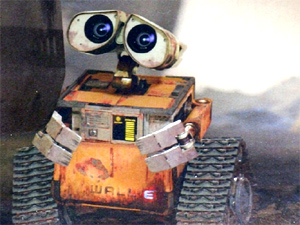
Robot with heart of gold falls in love: Wall-E, a beautiful Pixar vision, full of charm, humor, suspense, romance, and magic
(quote)
Groundbreaking yet familiar, part romance, part sci-fi, Pixar's latest work is wonderful and full of wonder. - Kenneth Turan, Times Movie Critic
If Pixar Animation Studios has an enviable record of consistent success -- and with a worldwide box-office gross of $4.3 billion from its eight films, it certainly does -- it's because the company has an uncanny gift for pushing things further without pushing too far. Pixar's adventurous new film, the one-of-a-kind "Wall-E," shows how it's done. Daring and traditional, groundbreaking and familiar, apocalyptic and sentimental, "Wall-E" gains strength from embracing contradictions that would destroy other films. Directed by Pixar stalwart Andrew Stanton, who co-wrote and directed the Oscar-winning "Finding Nemo," "Wall-E" is the latest Pixar film to manage what's become next door to impossible for anyone else: appealing to the broadest possible audience without insulting anyone's intelligence.
The origins of "Wall-E's" story, as related in the film's teaser trailer, go back to 1994, when Pixar honchos held a now-celebrated lunch to spitball story ideas, which became "A Bug's Life," "Monsters, Inc." and "Finding Nemo." "Wall-E" is the last of that group to get made, in part because elements of it are so unconventional. For one thing, the film's exceptional first half hour or so lives and breathes on screen with just about zero human dialogue. But with the storied Ben Burtt, who did the job on "Star Wars," creating all kinds of noise as the film's sound and character voice designer, as well as music by Thomas Newman, you won't miss those words at all. You also won't miss them because the world of "Wall-E," created by production designer Ralph Eggleston and his team, with the advice of high-powered cinematography consultants Roger Deakins and Dennis Murren, is so remarkable. The time is 800 years in the future and the setting is our own Earth, but it's not an Earth anyone would want to recognize.
Not to put too fine a point on it, our planet is a disaster, a bleak and disheartening ruin where every available surface is covered by towering skyscrapers of trash. It got so bad that Buy n' Large, the conglomerate that has somehow taken charge of the planet, leaned on the entire human population to leave with a "space is the final fun-tier" campaign that featured slogans such as, "Too much garbage in your face? There's plenty of space out in space." Though not likely the main reason the film was made, "Wall-E" can't help but send out a powerful and even frightening environmental message. Though G-rated, its dystopian vision (shot by Jeremy Lasky and Danielle Feinberg) of what the perils of consumer excess have in store for the planet is unnerving without trying too hard.
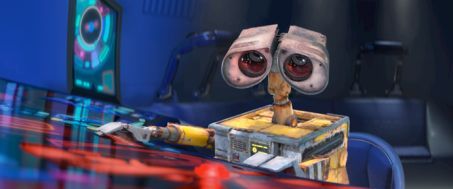
One reason "Wall-E" is as audience-friendly as it finally is is the presence of the endearing title character, whose name is an acronym for Waste Allocation Load Lifter -- Earth Class. What that means in practical terms is that Wall-E is a robotic trash compactor who has been quietly doing his job attacking Earth's endless mountains of refuse for 700 years. Unless you count his pal, a nameless but convivial roach, Wall-E is the only thing still moving on the entire planet. Given all that, it's to be expected that Wall-E, whose large binocular eyes and narrow neck turn him into a squat, mechanical E.T., has developed a few personal eccentricities over the years. For one thing, he's quite the collector, squirreling away everything from old Rubrik's Cubes to light bulbs to an actual living plant.
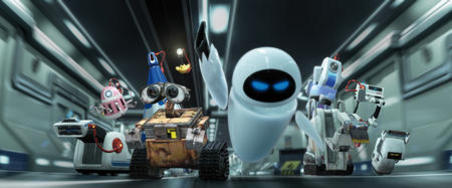
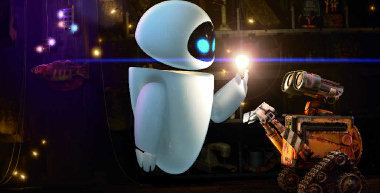
More than that, this set-in-his-ways old bachelor robot has developed a fixation with the movies. Not really the movies, but one movie in particular, the only video he's got. It is, of all things, "Hello, Dolly!" and screenwriters Stanton and Jim Reardon had the shrewd idea of opening the film with the jaunty lyric, "Out there is a world outside of Yonkers," as the camera somberly pans both the universe and the ruins of Earth. What really entrances "Wall-E" about "Hello, Dolly!" is the spectacle of people expressing emotion and connection by holding hands. Not a word is spoken, but we understand that this lonely Robinson Crusoe, like so many movie creatures before him, would like nothing better than to hold hands with another entity. And then it happens. A spaceship lands in Wall-E's neighborhood and leaves behind a sleek white oval-shaped probe-droid with bewitching blue eyes named Eve (for Extra-terrestrial Vegetation Evaluator), sent to Earth to find signs of life. High tech and armed with a laser weapon that pulverizes anything in sight, Eve fascinates Wall-E and he nervously scuttles around after her, fearful but intoxicated by her every move.

Though this wordless section of the film, punctuated only by Wall-E's frequent and idiosyncratic croak of "Eve," is in some ways merely a set up for the second half, it is easily the most memorable and distinctive part of the film. This segment, a kind of song without words, is a world-creating work of pure imagination that has been thought out to the nth degree.
"Wall-E's" second half involves the dauntingly overweight humans who have sent the probe (and who are shrewdly not pictured in any publicity material.) They've lived for centuries on a cruise liner-type spaceship called the Axiom run by a barely functional captain (Jeff Garlin) in thrall to a Hal-type eminence called Auto, voiced, in a nod to "Alien," by Sigourney Weaver. This part of the story gets increasingly familiar and sometimes borders on the predictably sentimental. But along with these inevitable elements of calculation, "Wall-E" never loses its sense of wonder: wonder at life, wonder at the universe, and even wonder at the power of computer animation to create worlds unlike any we've seen before. How often do we get to say that in these dispiriting times?
(unquote)
Images courtesy of Disney/Pixar, mlive.com, hamptonroads.com
Original Source and Video: LA Times
Special Gallery:Showbiz 7s: Movies that inspired 'Wall-E'
Related Article: :'Wall-E' draws design inspiration from Apple
Stunning: the Earth and Moon hang in space as seen from Mars. Images: NASA's discovery of water ice on Mars. What’s next?
(quote)
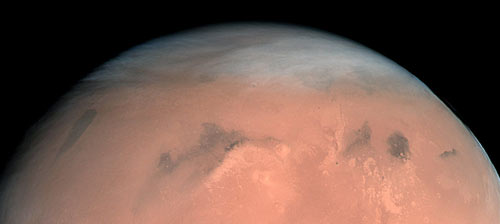
The announcement by NASA of the discovery of water ice on Mars by its Phoenix Lander probe made big news everywhere. The discovery involved the observation of water ice sublimating into the air - that is, the water went from solid to vapor state without reaching the liquid stage. The Martian atmosphere has perfect conditions for sublimation - extremely thin, dry and cold. How cold? Well, you can check the Live Martian Weather Report, with data from a station on board the Phoenix Lander.
What more do we know about Mars' atmosphere? It's hundreds of times thinner than Earth's atmosphere and is made of 95% carbon dioxide, 3% nitrogen, 1.6% argon, and contains traces of oxygen, water, and methane. We also know, from observations that it can support dust storms, dust devils, clouds and gusty winds. With an amazing number of six current live probes exploring Mars (two rovers, a lander, and three orbiters), there are many thousands of images available. Only a few, however show atmospheric phenomena. Presented here are some of the best images of Martian atmosphere (and beyond) in action. read more »
Contact Us

RSS feed