You are hereBlogs / WcP.Scientific.Mind's blog / Stunning: the Earth and Moon hang in space as seen from Mars. Images: NASA's discovery of water ice on Mars. What’s next?
Stunning: the Earth and Moon hang in space as seen from Mars. Images: NASA's discovery of water ice on Mars. What’s next?
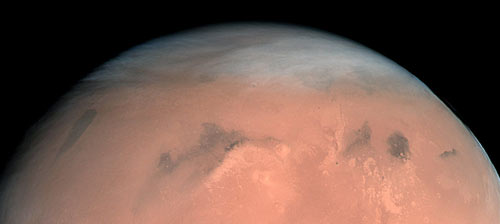
(quote)
The announcement by NASA of the discovery of water ice on Mars by its Phoenix Lander probe made big news everywhere. The discovery involved the observation of water ice sublimating into the air - that is, the water went from solid to vapor state without reaching the liquid stage. The Martian atmosphere has perfect conditions for sublimation - extremely thin, dry and cold. How cold? Well, you can check the Live Martian Weather Report, with data from a station on board the Phoenix Lander.
What more do we know about Mars' atmosphere? It's hundreds of times thinner than Earth's atmosphere and is made of 95% carbon dioxide, 3% nitrogen, 1.6% argon, and contains traces of oxygen, water, and methane. We also know, from observations that it can support dust storms, dust devils, clouds and gusty winds. With an amazing number of six current live probes exploring Mars (two rovers, a lander, and three orbiters), there are many thousands of images available. Only a few, however show atmospheric phenomena. Presented here are some of the best images of Martian atmosphere (and beyond) in action.


(unquote)
These and more photos courtesy of ESA, NASA, JPL (see original source: Boston Globe)
Related article: Can the Martian arctic support extreme life?


Contact Us

RSS feed


That picture of Earth and the moon wasn't taken anywhere close to Mars. From that distance, Earth would look just like a bright star. And while the moon would technically be visable at that distance, it's quite possible that due to it's proximity to Earth, it would be drown out by Earth's brightness.
Unless the rover was packing a hubble telescope, this was not taken from Mars. Maybe on the way to Mats, but like the other viewer mentioned, Earth would appear to be smaller than what Mars looks to us when we look up at the night sky.
This image was in fact taken from Mars orbit.
https://www.nasa.gov/mission_pages/MRO/multimedia/mro20080303earth.html
This is definitely one of the best articles I have read in this website!
Thanks Mate.
Thanks for your picture.
Maybe 16 degrees Celsius https://www.eyedoctorsupply.com/servlet/the-Optical-Lab-Equipment-%26-Supplies/Categories">Optical Lab Equipment (60 degrees Fahrenheit)," said Alan Robock, a meteorologist and climate researcher from Rutgers University who was not involved with the study.
Only if the camera of the probe was a telescope.