You are herescience
science
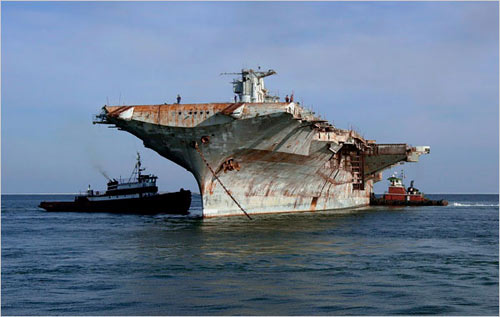
Warship now a home for fish: U.S.S. Oriskany, The Great Carrier Reef, is largest vessel ever sunk to make a reef
(quote)
PENSACOLA, Fla. - For Thom Dietmeyer, a retired naval officer, standing again on the bridge of his old ship was a dream come true, even if he was 70 feet below the surface of the ocean. “I knew exactly where I was going as soon as I got down there,” he said, recalling the dive, which took place a year ago last May on the wreck of an aircraft carrier called the Oriskany. The U.S.S. Oriskany, known as the Mighty-O, was commissioned in 1950 and served in Korea and Vietnam. The ship was sunk by the Navy in May 2006 under a pilot program to convert decommissioned vessels into artificial reefs. At 44,000 tons, 888-foot-long, it is by far the largest vessel ever sunk to make a reef.



Zoo Atlanta celebrates arrival of baby panda, 2nd cub of mother Lun Lun and only panda born in US in 2008 so far

(quote)
The Chengdu Giant Panda Breeding Research Base in Sichuan Province announced that 11-year-old panda Lun Lun gave birth to a cub in Zoo Atlanta in the United States at 10:11 AM Beijing time on August 31. It was her second birth since the base and the US zoo launched an international panda breeding program in 1999. Lun Lun gave birth to Mei Lan at the zoo in Sept 2006. Her second cub is the only giant panda born so far in the US in 2008, said Dennis Kelly, Zoo Atlanta's president and CEO.
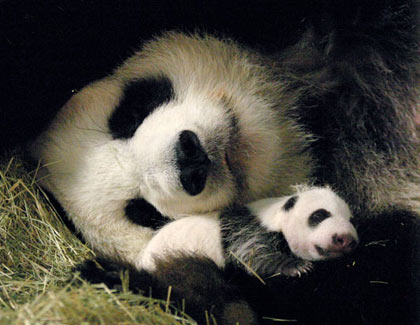
The zoo is continuing to monitor Lun Lun closely for a possible second birth. Twin births take place nearly 50 percent of the time with giant pandas. A second cub could arrive as much as 12 to 24 hours after the first, according to Zhang Zhihe, chief of the base.
Lun Lun is caring for her cub, which is about the size of a human hand. The zoo's veterinary team will conduct the cub's first checkup when it is deemed possible to do so without disrupting maternal care. The zoo's animal management and veterinary teams, joined by Yang Kuixing, an official from the Chengdu base, will continue round-the-clock monitoring of the mother and cub, Kelly said. read more »
Towers of food, farms in the sky: self-sustaining skyscrapers in the city, vertical farming gains new interest

(quote)
What if “eating local” in Shanghai or New York meant getting your fresh produce from five blocks away? And what if skyscrapers grew off the grid, as verdant, self-sustaining towers where city slickers cultivated their own food?
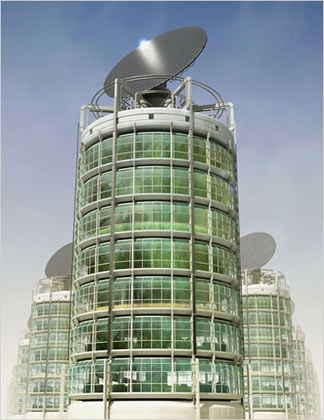
Dickson Despommier, a professor of public health at Columbia University, hopes to make these zucchini-in-the-sky visions a reality. Dr. Despommier’s pet project is the “vertical farm,” a concept he created in 1999 with graduate students in his class on medical ecology, the study of how the environment and human health interact. read more »
Galactic clash unmasks dark matter: ordinary mater and dark matter separate as two massive galaxies collide

(quote)
Striking evidence has been found for the enigmatic "stuff" called dark matter which makes up 23% of the Universe, yet is invisible to our eyes. The results come from astronomical observations of a titanic collision between two clusters of galaxies 5.7 billion light-years away. Astronomers detected the dark matter because it separated from the normal matter during the cosmic smash-up. The research team are to publish their findings in the Astrophysical Journal.
They used the Hubble and Chandra space telescopes to study the object MACSJ0025.4-1222 - formed after an incredibly energetic collision between two large galaxy clusters. Each of these large clusters contains about a quadrillion times the mass of our Sun.

25 Aug 1609. Galilei Galileo demonstrates his first telescope

(quote)
Called the Father of Modern Science by Einstein, Galileo was born into a musical family in Pisa. After studying mathematics and natural philosophy he was appointed to the Chair of Mathematics in 1589 before moving to the University of Padua where he made major discoveries in Fundamental and Applied Science. These included a military compass and an improved version of the telescope. With the later he was the first to identify the moons of Jupiter and describe the topography of our Moon.
On 25 August 1609, he demonstrated one of his early telescopes, with a magnification of about 8 or 9, to Venetian lawmakers. With a Galilean telescope, the observer could see magnified, upright images on the earth - it was what is commonly known as a terrestrial telescope or a spyglass. He could also use it to observe the sky; for a time he was one of those who could construct telescopes good enough for that purpose.
(unquote)
Image credit Giuseppi Bertini (Public Domain)
Amazing photos from Greenland, where unfortunately ice runs away by hundreds of billions of tons a year

(quote)
Ice sculptures constructed from the spare core samples by the scientists working on the North Greenland Eemian Ice Drilling project.

The ice samples, which the researchers analyze for clues to the temperature and concentration of greenhouse gases of the ancient atmosphere, are collected using this drill.

The visiting group of scientists, journalists and Danish environmental officials land at NEEM, the North Greenland Eemian Ice Drilling project. NEEM had arranged for the visitors to examine their research, which focuses on the climatic conditions which shaped the warm geologic period before the earth's last Ice Age, an important clue in understanding global warming. The camp is located approximately 600 miles north of the Arctic Circle. read more »
All the same: clone breaching lives’ uniqueness? S Korea reveals 1st dog clones - 1 dead dog into 5 identical ones
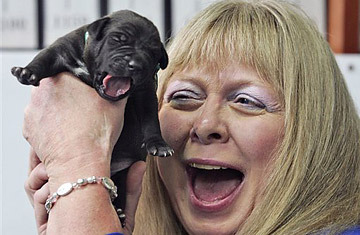
She has brought her precious pooch back from death, more than one but five – via cloning at the price of $50,000. Not the one unique dog Booger, but a bunch - FIVE!
Woken up at midnight by dear memory of the dead dog? Or thrilled by five identical dogs resembling the dead one? It is not a bad idea to hear from the very first commercial cloning client, or to imagine, the true sentiment before jumping to clone yours.
(quote)
(SEOUL, South Korea) — Booger is back. An American woman received five puppies Tuesday that were cloned from her beloved late pitbull, becoming the inaugural customer of a South Korean company that says it is the world's first successful commercial canine cloning service. Seoul-based RNL Bio said the clones of Bernann McKinney's dog Booger were born last week after being cloned in cooperation with a team of Seoul National University scientists who created the world's first cloned dog in 2005.
Contact Us

RSS feed