You are herescience
science
Rising Acidity in World’s Ocean Waters 100 Years Earlier than Predicted
(quote)
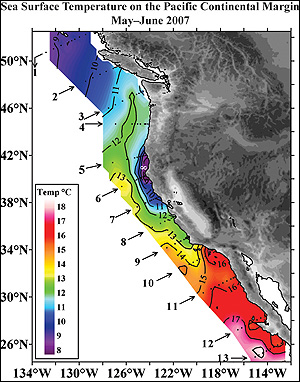
Climate models predicted it wouldn't happen until the end of the century. So Seattle researchers were stunned to discover that vast swaths of acidified sea water are already showing up along the Pacific Coast as carbon dioxide from power plants, cars and factories mixes into the ocean. In some places, including Northern California, the acidified water was as little as four miles from shore.
"What we found ... was truly astonishing," said oceanographer Richard Feely, of the National Oceanic and Atmospheric Administration's Pacific Marine Environmental Laboratory in Seattle. "This means ocean acidification may be seriously impacting marine life on the continental shelf right now." The phenomenon is an aspect of global warming scientists are just beginning to understand.
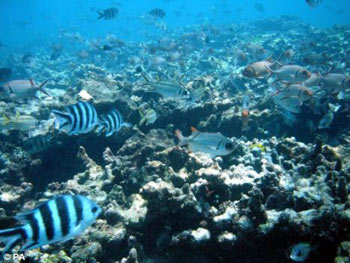
Acidified ocean water can be fatal to some fish eggs and larvae. It also interferes with the formation of shells and skeletons, harming corals, clams, oysters, mussels and the tiny plankton that are the basis of the marine food web. "Their shells dissolve faster than they are able to rebuild them," said Debby Ianson, an oceanographer at Fisheries and Oceans Canada and a co-author of the study published today in the online journal Science Express.
Since the Industrial Revolution, when humans began pumping massive amounts of carbon dioxide into the atmosphere, the oceans have absorbed 525 billion tons of the greenhouse gas, Feely estimates. That's about a third of the man-made emissions during that time. By reducing the amount of carbon dioxide in the atmosphere, the oceans have blunted the temperature rise due to global warming. But they've suffered for that service, with a more than 30 percent increase in acidity.
"This is another example where what's happening in the natural world seems to be happening much faster than what our climate models predict," said Carnegie Institution climate scientist Ken Caldeira, whose work suggested it would be nearly 100 years before acidified water was common along the West Coast. And there's worse to come, the scientists warn. The acidified water upwelling along the coast today was last exposed to the atmosphere about 50 years ago, when carbon-dioxide levels were much lower than they are now. That means the water that will rise from the depths over the coming decades will have absorbed more carbon dioxide, and will be even more acidic. "We've got 50 years' worth of water that's already left the station and is on our way to us," study co-author Hales said. "Each one of those years is going to be a little bit more corrosive."
(unquote)
Images courtesy of Dana Greeley & Simone Alin, PMEL, and Daily Mail
Original Source: Seattle Times


NASA Mars Probe Prepares for Risky Landing
Original Source: BBC News
(quote)
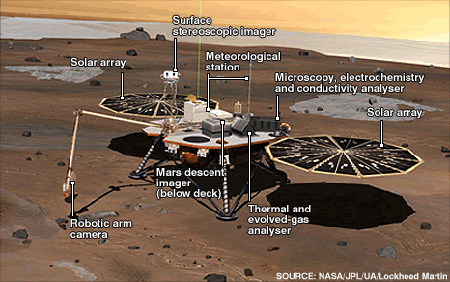
The Phoenix lander is due to touch down on Monday in the far north of the Red Planet, after a 423-million-mile journey from Earth. The probe is equipped with a robotic arm to dig for water ice thought to be buried beneath the surface. Scientists say the mission should give the clearest indication yet of whether Mars could once have harbored life.
The final seven minutes of the probe's ten-month journey is regarded as the riskiest part of the mission. After it enters the top of the Martian atmosphere at nearly 5.7km/s (13,000 mph), the probe must perform a series of maneuvers to come safely to rest. It will release a parachute, use pulsed thrusters to slow to a fast walking speed, then come to a halt on three legs. If all goes to plan, the Phoenix lander will reach the surface of Mars at 0053 BST (1953 EDT) on May 26. Nasa controllers will know in about 15 minutes whether the attempt has been successful.
Landing on Mars is a notoriously tricky business. Of the 11 missions that have tried to land probes on Mars since 1971 - only five have succeeded. Phoenix is an apt name for the current mission, as it rose from the ashes of two previous failures. In September 1999, the Mars Climate Orbiter spacecraft crashed into the Red Planet following a navigation error caused when technicians mixed up "English" (imperial) and metric units. A few months later, another Nasa spacecraft, the Mars Polar Lander (MPL), was lost near the planet's South Pole. Phoenix uses hardware from an identical twin of MPL, the Mars Surveyor 2001 Lander, which was cancelled following the two consecutive failures. The probe was launched on 4 August 2007 on a Delta II rocket from Cape Canaveral Air Force Station in Florida.
(unquote)


Social Networks and Kicking Bad Habits - Quitting Smoking Can Be Contagious
Original Source: Reuters
(quote)
The same team of experts who found that obesity may be socially contagious said they found similar patterns among smokers, with people clearly influencing others in their social and family networks. In fact, the most isolated people are now those who remain the most addicted as their personal networks get pushed to the fringes, they wrote in the New England Journal of Medicine.
Dr. Nicholas Christakis of Harvard Medical School in Boston and Dr. James Fowler of the University of California, San Diego, studied 12,067 people who have been taking part in the Framingham study -- a study of the health and habits of nearly an entire town in Massachusetts -- for the past 32 years. "We've found that when you analyze large social networks, entire pockets of people who might not know each other all quit smoking at once," Christakis said in a statement. "What appears to happen is that people quit in droves."
Smoking is becoming increasingly less common in the United States. In 1965, 42 percent of the population smoked, according to the U.S. Centers for Disease Control and Prevention. That number has fallen to around 20 percent. When the Framingham study started, around 37 percent of adults smoked. Spouses had strong effects -- when someone quit, his or her spouse was 67 percent less likely to continue smoking. Quitters influenced their brothers or sisters -- siblings were 25 percent less likely to smoke if one of them quit, while the friend of someone who kicked the habit was 36 percent less likely to smoke. Even co-workers are influential -- in small firms, a quitter could decrease smoking among peers by 34 percent.
Richard Suzman, who directs behavioral studies at the National Institute of Aging, said the research could influence policy. "The results suggest new and probably more powerful approaches to changing health behaviors, such as smoking, by careful targeting of small peer groups as well as single individuals," he said.
(unquote)
Images courtesy of Reuters and iStockPhoto


Scientists Observe Birth of a Supernova, Captured on Camera For the First Time
Original Source: Spaceflight Now
(quote)
PRINCETON, NJ -- When she peered into the screen of her computer one day in January, Alicia Soderberg was supposed to see a small, dull glowing smudge in one corner, the evidence of a month-old supernova that would help her better understand the mystery of these huge exploding stars. What the Princeton University astronomer saw instead was anything but dull. As Soderberg and Edo Berger, a postdoctoral research associate at Princeton, studied the X-ray emissions conveyed from space by NASA's Swift satellite, they saw an extremely bright light that seemed to jump out of the sky. They didn't know it, but they had just become the first astronomers to have caught a star in the act of exploding. The once-in-a-lifetime event, described in a paper published in the May 22 issue of Nature, has transfixed the worldwide astronomical community.
Soderberg and Berger wanted to observe a supernova known as SN 2007uy in the spiral galaxy NGC 2770, located 90 million light years from Earth in the constellation Lynx. They could plan to do that because they are able to view images captured by the telescope a few hours after the observation merely by downloading the data from the Swift website. The sudden appearance nearby of the X-ray burst of the newer supernova, easily captured by the NASA satellite with multiple instruments that can detect gamma rays, X-rays and ultraviolet light, has set scientists on a new path. "This phenomenon had been predicted more than 30 years ago, but is now observed for the first time," said Roger Chevalier, the W.H. Vanderbilt Professor of Astronomy at the University of Virginia. "These are the earliest observations of light from a supernova after the central collapse that initiated the explosion."
In the Nature paper, Soderberg and 38 colleagues show that the energy and pattern of the X-ray outburst is consistent with what scientists would have expected to see in the birth of a neutron star -- a shock wave blasting through the surface of the original massive star. Until now, astronomers have only been able to observe supernovae brightening days or weeks after the event, when the expanding shell of debris is energized by the decay of radioactive elements forged in the explosion.
(unquote)
Photos Courtesy of AFP and NASA/Swift Science Team/Stefan Immler



Britain's Couch Potato Children Now among the Fattest in Europe
Original Source: Daily Mail
(quote)
British children are among the worst in a Europe-wide obesity league table, with around a third weighing more than they should. A couch potato lifestyle and a growing appetite for fast food is blamed for boys and girls weighing in near the top of a 27-country fat league.
Scottish girls take second place in the female rankings, with almost 33 per cent overweight. English girls are fourth, with 29.3 per cent too heavy for their height. The heaviest girls are in Portugal (34.3 per cent), while the slimmest are in Latvia and Lithuania (3.5 per cent overweight). Among the boys, Scotland was again second, with almost 35 per cent too heavy for their height. Only Spanish boys are heavier. English boys are in sixth place at 29 per cent - compared to the lean lads of Lithuania, where only 8 per cent are overweight. The figures, which were compiled by the IASO from government and scientific studies, come as British doctors warn they are treating children as young as two for obesity.
Obesity experts said the results could be partly explained by a couch potato lifestyle, in which TV dinners have replaced family meals and computer games are preferred to outdoor play. Dr Tim Lobstein, of the International Association for the Study of Obesity, said: "There is a big industry selling us more TV to watch, more computer games to play, more DVDs to sit and watch. There is a big industry promoting screen watching which is a sedentary behaviour and you just get fatter while you do it."
Dr Ian Campbell, medical director of the charity Weight Concern, said childhood obesity could only be tackled by parents, schools and government working together. Safe, accessible exercise facilities and nourishing and affordable meals should be a priority, he said.
(unquote)

Nearly One Third of World's Species Extinct Since 1970
Original Source: BBC News
(quote)
Between a quarter and a third of the world's wildlife has been lost since 1970, according to data compiled by the Zoological Society of London. Populations of land-based species fell by 25%, marine by 28% and freshwater by 29%. Humans are wiping out about 1% of all other species every year, and one of the "great extinction episodes" in the Earth's history is under way, it says. Pollution, farming and urban expansion, over-fishing and hunting are blamed.
The Living Planet Index, compiled by the society in partnership with the wildlife group WWF, tracks the fortunes of more than 1,400 species of fish, amphibians, reptiles, birds and mammals, using scientific publications and online databases. It said numbers had declined by 27% in the 35 years from 1970 to 2005. Some of the worst hit are marine species which saw their numbers plummet by 28% in just 10 years, between 1995 and 2005. Populations of ocean birds have fallen by 30% since the mid 1990s, while land-based populations have dropped by 25%.
The WWF said that over the next 30 years, climate change was also expected to become a significant threat to species. Director general James Leape said: "Reduced biodiversity means millions of people face a future where food supplies are more vulnerable to pests and disease and where water is in irregular or short supply. "No-one can escape the impact of biodiversity loss because reduced global diversity translates quite clearly into fewer new medicines, greater vulnerability to natural disasters and greater effects from global warming."
The WWF is calling on governments meeting in Bonn to honour their commitments to put in place effective protected areas for wildlife and to adopt a target to achieve net annual zero deforestation by 2020. The UK's Biodiversity Minister, Joan Ruddock, said the report showed that the international community had to work together to stem the decline. "The fact that human activities have caused more rapid changes in biodiversity in the last 50 years than at any other time in human history should concern us all," she said. "Supporting wildlife is critical to all our futures."
(unquote)
Images courtesy of BBC News and WWF


Contact Us

RSS feed


