You are herescience
science
March 18, 2009. Canada marks "Oceans and Marine Life Polar Day", International Polar Year (the 1st IPY: 1882–1883) webcast event
(quote)
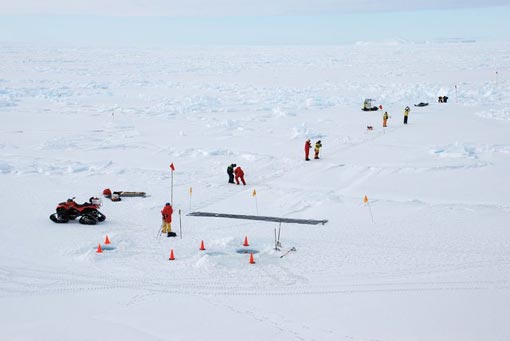
OTTAWA, ONTARIO - "Oceans and Marine Life Polar Day", an International Polar Year (IPY) webcast event, took place on March 18, 2009, from 1 p.m. to 4 p.m., at the theatre of the Museum of Civilization in Gatineau, Quebec. "Our Government has made a tremendous contribution to Arctic research during International Polar Year. Polar Days are a great opportunity to share the initial findings of this research with the public," said the Honourable Chuck Strahl, Minister of Indian Affairs and Northern Development. To learn more about "Oceans and Marine Life Polar Day" events in Canada and around the world, as well as other national and international initiatives related to International Polar Year, we invite you to visit www.ipy.gc.ca. read more »


130 years ago today: March 14, 1879, Birth of Albert Einstein - Emblem of Reason, Icon of Wisdom

(quote)
When Einstein was born, his mother worried that his head was too large and his grandmother exclaimed that he was "much too fat." A few years later, when Einstein was four or five, he had his first scientific experience: his father showed him a pocket compass and the young boy marveled at the fact that regardless of where the compass was turned, the needle always pointed north. The needle's invariable northward swing, guided by an invisible force, profoundly impressed the child. The compass convinced him that there had to be "something behind things, something deeply hidden."

Einstein's formal education began at age six, when he enrolled in the Petersschule on Blumen- strasse, a Catholic elementary school in Munich. Since his parents were not practicing Jews, they cared more about the school's academic standards than its religious affiliation. Einstein did well in school, but he was a quiet child and kept his distance from his peers. He was uncomfortable with the principle of absolute obedience and the military drills that dominated the school's atmosphere. read more »
On Mar 2, 1969 world's first supersonic jetliner Concorde took flight, feat of collaboration eng. & work of beauty

(quote)
It was a feat of engineering and a work of exceptional beauty and grace. It won the hearts and minds of millions of people.
Forty years ago today the supersonic Concorde took its first test flight, and a design paragon flashed across the skies over Toulouse. With its droop nose and delta wing, the Concorde was a high point of 20th century engineering (its maiden flight came three months before the first moon landing) and the kind of cooperative effort that now seems beyond us. As we enter a period of infrastructure spending, it’s worth noting what kept the Concorde aloft for 27 years.

The most beautiful experience we can have is the mysterious... the fundamental emotion which stands at the ...
The most beautiful experience we can have is the mysterious... the fundamental emotion which stands at the cradle of true art and true science.
NASA's spacecraft Kepler blasts off on a three-year mission in search of Earth-like planets
(quote)
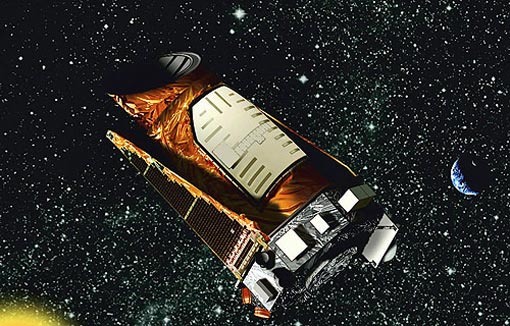
NASA's Kepler spacecraft blasted off from Kennedy Space Center in Florida on Friday on a three-year mission to find Earth's twin, a Goldilocks planet where it's neither too hot nor too cold, but just right for life to take hold.
The Delta II rocket, carrying the widest field telescope ever put in space, lifted off the launch pad at Cape Canaveral at 10:49 p.m. Eastern time. The launch vehicle headed down-range, gathering speed as its three stages ignited, one after the other, passing over Antigua Island in the Caribbean and later over tracking stations in Australia before climbing into orbit.
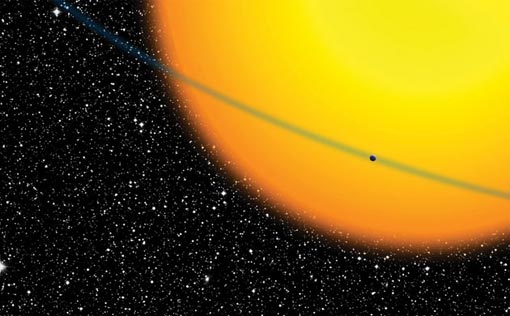
Kepler will eventually settle down to scan tens of thousands of stars near the constellations Cygnus and Lyra in search of planets where water could exist on the surface in liquid form, a key condition for life as we know it. "We have a feeling like we're about to set sail across an ocean to discover a new world," said project manager Jim Fanson of the Jet Propulsion Laboratory in La Cañada Flintridge. "It's sort of the same feeling Columbus or Magellan must have had." read more »
MIT Solar Electric Vehicle Team unveils sleek 90-mph car, will compete in World Solar Challenge in Australia

(quote)
MIT's Solar Electric Vehicle Team, the oldest such student team in the country, has just finished construction of its latest high-tech car and unveiled it to the public this Friday. "It drives beautifully," said George Hansel, a freshman physics major at the Massachusetts Institute of Technology and a member of the team. "It's fun to drive and quite a spectacle." With six square meters of monocrystalline silicon solar cells and improved electronic systems and design, the car can run all day on a sunny day at a steady cruising speed of 55 mph. The car will be competing in October in the World Solar Challenge race across Australia, and in preparation for that the team plans to drive the car across the United States over the summer. About a dozen team members are expected to go to Australia for the race, although only four will drive the solar car in the competition.

Snowflakes are science and art: see ice crystals, simple, complex, the basics behind these miniature miracles of Nature
(quote)
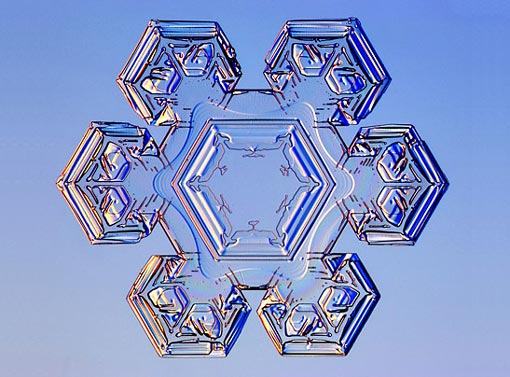
Caltech physics professor Kenneth G. Libbrecht has turned his passion for the study of ice crystals into an art form. In his books and website, snowcrystals.com, he breaks down some of the basics behind these miniature miracles of nature
Stellar Plates
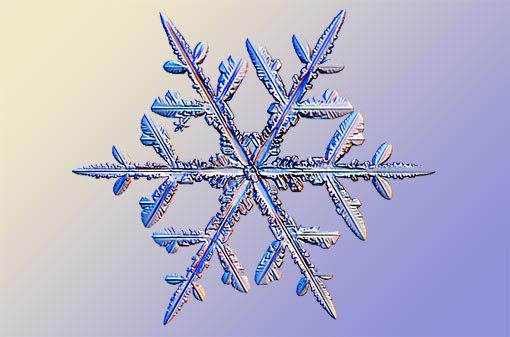
These common snowflakes (above) are thin, plate-like crystals with six broad arms that form a star-like shape. Shapes like these form around 28 degrees Fahrenheit, while columns and slender needles appear near 23 degrees. Plates and stars again form near 5 degrees Fahrenheit.
Simple Prisms
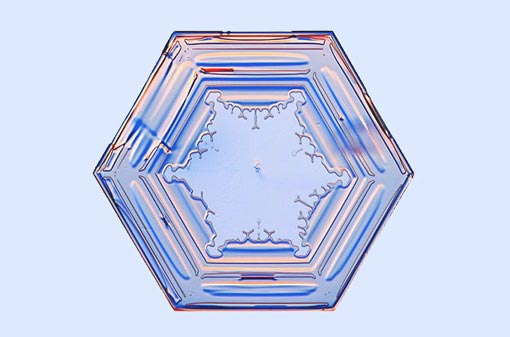
Snowflakes are not frozen raindrops (that is better known as sleet). They form when water vapor condenses directly into ice, which happens in the clouds. In their most basic form, snow crystals are hexagonal prisms like the sample, above, but other, more complex forms are famously possible.
Sectored Plates
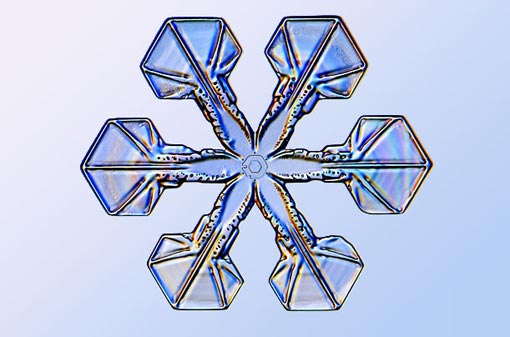
The simplest sectored plates are hexagonal crystals that are divided into six equal pieces, like the slices of a pie. More complex specimens show prominent ridges on broad, flat branches.
Contact Us

RSS feed


