You are herescience
science
Science without religion is lame, religion without science is blind. - Albert Einstein
Science without religion is lame, religion without science is blind.


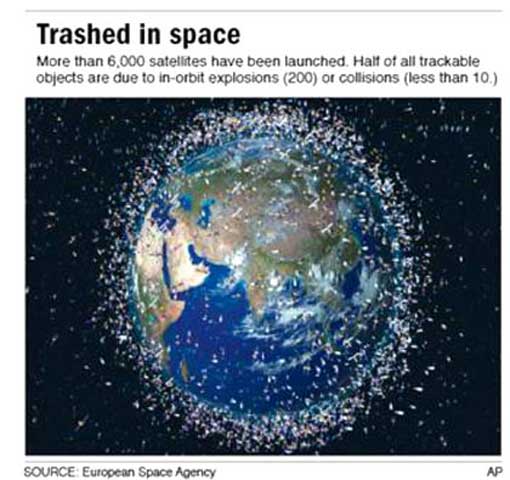
Man-made junk in low Earth orbit: satellite collision highlights space pollution and rising hazard from debris
(quote)
The military tracks about 18,000 pieces of orbital debris. On Tuesday, the census of space-garbage suddenly jumped by 600, the initial estimate of the number of fragments from a stunning collision of two satellites high above Siberia.
Space is now polluted with the flotsam of a satellite-dependent civilization. The debris is increasingly a hazard for astronauts and has put crafts such as the Hubble Space Telescope and communications satellites at risk of being struck by an object moving at high speed.
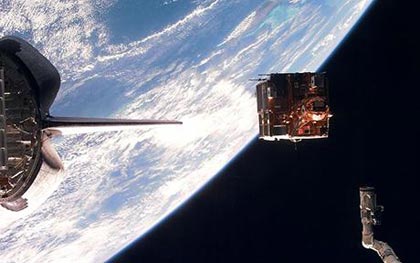
The military's radar can spot objects about four inches in diameter - roughly the size of a baseball - or larger. This collision, however, may have produced many thousands of small, undetectable pieces of debris that would still carry enough kinetic punch at orbital velocities to damage or destroy a spacecraft. read more »
Ocean Mysteries: 'Immortal' jellyfish from Caribbean capable of reverting to younger self spreading all over world

(quote)
Marine biologists say the jellyfish numbers are rocketing because they need not die. Dr Maria Miglietta of the Smithsonian Tropical Marine Institute said: "We are looking at a worldwide silent invasion."
The jellyfish are originally from the Caribbean but have spread all over the world. Found in warm tropical waters Turritopsis is believed to be spreading across the world as ships’ ballast water is discharged in ports.

Turritopsis Nutricula is technically known as a hydrozoan and is the only known animal that is capable of reverting completely to its younger self. It does this through the cell development process of transdiff- erentiation. Scientists believe the cycle can repeat indefinitely, rendering it potentially immortal.
Though solitary, they are predatory creatures and evolve asexually from a polyp stage. While most members of the jellyfish family usually die after propagating, the Turritopsis nutricula has developed the unique ability to return to a polyp state. read more »
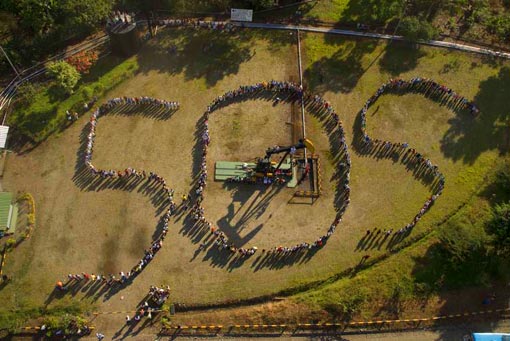
"SOS Amazon": 1st action of Amazon tribes, sending message "Wake Up, World!" at 2009 World Social Forum in Brazil

(quote)
BELÉM, Brazil, Jan 27 (IPS) - A human banner made up of more than 1,000 people, seen and photographed from the air, sent the message "SOS Amazon" to the world, in the first action taken by indigenous people hours before the opening in northern Brazil on Tuesday of the 2009 World Social Forum (WSF).

The mass message reflects "our concern about global warming, whose impact we will be the first to feel, although we, the peoples of the Amazon, have protected and cared for the forests," Francisco Avelino Batista, an Apurinán Indian from the Purus river valley in the Brazilian Amazon, told IPS.
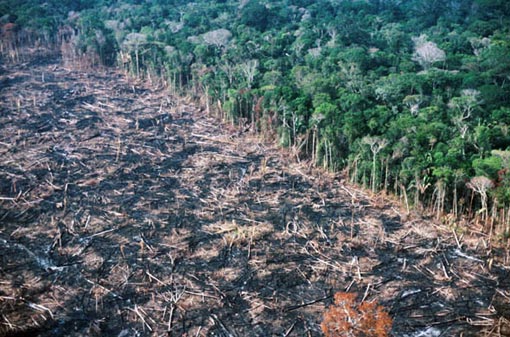
"SOS Amazon": every second we lose 1.5 acres of rainforests once covering 14% of earth land surface, now a mere 6%
(quote)
The Disappearing Rainforests
We are losing Earth's greatest biological treasures just as we are beginning to appreciate their true value. Rainforests once covered 14% of the earth's land surface; now they cover a mere 6% and experts estimate that the last remaining rainforests could be consumed in less than 40 years.

* One and one-half acres of rainforest are lost every second with tragic consequences for both developing and industrial countries.
* Rainforests are being destroyed because the value of rainforest land is perceived as only the value of its timber by short-sighted governments, multi-national logging companies, and land owners.

* Nearly half of the world's species of plants, animals and microorganisms will be destroyed or severely threatened over the next quarter century due to rainforest deforestation. read more »
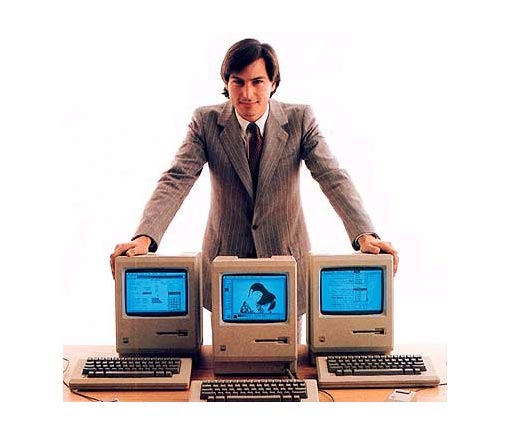
25 years of innovation: Apple's unveiling of the first Macintosh forever changed the future of personal computing
(quote)
The Macintosh - the first to bear the name - turns 25 on 24 January. The machine debuted in 1984 and kicked off a product line that were Apple's flagship computers for many years.
The Macintosh helped popularize the combination of graphical interface and mouse that is ubiquitous today. It had a revolutionary all-in-one design, and crucially, used a graphical user interface to navigate around, rather than text commands. This enabled the Apple Macintosh to cross the species barrier – everyday users could now use the computer, rather than just geeks au fait with scripting and coding. Indeed, the $2,495 price tag was perhaps the only barrier to entry.

The mouse input system and simple GUI enabled users to carry out a range of tasks that had been impossible on other computers. The Apple Macintosh came bundled with two software programs, MacWrite and MacPaint, signalling the birth of word processing and desktop publishing. With just 128KB of memory and a sloth-like 8MHz processor, the Apple Macintosh is woefully underpowered by today’s standards, but was cutting edge at the time. read more »
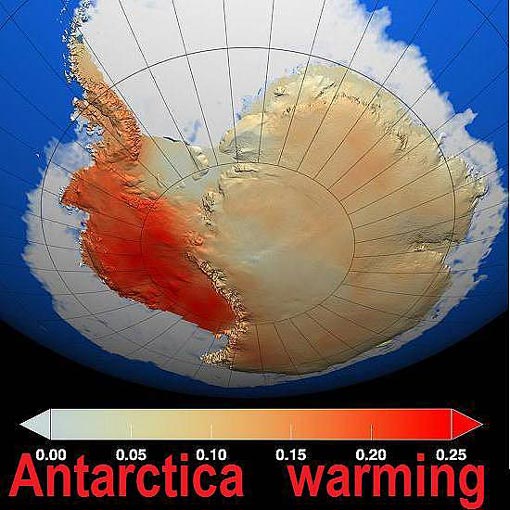
Antarctica: Larsen B ice shelf, a large floating ice mass shattered, separated: AVHRRadiometer deployed on satellites since 1981
(quote)
The Antarctic Peninsula juts into the Southern Ocean, reaching farther north than any other part of the continent. The southernmost reach of global warming was believed to be limited to this narrow strip of land, while the rest of the continent was presumed to be cooling or stable.
Not so, according to a new analysis involving NASA data. In fact, the study has confirmed a trend suspected by some climate scientists. "Everyone knows it has been warming on the Antarctic Peninsula, where there are lots of weather stations collecting data," said Eric Steig, a climate researcher at the University of Washington in Seattle, and lead author of the study. "Our analysis told us that it is also warming in West Antarctica."
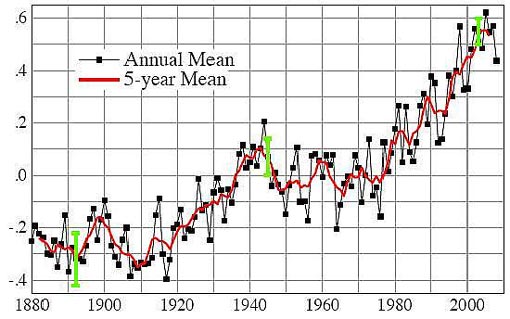
The finding is the result of a novel combination of historical temperature data from ground-based weather stations and more recent data from satellites. Steig and colleagues used data from each record to fill in gaps in the other and to reconstruct a 50-year history of surface temperatures across Antarctica. read more »
Contact Us

RSS feed


