You are herescience
science
Portraits of wondrous Earth: ice storm glazed tree; poetic snowflakes; ice caverns; Giant's Causeway; geysers; sea unicorns
(quote)
Ice
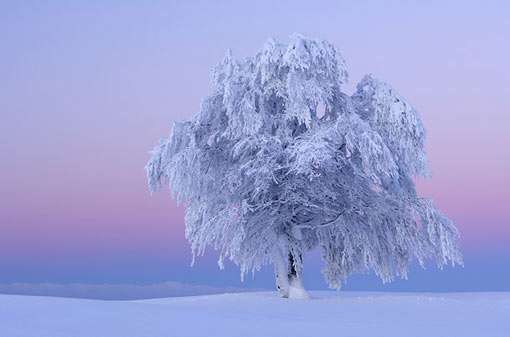
The residue of an ice storm glazes a beech tree, pushing its branches to a near-breaking point. Ice storms are formed when two layers of cold air (one near the earth's surface, another far above) sandwich between them a tier of warm air. Precipitation from the top layer starts out as snow, but when it falls into the middle, warmer belt, it melts into rain. Then, on its way through the lowest belt, it undergoes a little-understood process known as "supercooling" which causes it to chill well below the freezing point of water, yet still remain liquid. When this unnaturally cold water hits the ground, it instantaneously freezes into a translucent glaze that takes on, in intricate detail, the shape of whatever it surrounds.

Clouds
Water is a shape shifter: familiar in its liquid and frozen forms, it is invisible in its third form, as a vapor, until it coalesces into clouds overhead or shrouds us in ghostly fog. One of nature's everyday wonders, clouds hide in plain sight until they are touched with the sun's glory at sunrise and sunset or pile up to form a lightning-generating, anvil-headed cumulonimbus thundercloud.

The Sun read more »


Bread-loaf-sized satellite Firefly on lightning & gamma rays (photon of penetrating electromagnetic radiation fr atomic nucleus)

(quote)
Firefly is a new mission to study lightning and gamma rays with CubeSats, small satellites in the shape of a cube.
Firefly, it's called, this new small satellite mission sponsored by the National Science Foundation (NSF). It's designed to help solve the mystery of the most powerful natural particle accelerator in Earth's atmosphere: TGFs, or terrestrial gamma-ray flashes. TGFs likely result from thunderstorms.
The mission is the second project under the new NSF CubeSat program. A CubeSat satellite, about the size of a loaf of bread, consists of three cubes attached end to end in a rectangular shape.
(unquote)
Photo courtesy of NASA/GSFC
Original Source: National Science Foundation
Solar Energy: Spain 4th in world, 2nd in Europe behind Germany; number of solar companies leapt from couple dozen to few hundred
(quote)
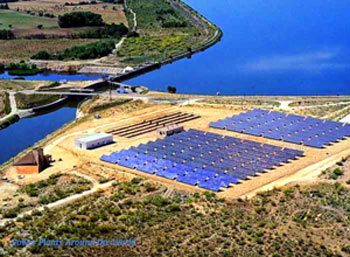
As researchers continue to explore new ways to promote and improve solar power, Spain forges ahead with plans to build concentrating solar power plants, establishing the country and Spanish companies as world leaders in the emerging field. At the same time, the number of installed photovoltaic systems is growing exponentially, and researchers continue to explore new ways to promote and improve solar power. This is the seventh in an eight-part series highlighting new technologies in Spain and is produced by Technology Review, Inc.’s custom-publishing division in partnership with the Trade Commission of Spain.
World's first biofuel-powered flying car - Parajet Skycar drives like a car and flies like a plane

(quote)
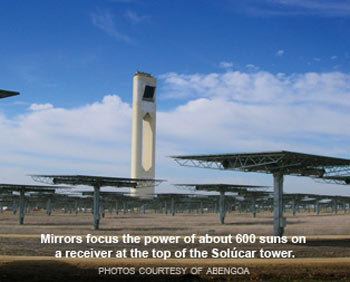
To Timbuktu by flying car: it sounds the most unlikely journey on earth; a sci-fi voyage from the pages of Jules Verne. But this is no fantasy. The car really flies. And the journey will become reality early in the new year when two explorers set off from London in a propeller-powered dune buggy heading for the Sahara.
The seed of this improbable adventure was sown four years ago when Gilo Cardozo, a paramotor manufacturer, had a eureka moment. For those not familiar with paramotors, picture a parachutist with a giant industrial fan strapped to his back, which provides forward motion and boosts lift for the parachute - or wing - during takeoff. Cardozo’s brainwave was to attach a car to the fan. “I started making a paramotor on wheels that you sit on and take off and it suddenly occurred to me, ‘Why not just have a car that does everything?’” recalls Cardozo, whose Wiltshire-based company Parajet built the paramotor that the adventurer Bear Grylls used to fly near Everest last year.

World first. Ever-restless ocean wave farm generates electricity for 1,500 homes on shore: Pelamis in Portugal

(quote)
Three red snakelike devices bobbing in the waves three miles (4.8 kilometers) off the coast of Agucadoura, Portugal, represent the first swell of what developers hope will be a rising tide of wave power projects. These big metallic sea snakes bobbing in the ever-restless waves of the North Atlantic are generating electricity for over a thousand homes on shore. The world’s most ambitious, working wave farm for generating electricity, it is part of Portugal’s national effort to become energy self-sufficient as Denmark has done since the 1970s oil crisis. Portugal is not a wealthy nation and has no coal or petroleum. So wind and water and sunshine are their favored sources of energy. Portugal is also one nation encouraging local cities to become zero emission communities.

Work of art: house with natural light. Intensely green: sunflower husk wall panels, solar heating, recycled water for garden

(quote)
Thomas Small is an accomplished cook, so it’s important for him to try new and exotic ingredients every now and then. When it came to the construction of his eco-friendly house, that’s exactly what his architects gave him. After all, crushed sunflower husks and shredded blue jeans don’t sound like typical building blocks. But in the world of green design, such ingredients are not rare. So now, Mr. Small and his wife, Joanna Brody, along with their two very young children and a pair of large French Briard dogs, share a prefabricated urban building that has become an example for others looking for creative ways to go green.

Nature provides. A tree fungus could provide green fuel that can be pumped directly into vehicle tanks: Patagonian rainforest

(quote)
A tree fungus could provide green fuel that can be pumped directly into vehicle tanks, US scientists say. The organism, found in the Patagonian rainforest, naturally produces a mixture of chemicals that is remarkably similar to diesel. "These are the first organisms that have been found that make many of the ingredients of diesel," said Professor Gary Strobel from Montana State University. "This is a major discovery."
The discovery may offer an alternative to fossil fuels, said Strobel, MSU professor of plant sciences and plant pathology, who travels the world looking for exotic plants that may contain beneficial microbes. The find is even bigger, he said, than his 1993 discovery of fungus that contained the anticancer drug taxol. The fungus, called Gliocladium roseum and discovered growing inside the ulmo tree (Eucryphia cordifolia) in northern Patagonia, produces a range of hydrocarbon molecules that are virtually identical to the fuel-grade compounds in existing fossil fuels.

Contact Us

RSS feed


