You are hereArchive
Archive
Global financial summit from G7 to G20; new strong voice of BRIC nations: Brazil, Russia, India and China

(quote)
Western nations began to cede some control as countries including Brazil, India and China – which with Russia form the so-called BRIC nations – managed to guarantee a greater presence on the international stage.
All three will now join the board of the Financial Stability Forum – the global economic policy powerhouse that to date has been the bastion of the G8.

Each is likely to play a stronger role in the reform of major institutions such as the International Monetary Fund than might previously have been witnessed under the old economic order.
The final summit communiqué also gave particular reference to emerging and developing economies, urging them to undertake commitments consistent with their capacities and roles in the global economy – a clear admission of their increased importance. read more »


Europe loves bikes. Assembly lines of biggest facility in Europe have average output of 3000 bikes per day, 1 million in 2009
(quote)
SERZEDO, Portugal – Recently the biggest bike facility in Europe started its production. That facility is located in Portugal; is operated by a company called RTE and is to produce one million bikes in 2009.
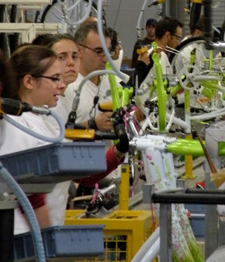
RTE’s assembly lines have an average output of 3000 bikes per day, depending on the season and the model. When a new collection is being launched or there is an urgent need for big quantities, RTE can produce 3400 units per day. Otherwise the assembly line only needs to work one 8-hour shift per day. Normally, the total daily production is shipped on the same day to a Decathlon centre of distribution.
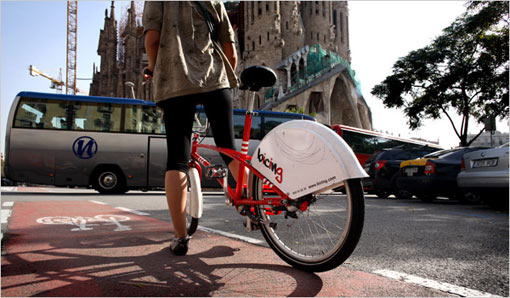
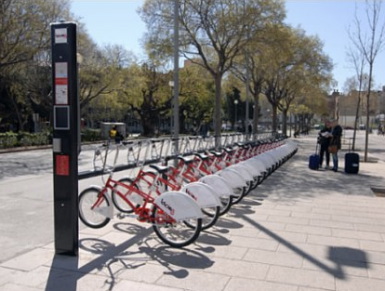
In addition to Paris' Velib bike rental program, Barcelona, Seville and Stockholm all have bike rentals available.
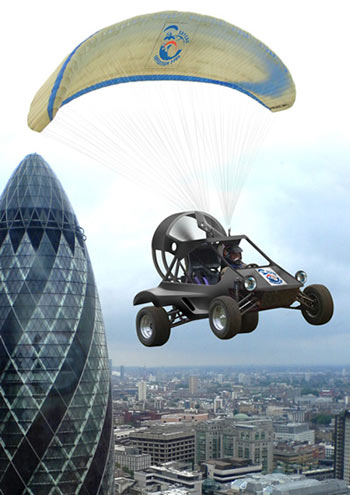
World's first biofuel-powered flying car - Parajet Skycar drives like a car and flies like a plane
(quote)
To Timbuktu by flying car: it sounds the most unlikely journey on earth; a sci-fi voyage from the pages of Jules Verne. But this is no fantasy. The car really flies. And the journey will become reality early in the new year when two explorers set off from London in a propeller-powered dune buggy heading for the Sahara.
The seed of this improbable adventure was sown four years ago when Gilo Cardozo, a paramotor manufacturer, had a eureka moment. For those not familiar with paramotors, picture a parachutist with a giant industrial fan strapped to his back, which provides forward motion and boosts lift for the parachute - or wing - during takeoff. Cardozo’s brainwave was to attach a car to the fan. “I started making a paramotor on wheels that you sit on and take off and it suddenly occurred to me, ‘Why not just have a car that does everything?’” recalls Cardozo, whose Wiltshire-based company Parajet built the paramotor that the adventurer Bear Grylls used to fly near Everest last year.

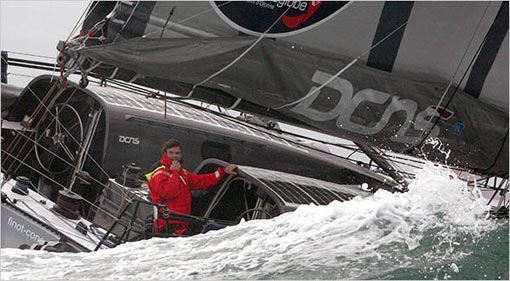
Vendée Globe yacht race: 23k-mile round-the-world alone, non-stop no-assist, via South Pole and back in 60ft monohulls
(quote)
The French do not lack for creativity, and some of it has been expended over the years to develop sports events. The French were the driving force behind the modern revival of the Olympics. They played a vital role in starting soccer’s World Cup and European Cup, which is now better known as the Champions League, and in Alpine skiing’s World Cup. They also dreamed up the Tour de France and the Vendée Globe yacht race.
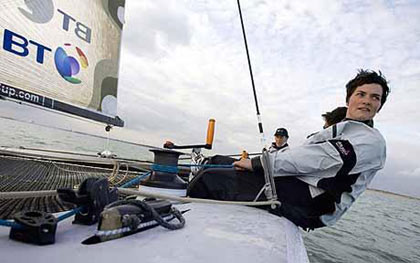
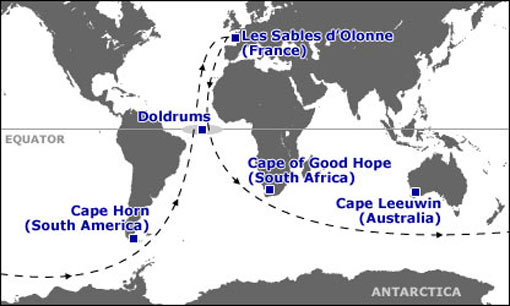
That last event is surely the most obscure. But in France, the Vendée Globe is a major happening - a quadrennial opportunity for Gallic sea dogs and landlubbers alike to reacquaint themselves with the iceberg-infested dangers of the southern oceans and man’s (and woman’s) capacity for salt-stained, sleep-starved solitude. The concept is brutal if attractively simple: competitors race alone around the South Pole and back in 60-foot monohulls without stopping. There are strict limits on outside assistance once the sailors leave Les Sables d’Olonne on the west coast of France.
World first. Ever-restless ocean wave farm generates electricity for 1,500 homes on shore: Pelamis in Portugal

(quote)
Three red snakelike devices bobbing in the waves three miles (4.8 kilometers) off the coast of Agucadoura, Portugal, represent the first swell of what developers hope will be a rising tide of wave power projects. These big metallic sea snakes bobbing in the ever-restless waves of the North Atlantic are generating electricity for over a thousand homes on shore. The world’s most ambitious, working wave farm for generating electricity, it is part of Portugal’s national effort to become energy self-sufficient as Denmark has done since the 1970s oil crisis. Portugal is not a wealthy nation and has no coal or petroleum. So wind and water and sunshine are their favored sources of energy. Portugal is also one nation encouraging local cities to become zero emission communities.

Poem in Art: Of Time long past: And, was it sadness or delight,... - Percy Bysshe Shelley

Like the ghost of a dear friend dead
Is Time long past.
A tone which is now forever fled,
A hope which is now forever past,
A love so sweet it could not last,
Was Time long past.
There were sweet dreams in the night
Of Time long past:
And, was it sadness or delight,
Each day a shadow onward cast
Which made us wish it yet might last -
That Time long past.
- Percy Bysshe Shelley
"Maintain the Gross National Happiness", vows 28-year old Oxford graduate newly crowned the fifth King of Bhutan

(quote)
The United States was not the only country to name a new leader last week. In Bhutan, an insular nation of about 600,000 people located high in the Himalayas, a new king was crowned. 28-year-old Jigme Khesar Namgyel Wangchuck, an Oxford-educated bachelor, was crowned as Bhutan's fifth king - now the world's youngest reigning monarch. Bhutan also has the distinction of being the world's youngest democracy - having held parliamentary elections last March for the first time ever. The young ruler vows to maintain a stance of protection against the worst aspects of globalization, maintaining the "Gross National Happiness", a measurement of national progress that places a high value on spiritual development. Gross National Happiness is a term invented by, and proudly embraced by Bhutanese since 1972.
Above: Bhutan's fourth King Jigme Singye Wangchuck (right) crowns his son Jigme Khesar Namgyel Wangchuck as the fifth King of Bhutan, in the Throne room of the Tashichhodzong Palace during the coronation ceremony in Thimphu, Bhutan on November 6, 2008. With medieval tradition and Buddhist spirituality, a 28-year-old with an Oxford education assumed the Raven Crown of Bhutan on Thursday, to guide the world's newest democracy as it emerges into the modern world.

Contact Us

RSS feed


