You are hereArchive - 2008
Archive - 2008
Graphic novels, all grown up – story-telling art form with both image and text, the medium’s influence rises and broadens

(quote)
In 1969, the American writer John Updike famously declared, "I see no intrinsic reason why a doubly talented artist might not arise and create a comic strip novel masterpiece."
The statement was immediately ridiculed by literary traditionalists, who disparaged comics as a "low" medium unworthy of serious critical attention. But it became a rallying cry among comic book creators, long second-class citizens in the art world.

Forty years has proved their prescience. Graphic novels – usually defined as extended-length illustrated books with mature literary themes – have risen to widespread prominence, spurred on by the work of respected talents such as Art Spiegelman ("Maus: A Survivor's Tale") and Will Eisner ("A Contract With God").
Graphic novel sales in Canada and the United States hit $375 million in 2007, five times the figure reported in 2001, according to ICv2, a pop culture site. "Jimmy Corrigan," a book by Chris Ware, has sold hundreds of thousands of copies alone; "Persepolis," originally a graphic novel by Marjane Sartrapi, picked up an Oscar for best animated film in February.

The world of comics and graphic novels is in the midst of a creative renaissance that may be greater than the dawn of the Marvel Universe in the 1960s. This development has been a longtime coming, considering that the beginnings of both newspaper comics and the cinema occurred at roughly the same time in the late 19th century. Film quite quickly matured into the 20th century's great American art form, while comics remained relatively insular and ignored by adults.

Alternative graphic novels are represented on film as well (Road to Perdition, Ghost World, American Splendor, Persepholis) and are increasingly making their presence felt at traditional book store chains where there are now entire sections devoted to graphic novels as well as manga (Japanese graphic novels, which are another subject entirely).
Generation Next folks currently coming-of-age are almost as conversant about the latest graphic novel as Generation X-ers were about grunge music. The main difference is that graphic novels show no signs of being a temporary trend. Indeed, they may be here to stay, well into the 21st century.
(unquote)

Images courtesy of Marjane Satrapi. Art Spiegelman, Naoki Urasawa, Neil Gaiman, and Evanston Review
Original Source: Christian Science Monitor and Evanston Review


Most threatened species on earth: one third of world’s coral reefs on verge of extinction due to ocean pollution, over-fishing

(quote)
July 10 (Bloomberg) -- A third of the world's corals could be dead within a few years, a shocking new report warns today. The biggest study of its kind has found that 200 out of 700 species of coral are on the brink of extinction - far more than was previously thought. If they die, some of the most beautiful and colourful reefs - home to millions of species of marine life - could be devastated. The speed of decline has shocked the 39 scientists who carried out the survey. Just 10 years ago only 13 species of coral were endangered. Researchers, who published their findings in the journal Science, say they have been badly hit by climate change, coastal development and overfishing.
A team of 39 researchers assessed the state of 704 coral species and found 32.8 percent are threatened with extinction. The study results, published today in the journal Science, are "worse than expected," said co-author Suzanne Livingstone, a marine biologist at Old Dominion University in Norfolk, Virginia. "When we began this process, we didn't think it would be anywhere near as high as that," Livingstone, also a marine species assessor for the International Union for Conservation of Nature, said yesterday in a telephone interview. "Climate change is the overarching threat which comes in on a much larger, global scale," adding to localized disturbances, she said. Death of corals can lead to the collapse of entire ecosystems.

Breakthrough: MIT researchers turn windows into solar panels, 10 times more effective solar power may be available in 3 years

(quote)
Researchers at MIT have created a new way to harness the sun's energy - by turning windows in big buildings into solar panels. The new technology, dubbed solar concentrators, harvests light over a wide area such as a window pane and then concentrates or gathers it at the window's edges, said Marc Baldo, a professor at MIT and head of the effort. Three members of the research team, which is publishing its findings in Friday's edition of Science, are in the process of incorporating a startup called Covalent Solar to develop the technology. The team has spent two years identifying organic dyes, painted onto glass or plastic, that can effectively concentrate the sun’s light onto solar cells, enabling them to produce more electricity from fewer cells.
The dyes basically reflect the light (technically, it’s actually absorbed and then sent back out), so that some of it is trapped inside the plane of glass, said Jon Mapel, a member of the research team. With the help of a scientific principal called "internal refraction," which is the same principal that keeps light trapped in optical fibers, the light bounces to the edges of the glass, which have been equipped with strips of solar cells that convert it into electricity. read more »
Knowledge is a process of piling up facts; wisdom lies in their simplification. - Martin Fischer
Knowledge is a process of piling up facts; wisdom lies in their simplification.
"Matter of survival": 5th-largest oil consumer South Korea restricts energy use to avert full-fledged crisis due to fuel prices

(quote)
SEOUL (Reuters) - South Korea said on Sunday it was implementing a multi-stage contingency plan aimed at reducing energy consumption before the skyrocketing oil prices push Asia's fourth-largest economy into a full-fledged crisis.
Prime Minister Han Seung-soo told a televised news conference the government would restrict driving of cars owned by public organizations as part of the measures, adding a tougher set of steps would be adopted if oil prices rose further. The move marks the first direct restriction on energy consumption introduced by the world's fifth-largest oil consumer since the country imposed some restrictions on transportation in the capital during the 1988 summer Olympics held in Seoul.
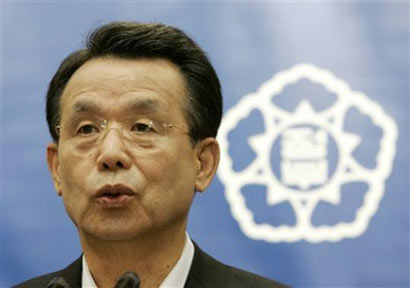
Thousands of public-sector vehicles will be allowed on the road only on alternate days, and air conditioning in government buildings will be restricted, according to Prime Minister Han Seung-soo. The restrictions will be introduced July 15 and will apply to 15,000 public-sector vehicles and more than 800 public offices and institutions. There are also plans to replace half the fleet of public-sector vehicles with compact or hybrid versions by 2012.
"Even the (oil) producing countries are now trying to save energy costs. We need to try twice as hard as they do... it's a matter of survival," Han said. South Korea covers almost all of its energy needs with imports and its economy, relying heavily on manufacturing of goods for exports, lags far behind the more advanced countries in energy efficiency.

"We expect to spend $111.2 billion this year on crude oil imports, up from $60.3 billion last year, due to prices that have more than doubled," Han said. The Finance Ministry cut last week this year's economic growth target to a three-year low of 4.7 percent from 6 percent and warned the country would post its first current account deficit in 11 years of about $10 billion due to high oil prices.
Finance Minister Kang Man-soo told the news conference the country's economic forecasts, based on the assumption of prices at $120 a barrel on average for the second half, would have to be revised further if crude oil continues to gain.
The measures -- restricting driving, raising average temperatures at government-owned buildings, and regulating use of power at public facilities -- would help reduce energy consumption by the public sector by 6.6 percent. But they are still largely symbolic and the total amount of energy saving will be small because they apply only to the public sector, which accounts for less than 4 percent of South Korea's total energy consumption. The government will consider imposing restrictive measures in the private sector only when the supply of crude oil is disrupted.
(unquote)
Photos courtesy of AP Photo/Ahn Young-joon, Chung Sung-Jun/Getty Images
Original Source: Washington Post and United Press International
Up and away in 150 beautiful balloons: US lawn-chair aviator succeeds in 235-mile flight of fancy

(quote)
CAMBRIDGE, Idaho (AP) — Using his trusty BB gun to help him return to Earth, a 48-year-old gas station owner flew a lawn chair rigged with helium-filled balloons more than 200 miles across the Oregon desert Saturday, landing in a field in Idaho. Kent Couch created a sensation in this tiny farming community, where he touched down safely in a pasture after lifting off from Bend, Ore., and was soon greeted by dozens of people who gave him drinks of water, local plumber Mark Hetz said.
"My wife works at the City Market," Hetz said. "She called and said, 'The balloon guy in the lawn chair just flew by the market, and if you look out the door you can see him. "We go outside to look, and lo and behold, there he is. He's flying by probably 100 to 200 feet off the ground. "He takes his BB gun and shoots some balloons to lower himself to the ground. When he hit the ground he released all the little tiny balloons. People were racing down the road with cameras. They were all talking and laughing."
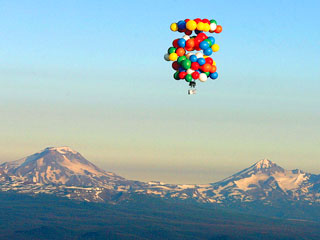
Couch covered about 235 miles in about nine hours after lifting off at dawn from his gas station riding in a green lawn chair rigged with an array of more than 150 giant party balloons.
Sandi Barton, 58, who has lived her whole life in this town of about 300, said she and her brother-in-law were the first ones to reach Couch and shook his hand. "Not much happens in Cambridge," she said, adding that about half the town turned out. "He came right over our pea field," she said. "He was coming down pretty fast." She said Couch gave some of his balloons to local children. It was not clear where Couch went after he landed.

It began after Couch, clutching a big mug of coffee, kissed his wife and kids goodbye, then patted their shivering Chihuahua, Isabella, on the head. After spilling off some cherry-flavored Kool-Aid that served as ballast, Couch got a push from the ground crew so he could clear light poles and soared over a coffee cart and across U.S. Highway 20 into a bright blue sky.
"If I had the time and money and people, I'd do this every weekend," Couch said before getting into the chair. "Things just look different from up there. You've moving so slowly. The best thing is the peace, the serenity... Originally, I wanted to do it because of boyhood dreams. I don't know about girls, but I think most guys look up in the sky and wish they could ride on a cloud." Couch's wife, Susan, called him crazy: "It's never been a dull moment since I married him."
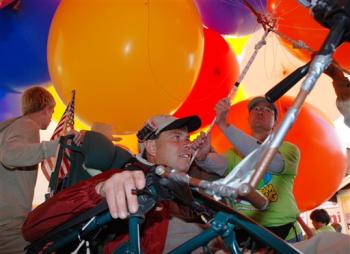
This was Couch's third balloon flight. He realized it would be possible after watching a TV show about the 1982 lawn chair flight over Los Angeles of truck driver Larry Walters, who gained folk hero fame but was fined $1,500 for violating air traffic rules. In 2006, Couch had to parachute out after popping too many balloons. And last year he flew 193 miles to the sagebrush of northeastern Oregon, short of his goal. "I'm not stopping till I get out of state," he said. To that end, he ordered more balloons. Dozens of volunteers wearing fluorescent green T-shirts that said "Dream Big" filled latex balloons 5 feet in diameter, attached them to strings and tied clusters of six balloons each to a tiny carabiner clip. Each balloon gives four pounds of lift. The chair was about 400 pounds, and Couch and his parachute 200 more. "I'd go to 30,000 feet if I didn't shoot a balloon down periodically," Couch said.
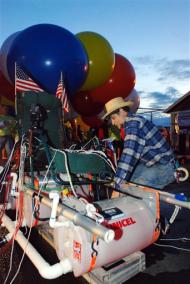
For that job, he carried a Red Ryder BB gun and a blow gun equipped with steel darts. He also had a pole with a hook for pulling in balloons, a parachute in case anything went wrong, a handheld Global Positioning System device with altimeter, a satellite phone, and two GPS tracking devices. One was one for him, the other for the chair, which got away in the wind as he landed last year. For food he carried some boiled eggs, jerky and chocolate. Couch flew hang gliders and skydived before taking up lawn-chair flights. He estimated the rig cost about $6,000, mostly for helium. Costs were defrayed by corporate sponsors.
(unquote)
Photos courtesy of AAP, Aero-News Network, Inc., and AP Photo/Jeff Barnard
Original Source: AP
Cartoons - "Patriot", "Just Us Department", "Provinces of Iraq", "The pilot is extra", disaster response, scooters, GM, and more
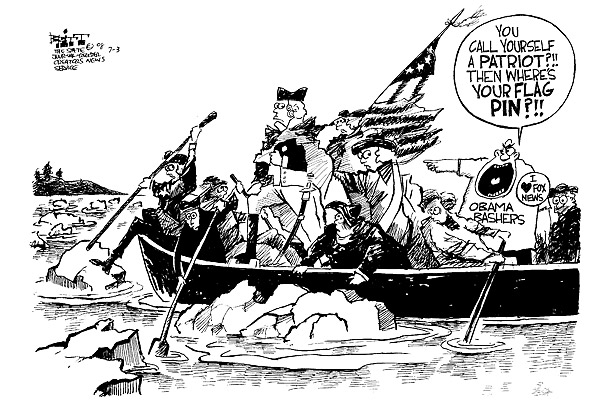

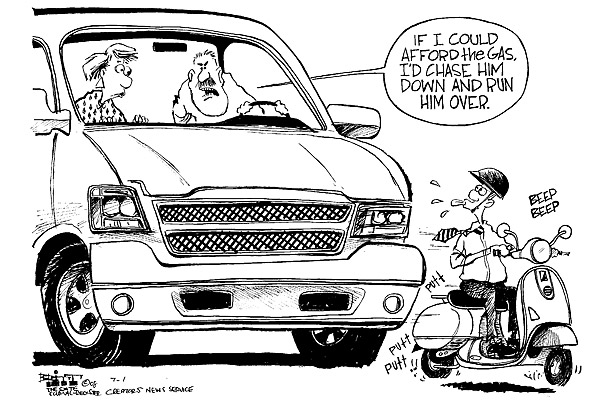

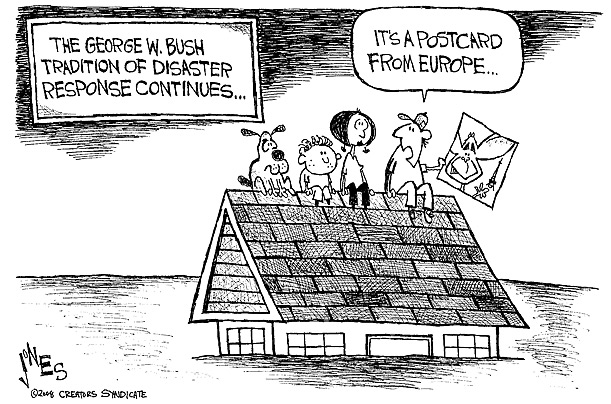
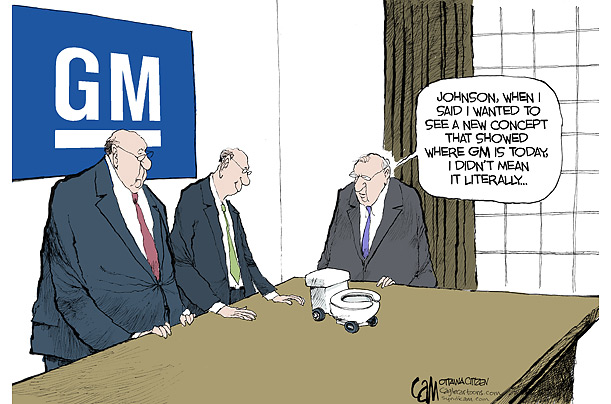
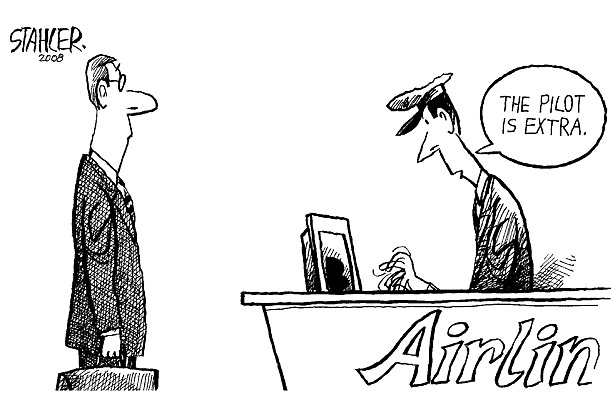
Images courtesy of Britt/State Journal-Register, Britt/The State Journal-Register, Sherttius / Boulder Camera, and CAM/Ottawa Citizen/Copley News Service, Mike Smith/Las Vegas Sun/King Features Syndicate, and Jones/Creators Syndicate
Original Source: Time
Contact Us

RSS feed