You are hereArchive - 2008
Archive - 2008
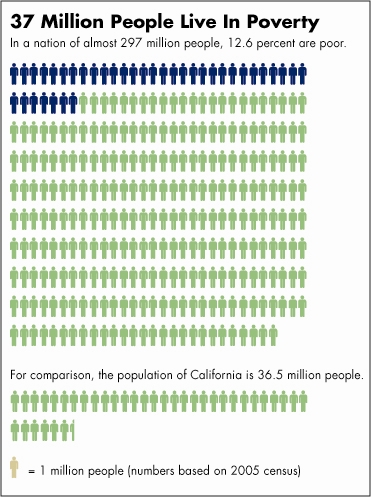
"These truths to be self-evident, that all men are created equal". $656 bil. for Iraq War? or for 37 mil. Americans in poverty?

(quote)
Today marks the birth of a notion as well as a nation
July 4, 2008
By Jerry Davich Post-Tribune metro columnist
"We hold these truths to be self-evident, that all men are created equal, that they are endowed by their Creator with certain unalienable rights, that among these are life, liberty and the pursuit of happiness."
When in the course of human events, it becomes necessary for a pampered, privileged, and not-so-patriotic newspaper columnist to finally take the time to read his nation's most hallowed document, it must seem like a sad state of affairs, I agree. Yet here I am, a 46-year-old Yankee Doodle Davich who not once has read every word in the Declaration of Independence, arguably the most masterfully written political prose of Western civilization. Oh, sure, I can be a patriotic pretender and regurgitate its revolutionary highlights, such as "self-evident truths," "unalienable rights," and "all men are created equal." But what does that all mean in 2008, in a country that went from 2.5 million people in 1776 to 305 million today, with who knows how many here illegally or what that really means?

In a country that riveted its global identity to become the economic leader, only to predictably lose that title to China. Or which has so far allocated $656 billion for the war in Iraq while millions of Americans go without food, health care, and proper education. And a country which only recently experienced its first "mountaintop moment" regarding civil rights, and possibly the not-so-self-evident truth that all men are created equal.
On June 28, 1776, Thomas Jefferson finished drafting the first version of the Declaration of Independence. On June 28, 2008, I began studying the final version in earnest. On July 4, 1776, the Continental Congress adopted the document, and it later served as an autographed preamble for the birth of a nation. On July 4, 2008, I'd like to use this space as a preamble for the birth of a notion: Between the cookouts, parades, and fireworks, how about we pause to reflect how the Declaration has stood the test of time. And what better time, on the nation's 232nd birthday, to spark a conversation of sovereign thought among free people.
What would they think?
I can't help but wonder what our founding fathers would think of America the Bountiful in the 21st century, in all its hope and hype, gore and glory, fakeness and flag-waving.
Would they condemn, condone, or celebrate a racially mixed presidential candidate? Or a middle-aged woman for that matter? Would they embrace or be aghast over the proliferation of guns? Or the recent Supreme Court ruling on the right to bear arms? Would they be surprised or surly over our global trade agreements with other countries, including the $107 billion of trade each year with the United Kingdom, our adversary in 1776, but our sixth-leading trading partner today? These are the questions I asked myself while reading the Declaration and its 56-signature endorsement.
Also, it seems our founding framers' clear, concise, and candid public declaration in 1776 has been replaced by red, white and often untrue political decoration in 2008, an election year. Rhetoric has replaced reasoning. Sound-bites have replaced sound thinking. Image has replaced imagination. Maybe my star-spangled skepticism seems un-American, but I feel there's a thin line between how we praise a "patriot" versus how we torment a "traitor."
Isn't it still our duty to be the watchdog of government, to secure our life, liberty, and pursuit of happiness, and if necessary to indict our leaders, just as the Declaration indicted King George III? Isn't it our duty to question whether our personal freedoms are being protected, protracted, or politically pawned away? Isn't it our duty to reconsider exactly what defines our so-called unalienable rights? Two centuries later, does the term still adhere to our basic human rights, or do we view them as more national than natural?

Who's a patriot today?
And where does the "Creator" still fit into this 232-year-old marriage between church and state? A recent poll showed an overwhelming majority of Americans are "absolutely certain" that God exists, but many of them don't believe in worshipping on a regular basis. Is there a parallel with those same Americans who genuinely believe in democracy but are not absolutely certain about our government?
And what defines a patriot these days, "a person who loves, supports, and defends his or her country and its interests with devotion," according to my dictionary. Or someone who must symbolically wear an American flag pin to prove it?
On the morning of July 4, 1776, church bells rang out when the Declaration was finally, and formally, adopted. But, I discovered, two statesmen ended up not signing it. John Dickinson clung to the idea of reconciliation with Britain, and Robert R. Livingston thought the Declaration was premature. Today I can only wonder about all the statesmen in 21st century America who would have joined Dickinson and Livingston, refusing to put their necks on the line for the birth of a notion, and a nation.
(unquote)
Images courtesy of Getty Images and Center for American Progress, and paintings by Gilbert Stuart and Arnold Friberg
Original Source: Post-Tribune and Center for American Progress


US court order: Google must reveal all users’ information - every user who has ever watched any video on YouTube, worldwide

(quote)
Google expressed disappointment and privacy groups voiced outrage Thursday after a judge ordered Google to give entertainment giant Viacom details of video-watching habits of visitors to its popular video-sharing website YouTube. On Tuesday US District Court Judge Louis Stanton backed Viacom's request for data on which YouTube users watch which videos on the website. Viacom is seeking the data as potential evidence for a billion-dollar copyright suit against Google, which Viacom charges acts as a willing accomplice to Internet users that put clips of Viacom's copyrighted television programs on YouTube.
The US court has ordered Google to hand over the "logging database" which is updated each time a video is watched on YouTube. The database contains the unique login ID of the user who watched it, the time when the user watched it, the IP address (unique online identifier) of the computer used to watch the video and the identifier for the video. The database is stored on live servers at Google and equates to 12 terabytes of storage. The judge also ruled that Google should divulge the details of every video that has ever been removed from YouTube, for whatever reason. If you've ever watched a video on YouTube then the details of that viewing will be stored somewhere in that database. This copyright case might be taking place in the US but it would appear the logging database makes no distinction between users in different countries. read more »
Golden Globes award goes to Angelina Jolie and Brad Pitt and they are expecting twins!

(quote)
Brad Pitt and Angelina Jolie's love for children is by no means limited to their own: The couple has donated $1 million to help kids affected by the war in Iraq, the Education Partnership for Children of Conflict announced.
The organization will distribute the donation, made through the couple's Jolie-Pitt Foundation, to four organizations working on behalf of children who have lost parents, homes and schools in Iraq. Children in the U.S. who have lost parents in the conflict will also benefit.
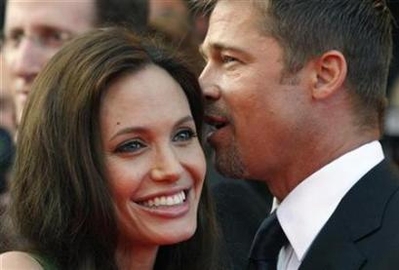
"These educational support programs for children of conflict are the best way to help them heal," said Jolie in a written statement from Education Partnership for Children of Conflict, which she co-chairs.
"We hope to encourage others to give to these great organizations," Pitt added in the statement.

The Jolie-Pitt Foundation has given $500,000 to three groups in the war-torn country which will provide aid for some 5,700 children, said the Education Partnership for Children of Conflict. read more »
Electric and fuel-sipping scooters, cute and cool win favors. When market changes, so does a driver's heart

(quote)
Imagine filling up your gas tank for less than $15. Some Americans are doing it — and they're doing it on two wheels.
Motorized scooters have emerged as the new transportation of choice for some Americans fed up with gas prices that have surged past $4 a gallon. Though the small, zippy vehicles aren't ideal for every purpose, some owners say they're great for short trips and running errands.
Chris Maxwell recently purchased a Yamaha Majesty scooter to ride around the small town of Natchez, Miss. His wife, Emily Maxwell, appreciates how much the couple saves on gas purchases. "It gets 50 to 60 miles a gallon in town and a full tank lasts two to three weeks," she said. "Right now it costs under $12 to fill it up, so we immediately get a $200 a month 'pay raise' from the lower fuel costs."

Shawn Pointer, of Kenosha, Wis., said he often straps in his four-pound Chihuahua, Missy, for rides down to a local river on his 2007 Honda Metropolitan. Pointer bought the blue and white scooter for $1,600 but pays only about $10 a month to fill its 1.2 gallon tank. The scooter gets roughly 100 miles a gallon so he can travel 120 miles for $4. The same trip in the typical car would cost nearly $18. read more »
History in less than 2 minutes in Olympic sport - Natalie Coughlin snatches back the world record of 100-meter backstroke
(quote)
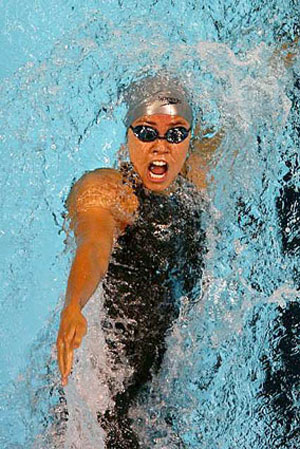
OMAHA - Call it the one-heat world record. For about two minutes, Hayley McGregory was on the top of the world. Swimming in the second-to-last heat of the preliminaries for the 100-meter backstroke at the United States Olympic Trials, the 22-year-old from Texas clocked a 59.15, breaking the world record by .06 seconds.
When McGregory made the turn at 50 meters on world-record pace, the Qwest Center crowd got firmly behind her, cheering loudly. Natalie Coughlin, whose record McGregory broke, was standing over McGregory’s lane as she finished, getting ready to race in the final heat. The plan was for Coughlin, who this year has recorded three of the five all-time fastest times in the event, to conserve her energy and deliver a nice, easy performance, maybe a second or so faster than her personal best.
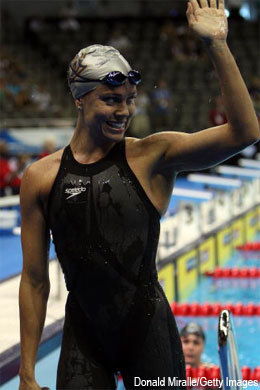
When Coughlin saw McGregory’s time, she switched gears. Swimming with a sense of urgency seldom seen from a top swimmer early in the day’s heats, the 25-year-old Coughlin one-upped McGregory with a time of 59.03. McGregory will go down as the world-record holder for less than two minutes. "Not even a whole minute, really," McGregory said with a chuckle. "It’s still awesome." Looking ahead to Monday night’s semifinal, she said, "I’m really excited to race next to her."
The top 16 finishers will race again Monday night, after which the field will be pared to eight finalists, who will compete Tuesday for the two berths to Beijing. "I was planning on going a lot easier this morning," said Coughlin, the gold medalist in the 100 backstroke at the 2004 Olympics with a time of 1:00.37. McGregory’s swim, she said, "gave me motivation to swim a little faster than I was originally planning." Coughlin, a Californian who came into the race with five of the 10 fastest swims in the event, looks at the 100 backstroke as her baby. She wasn’t going to let somebody take it from her without putting up a fight. "I didn’t really want her to have it long," Coughlin said. After all, Coughlin had held the mark uninterrupted since 2002 when she became the first woman to break the minute barrier in this event, going 59.58 six years ago.

Either Coughlin or McGregory, or both, could conceivably take the record down even more in the semifinals later tonight. McGregory may have popped up on Coughlin's radar in a big way, but the 22-year-old from Longhorn Aquatics in Texas is no pretender, having shown sub-minute speed in the event, going 59.46 at a meet in Austin earlier this month. She started her career at the University of Texas, transferred to USC and found herself a bit adrift when the program changed hands from Mark Schubert to Dave Salo when Schubert joined USA Swimming.
The rest of morning preliminaries went to form. Jessica Hardy (1:06.85) of Trojan Swim was the fastest qualifier in the 100 breaststroke, edging her teammates Rebecca Soni, who went 1:06.90. In the men's 100 backstroke, Randall Bal had the fastest time in 53.28. World-record holder and Nike endorser Aaron Peirsol, who experimented with Speedo's LZR Racer, was sixth in the 100 backstroke, going 54.14. "The way everyone's swimming, it looks like it's not that big a deal anymore," Peirsol said, joking of the four world records set here in less than two days.
(unquote)
Photos courtesy of Al Bello, Donald Miralle/Getty Images, and KCRA
Original Source: NY Times and LA Times
Fuel change breakthrough: biodiesel-powered speedboat Earthrace, around world in 60 days, beats record set in 1998 by 14 days

*Update Jan 6 2010* - Blue Roses to Earthrace Ady Gil: 100% biofuel, spirit of ocean, stands for life, saves crew, sunk by whaler, rests in sea...
(quote)
Team Earthrace, led by New Zealand Skipper Pete Bethune, has smashed the world circumnavigation record for a speedboat by almost 14 days. Almost five years of preparation, planning and two record attempts have paid off leaving the bio-diesel powered Earthrace team to claim the round the world speedboat record.
Possibly the coolest powerboat on the planet, the space age, wave piercing trimaran Earthrace took bio-fuel into history as the 78 foot, (24 metre) boat crossed the 'Round the World' finish line in Sagunto, Spain. In just 60 days Earthrace has powered almost 24,000 nautical miles around the world. Earthrace left Spain on Sunday April 27th at 14:35 local time (1325 GMT) and headed west on the long voyage around the world. The previous record for a powerboat to circumnavigate the globe was 74 days 20 hours 58 minutes 30 seconds, set by the UK boat ‘Cable & Wireless Adventurer’ in 1998.

"Necessity, who is the mother of invention." - Plato
Necessity, who is the mother of invention.
Contact Us

RSS feed


