You are hereBlogs / WcP.Story.Teller's blog / Dolphin & Whale more like people than we thought: Curious, playful, affectionate, sharing things, blowing water jets
Dolphin & Whale more like people than we thought: Curious, playful, affectionate, sharing things, blowing water jets
*Update 12 March 2013*
Christopher Swann, a cetacean novice, 'whale whisperer' - dances with whales 'Minkes are the smallest of the great whales but they still grow to a length of 30ft and weigh 7 tons... Orcas, or killer whales, are 8-ton sea monsters with dorsal fins like dinghy sails - lords of the sea at the top of the food chain, gladiatorial figures in black shining armour, cleaving the waves with dorsal fins as symbolic as the scythe of the Grim Reaper.’ Swann once followed a group of killers for 14 hours. Food and drink were irrelevant. The sun scorched his eyes and he felt himself drawn irresistibly into their world. 'As would happen many times there-after,’ he says, 'I simply became a whale.’
*Update 22 October 2012*
Listen: Beluga whale 'makes human-like sounds Researchers in the US have been shocked to discover a beluga whale whose vocalisations were remarkably close to human speech. While dolphins have been taught to mimic the pattern and durations of sounds in human speech, no animal has spontaneously tried such mimicry. "Our observations suggest that the whale had to modify its vocal mechanics in order to make the speech-like sounds," said Sam Ridgway, president of the National Marine Mammal Foundation and lead author on the paper. "The sounds we heard were clearly an example of vocal learning by the white whale."
*Update March 09, 2012* - 30 Dolphins stranded in Brazil and incredibly saved! Extremely rare event!
Robin Williams with dolphins in the wild
The historical origins of ‘whales as people’. In 1850, an anonymous letter, now known to have been penned by a Nantucket whaling captain, written in the voice of a polar whale pleading for it’s species survival, was published in the Honolulu Friend, stating:
I write in behalf of my butchered and dying species. I appeal to the friends of the whole race of whales. Must we all be murdered? Must our race become extinct? Will no friends and allies arise and revenge our wrongs?"
(quote)
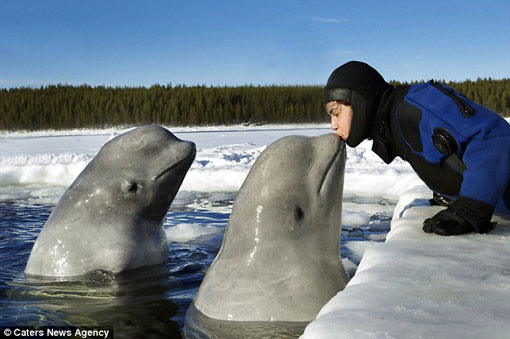
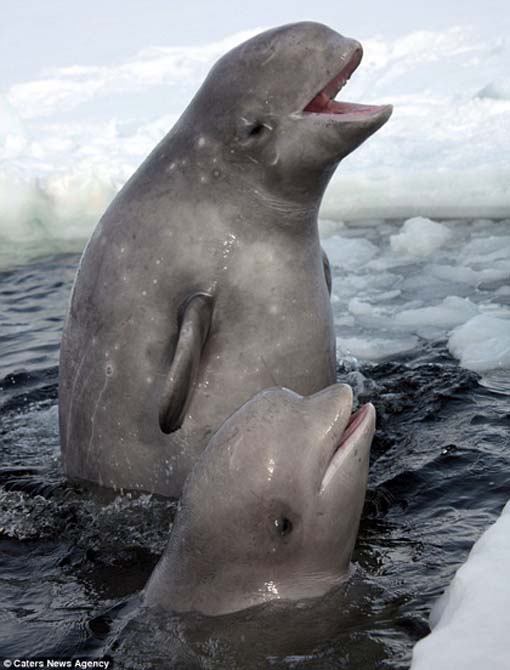
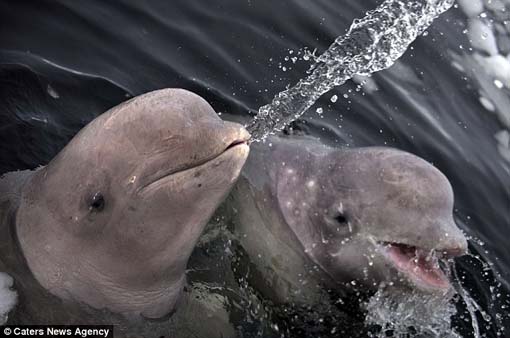
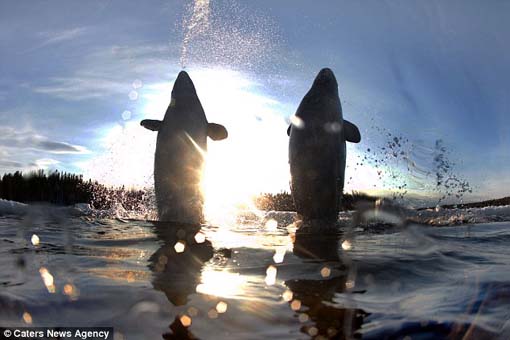
Wildlife photographer Dafna Ben Nun braved temperatures of minus 2 degrees to photograph the beautiful creatures in the White Sea, north-west Russia. The white beluga whales - which weigh around 3,000 lbs and measure up to 12 foot long - can be seen amazingly blowing water jets from their mouths.
The 31-year-old photographer spent almost an hour in the water with the two female whales. She said: 'If they don't want to do something they won't, but they are so friendly, I was playing with them and then they just starting spouting the water from their mouths, it was very funny. When you get in the water with them they are very curious and kept coming up to my camera. If I held onto their nose they would even lift me out of the water.'
The historical origins of ‘whales as people’
In an attempt to garner attention and raise awareness regarding the problematic use of orcas and other marine mammals in captivity for entertainment, PETA, an animal rights group, has sued Sea World, a corporation that builds and manages aquariums and marine parks. PETA is suing Sea World for violating these oceanic dolphin’s constitutional rights under the 13th amendment.
The 13th amendment to the United States Constitution explicitly outlaws slavery or involuntary captivity:
Section 1. Neither slavery nor involuntary servitude, except as a punishment for crime whereof the party shall have been duly convicted, shall exist within the United States, or any place subject to their jurisdiction.
Section 2. Congress shall have power to enforce this article by appropriate legislation.
PETA’s argument is that the 13th amendment doesn’t specifically apply to human beings, and that keeping marine mammals in captivity is tantamount to slavery. Jason Goldman has a good write-up on why this is not a 13th amendment issue. What most of the commentary is missing, and what Goldman missed the mark on, is that the 13th amendment is written in such a way as to not explicitly refer to people precisely because any institutionalized system of slavery necessitates the dehumanization of the slave class, so as a function of the nature of slavery, slaves must be thought of as less than human. The question PETA raises, and one that I will not be addressing here, is how far does the 13th amendment extend?
Whales and dolphins are intelligent, social animals, and the idea that they are sufficiently advanced enough to be considered for person-hood is not new. Last year, several groups argued that dolphins should be considered non-human persons and given a certain degree of legal protection. This ignores the fact that, thanks to the Marine Mammal Protection Act, whales and dolphins currently do have more legal protection than any other non-primate animal.
The idea the whales and other marine mammals have a special position near humans on the scale of consciousness and intelligence is much older than this recent revival. As far back as 1850, people, specifically whalers, were making the argument that whales were more like people than we thought. In 1850, an anonymous letter, now known to have been penned by a Nantucket whaling captain, written in the voice of a polar whale pleading for it’s species survival, was published in the Honolulu Friend, stating:
I write in behalf of my butchered and dying species. I appeal to the friends of the whole race of whales. Must we all be murdered? Must our race become extinct? Will no friends and allies arise and revenge our wrongs?
Ironically, it was the whalers who first rose the alarms about the future of whale species. At this point in history, the Steller Sea Cow had already gone extinct, the Atlantic Right Whales were no longer abundant enough to justify a hunt, and the whaleships of Nantucket and New Bedford, once able to fill their holds with oil during a 3 month voyage, were now at sea for up to three years and regularly circumnavigating the world in a hunt for the last few whales. The thoroughly western concept that whales are not only equal to humans, but in some cases surpass us, has its philosophical roots in the most American of all novels, where the great white whale is not only just an equal to the captain and crew of the Pequod, but god himself, Moby Dick. This complex and compelling personification of an individual whale has woven itself into American literature and history forever altering our collective understanding of the whale.
*Update Sept 2, 2012*
MIAMI - Veterinarians fed fish drinks to five rescued pilot whales Sunday and kept a close eye on them, trying to nurse the mammals back to health so they can one day return to the ocean. The five whales were among a group of 22 whales beached in South Florida on Saturday. The rest died of natural causes or had to be euthanized.
The two calves and three juveniles were brought to Florida Atlantic University’s Harbor Branch Institute for rehabilitation. Experts said the animals were worn out, but mostly doing well. Several organizations were working together to care for the whales. About 10 people monitored them around the clock and one person was assigned to each whale to watch it constantly. The whales are being fed fish smoothies through a feeding tube every four hours.
Wildlife experts believe the youngest whale - a female under the age of 2 - was still nursing. Her mother did not survive. “The baby is swimming around the group, calling and whistling for the mother, so we’re working to become the mom,” said Stephen McCulloch, Harbor Branch program manager. Experts are teaching her to drink formula from a bottle.
Davis said it was not clear why the whale pod stranded at Avalon Beach State Park in St. Lucie County. Allison Garrett, a spokeswoman for the National Oceanic and Atmospheric Administration’s fisheries service, said it’s possible one of the animals became sick and the rest of the pod followed it onshore.
“They won’t leave (a sick whale). They’ll stay together,” she said.
Almost thirty whales have been washed ashore near to a Scottish fishing town. Eighteen pilot whales are believed to have died on a beach near Anstruther in Fife, while another ten - including three pups - were stranded on the shore. The whales became stranded early on Sunday morning, with Fife Coastguard being called to the incident just after 7am. The surviving animals were being cared for by animal welfare workers, who hoped that the afternoon's high tide would carry them back out to sea.
The tide came in at 4.23pm on Sunday, and the whales were kept wet until then by more than 30 volunteers from the British Divers Marine Life Rescue (BDMLR). Local vets and the Scottish SPCA were also in attendance. Around 4.30pm, ten of the whales were re-floated in the water, but two became stranded again. A spokeswoman from the BDMLR said they were "hopeful" for the eight pilot whales that are still in the water and would monitor them for the next 24 hours. Fears have also been raised about another 24 pilot whales which are in shallow water three miles along the coast at Cellardyke.
Experts believe the whales might have come ashore in a group because of their social behaviour. Pilot whales will not leave a wounded or sick member of their school, and it is thought that the animals might have followed one such whale onto the shore and become stranded.
A spokeswoman for the Fife Coastguard said: "It is a very rare occurrence in Scotland and very sad. "The usual scenario would be that the whale that is leading the group has become ill, or has lost its way, and gets beached and the rest will follow on. Although we do not know for sure if that is what has happened.
(unquote)
Photos courtesy Caters News Agency


Contact Us

RSS feed