You are hereBlogs / WcP.Story.Teller's blog / Once upon a time: Christmas celebration outlawed in Boston; anyone exhibiting Christmas spirit fined 5 shillings
Once upon a time: Christmas celebration outlawed in Boston; anyone exhibiting Christmas spirit fined 5 shillings

(quote)
Christmas is the most popular holiday of the year in the whole world. About 400 millions people celebrates Christmas holiday each year in winter. In the early 17th century, a wave of religious reform changed the way Christmas was celebrated in Europe. When Oliver Cromwell and his Puritan forces took over England in 1645, they vowed to rid England of decadence and, as part of their effort, cancelled Christmas. By popular demand, Charles II was restored to the throne and, with him, came the return of the popular holiday. The pilgrims, English separatists that came to America in 1620, were even more orthodox in their Puritan beliefs than Cromwell. As a result, Christmas was not a holiday in early America.

From 1659 to 1681, the celebration of Christmas was actually outlawed in Boston. Anyone exhibiting the Christmas spirit was fined five shillings. By contrast, in the Jamestown settlement, Captain John Smith reported that Christmas was enjoyed by all and passed without incident. After the American Revolution, English customs fell out of favor, including Christmas. In fact, Congress was in session on December 25, 1789, the first Christmas under America’s new constitution.
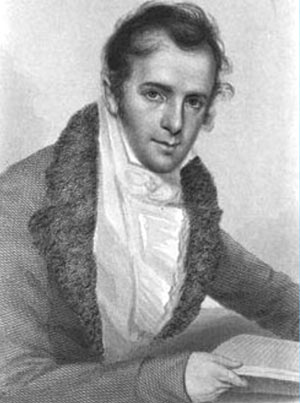
Christmas wasn’t declared a federal holiday until June 26, 1870 It wasn’t until the 19 century that Americans began to embrace Christmas. Americans re-invented Christmas, and changed it from a raucous carnival holiday into a family-centered day of peace and nostalgia. The early 19th century was a period of class conflict and turmoil. During this time, unemployment was high and gang rioting by the disenchanted classes often occurred during the Christmas season.
In 1828, the New York city council instituted the city’s first police force in response to a Christmas riot. This catalyzed certain members of the upper classes to begin to change the way Christmas was celebrated in America. In 1819, best-selling author Washington Irving wrote The Sketchbook of Geoffrey Crayon, gent., a series of stories about the celebration of Christmas in an English manor house. The sketches feature a squire who invited the peasants into his home for the holiday. In contrast to the problems faced in American society, the two groups mingled effortlessly.
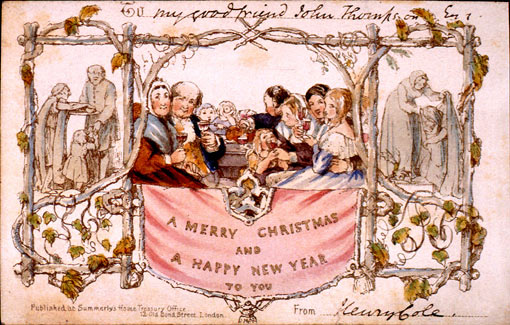
What is believed to be one of the first mass-produced Christmas cards -- dating back more than 160 years. The lithographed card caused a controversy in some quarters of Victorian English society when it was published in 1843 because it prominently features a child taking a sip from a glass of wine. Approximately 1,000 copies of the card were printed but only 10 have survived to modern times. Bridwell Library acquired its copy in 1982. The card was designed for Henry Cole by his friend, the English painter John Calcott Horsley (1808-1882). Cole wanted a ready-to-mail greeting card because he was too busy to engage in the traditional English custom of writing notes with Christmas and New Year's greetings to friends and family. The card pre-dated color printing so it was hand-colored. The card is divided into three panels with the center panel depicting a family drinking wine at a celebration and the flanking panels illustrating charitable acts of feeding and clothing the poor. The greeting reads: "A Merry Christmas and a Happy New Year to You." Cole, who also wrote and published Christmas books, printed more cards than he needed so he sold the extra cards for one shilling each. Bridwell Library's card was signed by Cole and addressed to the engraver of the card, John Thompson (1785-1866).
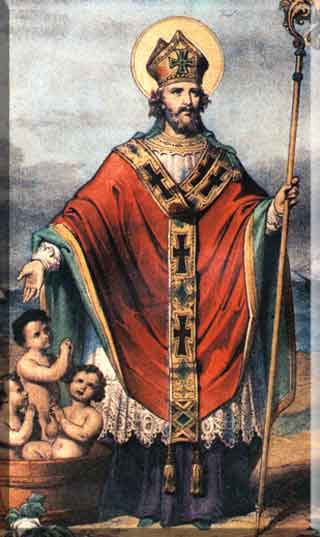
The figure of Father Christmas (Santa Claus) is based on Saint Nicholas, who became one of the youngest bishops ever at age 17. At age 30 he became the Bishop of Myra, a port town on the Mediterranean Sea, that is part of modern-day Turkey. He hailed from a rich home and became well known for supporting the needy. He would often be seen, clad in bishop's robes and riding on a donkey, handing out gifts to children. During the Middle Ages, many churches were built in honour of Saint Nicholas. In the 11th century, his remains were enshrined in a church in the Italian city of Bari. It is told that the first Crusaders visited Bari and carried stories about Nicholas to their homelands. The anniversary of his death, 6 December, became a day to exchange gifts.
During the Protestant Reformation of the 16th century, Martin Luther tried to stop the worship of saints, and the feast of Saint Nicholas was abolished in some European countries. The gift giver took on other names: in Germany, he became Der Weinachtsmann ("Christmas Man"), Père Noël in France, Father Christmas in Britain and the colonies. The Dutch, under Peter Stuyvesant, founded New York - named New Amsterdam under the Dutch and renamed when the British took over the colony - and brought with them the celebrations of Sinterklaas, the Dutch name for Saint Nicholas. Santa Claus is the American pronunciation of Sinter Klaas.
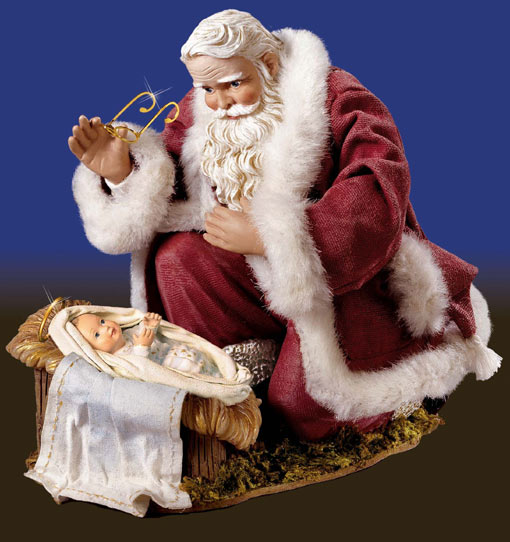
In Brazil, Spain and Peru, he's called Papa Noel.
In Italy he is known as Babbo Natale.
In France, he's known as Pere Noel.
In Germany, he is known as either Christindl, or the Christ Child.
In Morocco he is known as Black Peter.
In the Netherlands, he is called Kerstman.
In Finland, he is called Joulupukki.
In Costa Rica, Colombia, and parts of Mexico, the gift bearer is el Niño Jesus, "the infant Jesus."
(unquote)
Images courtesy of sigrid, Stacey / north-pole-christmas.com, fcahomeschool.com, SMU, The St. Nicholas Society, Bridwell Library, and funfacts.com
Original Source: Christmas History Blog, funfacts.com, and funandgames.org (Information courtesy of Ask Jeeves at www.ask.co.uk)


Contact Us

RSS feed


What a great post. From where do you collect such good knowledge.
Yes, I agree with your comment.
Regards.
Excellent website you have here: so much cool information!..
Have you ever consider some kind of writing service like https://www.apexessays.com/">pay to write my essay. I know many of you didn't head of that kind of service but that exist.
Christmas is both a sacrosanct religious occasion and an overall social and business marvel. For two centuries, individuals around the globe have been watching it with conventions and practices that are both religious and mainstream in nature. Christians observe Christmas Day as the commemoration of the introduction of Jesus of Nazareth, an otherworldly pioneer whose lessons frame the premise of their religion.
Christmas is the time of the enjoyment and it is the day when you think about the good and bad deeds. It is the day when you strongly decided to work good deed so that people appreciate or recognized you because of the good deed. Your https://www.rushessaya.com/">rushmyessay article is so amazing in which you mention all the history of the Christmas.
Christmas is the name of the celebration in which you feel happy and it is all about to love. The love for the Christ Jesus and remind the good deeds. It is the day when you decorate your whole house and streets. In this event, all the people can use https://topaussiewriters.com/">essay promotional codes for getting special discounts.
Christmas is a time to celebrate it with family and friends and show their love for the God. It is the time to remind the memory of the birth of the Jesus Christ and get https://essayshop.biz/index.php?route=product/product&product_id=55">rush essays who do something good for the better life and help to each other. But it is the great history of the Christmas and I feel like amazing.
Good to read :)
the christmas is not fulfilled without a wine that stored in a best wine coolers
This blog gives the history of the Christmas. I have heard lots of things about the event of the Christmas which comes every year in December. The community of the Christian celebrates this https://www.bestessay.org/">best essay with event because it is the birthday of the Jesus Christ. This is the good information which helps me lots.
Christmas is an event in which every person can enjoy with specific ways. The season is that it has religious importance and everybody celebrate this event with family and complete all the conditions to celebrate this event. This post is a religious and worthy to me because it has the history related to the Christmas and I want to know about https://www.bestessay.org/">bestessay all this event. And it's my passion of my life.
Christmas is the event in which we celebrate it with full of spirit and courage. When the event of Christmas comes means it’s a time to rejoice and full of fun. We should learn about the history so that we know about our ancestor and how they celebrate the Christmas event. According to me, the article is very good. Get https://essaymama.org/">cheap essays service from our trusted service to manage all type of work.
Christmas is the best celebration events that everyone enjoy with best method but here I find Christmas spirit fined 5 shillings that help me a lot to understand this topic. This https://nsw-writers.com/">website is the best way of providing great knowledge to complete the task.
You are doing an amazing job.
I am too much glad to see this article that Prince William doing a great social work for all homeless people. This is really good efforts to help poor people and I really impress his personality and appreciate for this great work. I suggest you to read https://www.writemyessay-site.com/">write my paper reviews which I gave while getting the online assistance of writers.
your articles are constantly awesome. You compose with exactness and your data is constantly precise. What's more, those two things make an article go from great to awesome! Continue distributing more extraordinary articles. https://livehealthyalways.com/pregnancy/6-weeks-pregnant-ultrasound/">6 weeks ultrasound picture By the way i am looking for some pregnancy blogs because i just found that i am pregnant and i just found it.
Good