You are hereScience & Technology
Science & Technology
Beyond Blogs - How Blogs, Wikis, and Social Media Have Changed the Way Businesses Work
Original Source: BusinessWeek
(quote)
...blogs, it turns out, are just one of the do-it-yourself tools to emerge on the Internet. Vast social networks such as Facebook and MySpace offer people new ways to meet and exchange information. Sites like LinkedIn help millions forge important work relationships and alliances. These social connectors are changing the dynamics of companies around the world. Millions of us are now hanging out on the Internet with customers, befriending rivals, clicking through pictures of our boss at a barbecue, or seeing what she read at the beach. It's as if the walls around our companies are vanishing and old org charts are lying on their sides.
This can be disturbing for top management, who are losing control, at least in the traditional sense. Workers can fritter away hours on YouTube. They can use social networks to pillory a colleague or leak secrets. That's the downside, and companies that don't adapt are sure to get lots of it. But there's an upside to the loss of control. Ambitious workers use these tools to land new deals and to assemble global teams for collaborative projects. The potential for both better and worse is huge, and it's growing—and since 2005 the technologies involved extend far beyond blogs. read more »
Scientists Observe Birth of a Supernova, Captured on Camera For the First Time
Original Source: Spaceflight Now
(quote)
PRINCETON, NJ -- When she peered into the screen of her computer one day in January, Alicia Soderberg was supposed to see a small, dull glowing smudge in one corner, the evidence of a month-old supernova that would help her better understand the mystery of these huge exploding stars. What the Princeton University astronomer saw instead was anything but dull. As Soderberg and Edo Berger, a postdoctoral research associate at Princeton, studied the X-ray emissions conveyed from space by NASA's Swift satellite, they saw an extremely bright light that seemed to jump out of the sky. They didn't know it, but they had just become the first astronomers to have caught a star in the act of exploding. The once-in-a-lifetime event, described in a paper published in the May 22 issue of Nature, has transfixed the worldwide astronomical community.
Soderberg and Berger wanted to observe a supernova known as SN 2007uy in the spiral galaxy NGC 2770, located 90 million light years from Earth in the constellation Lynx. They could plan to do that because they are able to view images captured by the telescope a few hours after the observation merely by downloading the data from the Swift website. The sudden appearance nearby of the X-ray burst of the newer supernova, easily captured by the NASA satellite with multiple instruments that can detect gamma rays, X-rays and ultraviolet light, has set scientists on a new path. "This phenomenon had been predicted more than 30 years ago, but is now observed for the first time," said Roger Chevalier, the W.H. Vanderbilt Professor of Astronomy at the University of Virginia. "These are the earliest observations of light from a supernova after the central collapse that initiated the explosion."
In the Nature paper, Soderberg and 38 colleagues show that the energy and pattern of the X-ray outburst is consistent with what scientists would have expected to see in the birth of a neutron star -- a shock wave blasting through the surface of the original massive star. Until now, astronomers have only been able to observe supernovae brightening days or weeks after the event, when the expanding shell of debris is energized by the decay of radioactive elements forged in the explosion.
(unquote)
Photos Courtesy of AFP and NASA/Swift Science Team/Stefan Immler



EU: Google Maps Street View vs. privacy laws - people walking in street captured by photos
Original Source: BusinessWeek
(quote)
Global search engine colossus Google has been warned by the EU data protection chief that the "Street View" feature on its Google Maps service could run up against European privacy laws if it launches in EU countries. Peter Hustinx, the EU data protection supervisor, told reporters while presenting his annual data protection report on Thursday (15 May) that if Google launched such a feature in Europe, the company would first have to comply with European privacy legislation, which in many member states is stricter than in the United States.
Street View allows users of Google's online map service to have a full-colour, 360-degree look around city streets. Users can digitally walk up and down the virtual street, which is built from composites of photographs taken by roaming Google cars with roof-mounted cameras. The service, already launched for many US and Canadian cities, has wowed users, who report that Street View allows them to digitally make a trip to cities they have always wanted to visit. At the same time, privacy concerns have arisen, as people walking down a street are also captured by the photographs.
"Complying with European data protection law is going to be part of their business success or failure," Mr Hustinx added. "If they would ignore it, it is likely to lead to [court] cases, and I think they would be hit hard." The company has not launched the service in Europe yet, although it has announced plans to do so next year, and Google cars snapping away photos of the vias and rues of Rome and Paris have already been spotted. read more »
Verizon Wireless joins LiMo Foundation, chooses Linux over Android for mobile platform
Original Source: Ars Technica
"Mobile carrier Verizon Wireless has joined the Linux Mobile (LiMo) Foundation and has announced plans to adopt the open source software platform. Linux-based phones will be available from Verizon next year, alongside other devices that run competing proprietary operating systems.
The LiMo Foundation is an industry group that was founded by leading handset makers. Their goal is to collaboratively develop a comprehensive Linux-based mobile software stack that can be modified easily and used at no cost on a wide range of hardware devices. Key members include Motorola, NEC, NTT DoCoMo, Panasonic, Samsung, and LG.
Verizon's adoption of Linux sends a clear message about the viability of the open source operating system in the mobile space. Carriers and handset makers seem to recognize that open source software provides them with better value and more flexibility than proprietary alternatives."


Polar Bear Declared Endangered Species

(quote)
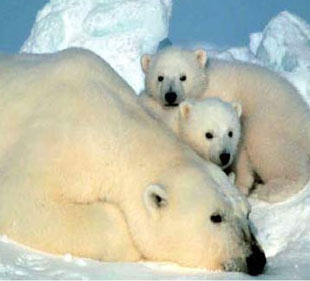
The U.S. Department of the Interior Wednesday listed the polar bear as a threatened species under the Endangered Species Act (ESA) of 1973 based on evidence that the animal's sea ice habitat is shrinking and is likely to continue to do so over the next several decades. Interior Secretary Dirk Kempthorne, however, made clear several times during a press conference announcing the department's decision that, despite his acknowledgement that the polar bear's sea ice habitat is melting due to global warming, the ESA will not be used as a tool for trying to regulate the greenhouse gas emissions blamed for creating climate change.
The decision was based on evidence that sea ice is vital for polar bear survival, that this sea ice habitat has been reduced, and that this process is likely to continue; if something is not done to change this situation, the polar bear will be extinct within 45 years, Kempthorne said. He pointed to computer models he and his colleagues studied that project a 30 percent decline in sea ice by 2050. read more »
8 Ideas to Fix the Global Food Crisis
(quote)
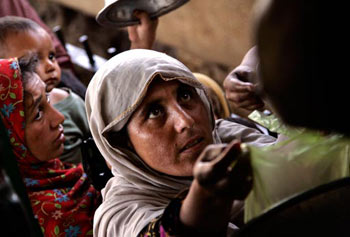
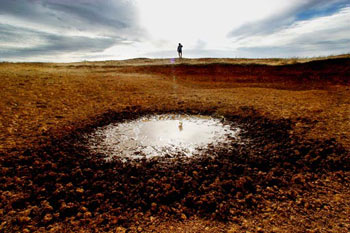
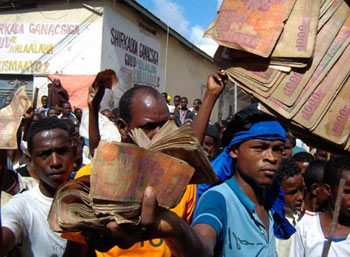
The world food crisis has two faces. Here in the United States, shoppers stare in disbelief at the rising price of milk, meat, and eggs. But elsewhere on the globe, anguish spills into the streets, as in Somalia last week when tens of thousands of rioters converged on the capital to protest for food.
The strain on U.S. consumers, grappling with the sharpest increase in grocery prices in years, is small compared with the starvation that toppled Haiti's government, ignited riots around the world, and is deepening the tragedy of Myanmar's cyclone survivors. And yet the connection between the developed and developing worlds will be crucial to solving what one United Nations official has called a "silent tsunami" of food prices that has plunged 100 million people deeper into poverty. To stem the misery, relief officials are calling both for emergency aid and for changes in policy worldwide.
...Among the proposed solutions: read more »
- Take a Pause on Biofuels
- Improve Food Aid
- Produce Higher Yields
- Grow Better Crops
- Curb the Speculators
- Break Down Trade Barriers
- Eat Less Meat


Contact Us

RSS feed