You are hereScience & Technology
Science & Technology
U.S. Senator Edward M. Kennedy undergoes successful brain surgery
(quote)
After investigating his options with his trademark intensity, Sen. Edward M. Kennedy underwent 3 1/2 hours of risky and exquisitely delicate surgery Monday to cut out as much of his cancerous brain tumor as possible. "I feel like a million bucks. I think I'll do that again tomorrow," the 76-year-old Massachusetts Democrat was quoted by a family spokeswoman as telling his wife immediately afterward.
The sole surviving son of America's most glamorous and tragic political family was diagnosed last month with a malignant glioma, an often lethal type of brain tumor discovered in about 9,000 Americans a year. Cutting a tumor down to size — or "debulking" it — is extremely delicate because of the risk of harming healthy brain tissue that governs movement and speech. But Friedman, who is the top neurosurgeon at Duke and an internationally known tumor surgeon, said Kennedy should not experience any permanent neurological effects. Doctors said Kennedy was awake for much of the surgery, which begins with opening the scalp and removing a piece of the skull to expose the brain. Sometimes, to avoid damaging areas that control speech, surgeons use a probe to stimulate parts of the brain, then hold a conversation with the patient.
Monday's operation "spells nothing but hope," Duke's Sampson said from Chicago, where he was attending a conference of 30,000 cancer specialists. "What we're seeing with the surgery and this conference is that there's hope for patients with this kind of cancer."
(unquote)
Photos courtesy of AP Photo/Getty Images


Pushing the Edge of Science - Growing Electronics with Viruses, Finding Alien Life, and Quantum Cryptography
(quote)
Angela Belcher
Edge work: “Programming” viruses to perform useful tasks
Why? It is clean and efficient.
Where? MIT
Initial response: “I was called insane.”
In a series of experiments at MIT, Belcher, working with a team of about 30 students and postdocs, has successfully programmed viruses to incorporate, then grow, a variety of inorganic materials, including nanoscale semiconductors, solar cells, and magnetic storage materials. Separately, she is using yeasts as scaffold organisms because of their ability to grow many different materials. “We look at yeasts as factories,” she explains. “Instead of Budweiser, there’s Nanoweiser.” Belcher has begun working with the U.S. Army on nanoscale batteries that would weigh a fraction of what current batteries weigh and be woven into a soldier’s uniform. She is also training viruses to “find mistakes in materials and give off a signal.” One possible application: spraying viruses on an airplane fuselage to check for microscopic defects. In addition, the National Cancer Institute is funding Belcher to use viruses to find peptides that can specifically identify cancer cells.
Dimitar Sasselov
Edge work: Finding life on planets outside our solar system
Why? We have to know.
Where? Harvard University
Initial response: “People are always very excited.” read more »
Cellulosic Ethanol Plant Opens, Uses Waste Biomass to Make Biofuel
Original Source: Technology Review
(quote)
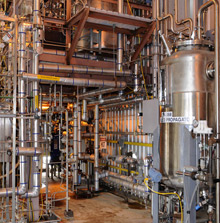
A biorefinery built to produce 1.4 million gallons of ethanol a year from cellulosic biomass will open tomorrow in Jennings, LA. Built by Verenium, based in Cambridge, MA, the plant will make ethanol from agricultural waste left over from processing sugarcane. It is the first demonstration-scale cellulosic ethanol plant in the United States and will be used to try out variations on the company's technology and is designed to run continuously. Verenium wants to demonstrate that it can create ethanol for $2 a gallon, which it hopes will make the fuel competitive with other types of ethanol and gasoline. Next year, the company plans to begin construction on commercial plants that will each produce about 20 to 30 million gallons of ethanol a year. Until now, technology for converting nonfood feedstocks into ethanol has been limited to the lab and to small-scale pilot plants that can produce thousands of gallons of ethanol a year. Since these don't operate continuously, they don't give an accurate idea of how much it will ultimately cost to produce cellulosic ethanol in a commercial-scale facility.
Almost all ethanol biofuel in the United States is currently made from corn kernels. But the need for cellulosic feedstocks of ethanol has been underscored recently as food prices worldwide have risen sharply, in part because of the use of corn as a source of biofuels. At the same time, the rising cost of corn and gas have begun to make cellulosic ethanol more commercially attractive, says Wallace Tyner, a professor of agricultural economics at Purdue University. A new Renewable Fuels Standard, part of an energy bill that became law late last year, mandates the use of 100 million gallons of cellulosic biofuels by 2010, and 16 billion by 2022.
So far, however, there are no commercial-scale cellulosic ethanol plants in operation in the United States, although a number of facilities are scheduled to start production in the next few years. The Department of Energy is currently funding more than a dozen companies that will be building demonstration- and commercial-scale plants. One of these, Range Fuels, based in Broomfield, CO, plans to open a commercial-scale plant next year. It will have the capacity to produce 20 million gallons of ethanol and methanol a year. Verenium will use a combination of acid pretreatments, enzymes, and two types of bacteria to make ethanol from the plant matter--called bagasse--that's left over from processing sugarcane to make sugar. It will also process what's called energy cane, a relative of sugarcane that's lower in sugar and higher in fiber. The high fiber content allows the plants to grow taller, increasing yield from a given plot of land.
The opening of the demonstration plant, and the current construction of a number of other demonstration- and commercial-scale cellulosic ethanol plants, marks a turning point for the industry, Riva says. The development of improved enzymes and fermentation organisms means that no further scientific breakthroughs are needed to make cellulosic ethanol commercially successful, he says. "There's been a tremendous amount of background work in science and technology development," he says. "We've learned so much about the process that the really important thing now is to start to deploy the technology at a commercial scale."
(unquote)
Japan Urges Limit on Cell Phone Use by Kids
(quote)
TOKYO (AFP) — A Japanese government panel called on parents and schools Monday to help limit the use of mobile phones by children to prevent them from accessing "harmful" information on websites. The advisory council on education made the proposal to Prime Minister Yasuo Fukuda as children become more prone to crimes involving dating websites and bullying on Internet school bulletin boards. The panel said it would urge "parents, schools and other people concerned to cooperate in preventing elementary and junior high school students from using mobile phones unless it is necessary." It called for limiting mobile phone use just to calls.
These measures are necessary to "protect children from harmful information and other negative influence involving the use of mobile phones" including "crimes and bullying," the report said. Press reports have linked some crimes by children to dating websites. "It is true that the use of mobile phones causes various problems," Fukuda told reporters. "I think the panel has made timely discussions on the problem." He added: "First of all, I wonder if there is any need for children to possess mobile phones."
While about a third of Japanese primary school students aged 7-12 use mobiles, by the time they get to high school that figure rises to 96 percent, according to a government survey last December. There are fears for students' safety as only about one percent of them have blocks on potentially harmful material, meaning they could reveal personal information, making them prey for fraudsters and pedophiles. But even on protected sites such as school bulletin boards, bullies are able to anonymously post comments without teacher oversight or intervention.
(unquote)
Images Courtesy of AFP and blog.pcnews.ro


Original Source: AFP
Rising Acidity in World’s Ocean Waters 100 Years Earlier than Predicted
(quote)
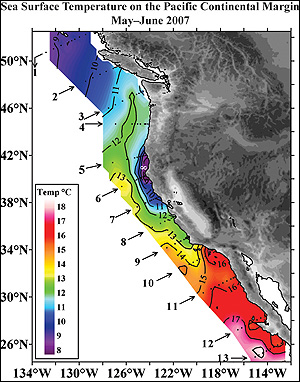
Climate models predicted it wouldn't happen until the end of the century. So Seattle researchers were stunned to discover that vast swaths of acidified sea water are already showing up along the Pacific Coast as carbon dioxide from power plants, cars and factories mixes into the ocean. In some places, including Northern California, the acidified water was as little as four miles from shore.
"What we found ... was truly astonishing," said oceanographer Richard Feely, of the National Oceanic and Atmospheric Administration's Pacific Marine Environmental Laboratory in Seattle. "This means ocean acidification may be seriously impacting marine life on the continental shelf right now." The phenomenon is an aspect of global warming scientists are just beginning to understand.
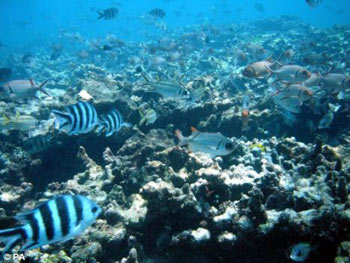
Acidified ocean water can be fatal to some fish eggs and larvae. It also interferes with the formation of shells and skeletons, harming corals, clams, oysters, mussels and the tiny plankton that are the basis of the marine food web. "Their shells dissolve faster than they are able to rebuild them," said Debby Ianson, an oceanographer at Fisheries and Oceans Canada and a co-author of the study published today in the online journal Science Express.
Since the Industrial Revolution, when humans began pumping massive amounts of carbon dioxide into the atmosphere, the oceans have absorbed 525 billion tons of the greenhouse gas, Feely estimates. That's about a third of the man-made emissions during that time. By reducing the amount of carbon dioxide in the atmosphere, the oceans have blunted the temperature rise due to global warming. But they've suffered for that service, with a more than 30 percent increase in acidity.
"This is another example where what's happening in the natural world seems to be happening much faster than what our climate models predict," said Carnegie Institution climate scientist Ken Caldeira, whose work suggested it would be nearly 100 years before acidified water was common along the West Coast. And there's worse to come, the scientists warn. The acidified water upwelling along the coast today was last exposed to the atmosphere about 50 years ago, when carbon-dioxide levels were much lower than they are now. That means the water that will rise from the depths over the coming decades will have absorbed more carbon dioxide, and will be even more acidic. "We've got 50 years' worth of water that's already left the station and is on our way to us," study co-author Hales said. "Each one of those years is going to be a little bit more corrosive."
(unquote)
Images courtesy of Dana Greeley & Simone Alin, PMEL, and Daily Mail
Original Source: Seattle Times
NASA Mars Probe Prepares for Risky Landing
Original Source: BBC News
(quote)
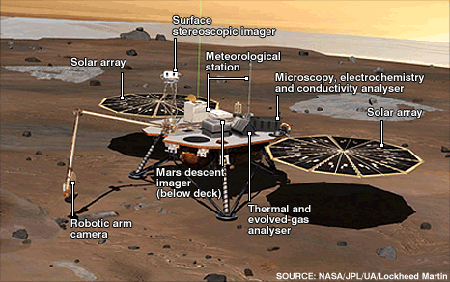
The Phoenix lander is due to touch down on Monday in the far north of the Red Planet, after a 423-million-mile journey from Earth. The probe is equipped with a robotic arm to dig for water ice thought to be buried beneath the surface. Scientists say the mission should give the clearest indication yet of whether Mars could once have harbored life.
The final seven minutes of the probe's ten-month journey is regarded as the riskiest part of the mission. After it enters the top of the Martian atmosphere at nearly 5.7km/s (13,000 mph), the probe must perform a series of maneuvers to come safely to rest. It will release a parachute, use pulsed thrusters to slow to a fast walking speed, then come to a halt on three legs. If all goes to plan, the Phoenix lander will reach the surface of Mars at 0053 BST (1953 EDT) on May 26. Nasa controllers will know in about 15 minutes whether the attempt has been successful.
Landing on Mars is a notoriously tricky business. Of the 11 missions that have tried to land probes on Mars since 1971 - only five have succeeded. Phoenix is an apt name for the current mission, as it rose from the ashes of two previous failures. In September 1999, the Mars Climate Orbiter spacecraft crashed into the Red Planet following a navigation error caused when technicians mixed up "English" (imperial) and metric units. A few months later, another Nasa spacecraft, the Mars Polar Lander (MPL), was lost near the planet's South Pole. Phoenix uses hardware from an identical twin of MPL, the Mars Surveyor 2001 Lander, which was cancelled following the two consecutive failures. The probe was launched on 4 August 2007 on a Delta II rocket from Cape Canaveral Air Force Station in Florida.
(unquote)


Fun, Fitness, and Games - Shigeru Miyamoto’s Newest Wii Fit
Original Source: New York Times
(quote)
IT’S O.K. to liken Shigeru Miyamoto to Walt Disney. When Disney died in 1966, Mr. Miyamoto was a 14-year-old schoolteacher’s son living near Kyoto, Japan’s ancient capital. An aspiring cartoonist, he adored the classic Disney characters. When he wasn’t drawing, he made his own toys, carving wooden puppets with his grandfathers’ tools or devising a car race from a spare motor, string and tin cans. Even as he has become the world’s most famous and influential video-game designer — the father of Donkey Kong, Mario, Zelda and, most recently, the Wii — Mr. Miyamoto still approaches his work like a humble craftsman, not as the celebrity he is to gamers around the world.
Perched on the end of a chair in a hotel suite a few dozen stories above Midtown Manhattan, the preternaturally cherubic 55-year-old Mr. Miyamoto radiated the contentment of someone who has always wanted to make fun. And he has. As the creative mastermind at Nintendo for almost three decades, Mr. Miyamoto has unleashed mass entertainment with a global breadth, cultural endurance and financial success unsurpassed since Disney’s fabled career.
Mario, the mustached Italian plumber he created almost 30 years ago, has become by some measures the planet’s most recognized fictional character, rivaled only by Mickey Mouse. As the creator of the Donkey Kong, Mario and Zelda series (which have collectively sold more than 350 million copies) and the person who ultimately oversees every Nintendo game, Mr. Miyamoto may be personally responsible for the consumption of more billions of hours of human time than anyone around. In the Time 100 online poll conducted this spring, Mr. Miyamoto was voted the most influential person in the world.
But it isn’t just traditional gamers who are flocking to Mr. Miyamoto’s latest creation, the Wii. Eighteen months ago, just when video games were in danger of disappearing into the niche world of fetishists, Mr. Miyamoto and Satoru Iwata, Nintendo’s chief executive, practically reinvented the industry. (Mr. Miyamoto’s full title is senior managing director and general manager of Nintendo’s entertainment analysis and development division.) Their idea was revolutionary in its simplicity: rather than create a new generation of games that would titillate hard-core players, they developed the Wii as an easy-to-use, inexpensive diversion for families (with a particular appeal to women, an audience generally immune to the pull of traditional video games). So far the Wii has sold more than 25 million units, besting the competition from Sony and Microsoft.
Last week Nintendo released its new Wii Fit system in North America, a device that hopes to make doing yoga in front of a television screen almost as much fun as driving, throwing, jumping or shooting in a traditional game. Though there were no hard sales figures available as of Tuesday, there were reports of stores across the country selling out of Wii Fit.
(unquote)


Contact Us

RSS feed


