You are hereScience & Technology
Science & Technology
iPhone into 10 more countries: Italy, Greece, Portugal, Czech Rep., Australia, New Zealand, India, Egypt, South Africa & Turkey
(quote)
BERLIN: Vodafone, the world's largest mobile phone operator, and Telecom Italia Mobile, the leader in the Italian cellphone market, said they had reached agreements with Apple to sell the multimedia telephone. Vodafone also said it would sell the iPhone in nine other countries: the Czech Republic, Greece, Portugal, India, Egypt, Australia, New Zealand, South Africa and Turkey.
"It was going to be difficult for Apple to continue on an exclusivity basis," said Carolina Milanesi, the research director for mobile devices at Gartner in London. "Opening up to more operators will widen their addressable market and therefore their overall sales potential."
(unquote)
(quote)
SYDNEY: "Vodafone Australia is enormously pleased to be included in the agreement to sell the iPhone to our customers later this year," Vodafone chief executive Russell Hewitt said.
"The iPhone has already proved to be extremely popular with customers in other parts of the world and Vodafone is confident that today's announcement will be well received by all Australians who are keen to get their hands on their own iPhone."
(unquote)
Photos courtesy of AP and Reuters


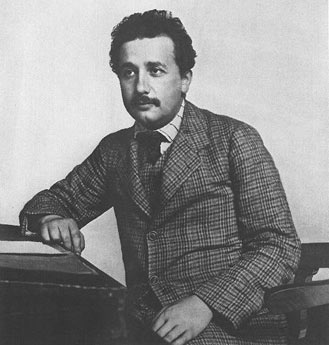
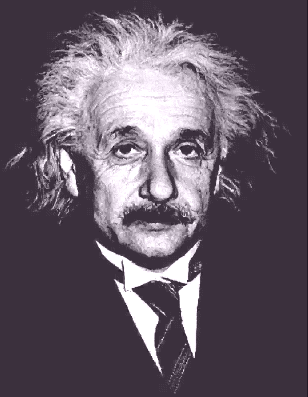
Albert Einstein - Emblem of Reason, Icon of Wisdom
(quote)
Bob Dylan came up with one way to remember Albert Einstein: “Now you would not think to look at him/But he was famous long ago/For playing the electric violin/On Desolation Row.”
This is the pure distillate of celebrity. Dylan’s folk-rock vision of “Einstein, disguised as Robin Hood” is one in which the original man has disappeared into a symbolic fog where more or less any meaning may be found. Nowadays, such content-less fame has become common, though there aren’t many out there who match Einstein for resonance. But when he first exploded into public view, there were no precedents. No scientist before or since has so completely transcended the role of expert to become a universal emblem of reason.
...
Photographers caught that wit as well as the gravitas. It helped that he was astonishingly willing to play along. No one made him ride that bicycle or stick out his tongue straight into the barrel of an oncoming lens. Whatever weariness he felt at the crush of the public gaze, he was almost always willing to pause for the shot. There is a story that he was once asked—by perhaps the only person on earth who did not recognize him—what he did for a living. He replied that he was a photographer’s model.
He was just as open to sharing his ideas. Einstein took seriously questions about his science, up to the point of writing one of the best introductions to relativity for the lay reader. (Called Relativity, it’s still in print.) He handled the ridiculous questions, too, with humor and enormous stamina. He told his interrogators what he thought of Prohibition (against, though he didn’t drink), the death penalty (against, at least some of the time), and abortion (for, up to a certain point in the pregnancy). No scientist before Einstein had been so willing to stand before his public.
(unquote)
Images courtesy of NASA

Oxygen-depleted Dead Zones in Oceans Increasing
"Records stretching back to 1960 prove what climate models had predicted: warmer oceans contain less oxygen. Oceanographer Lothar Stramma of the University of Kiel in Germany and his colleagues report in Science that an analysis of historical records and recent samples show that as the globe has warmed, waters with low oxygen content have expanded in the tropical Atlantic and equatorial Pacific oceans.
"The oxygen concentrations in these oxygen-minimum zones have decreased with time," says oceanographer and study coauthor Gregory C. Johnson of the National Oceanic and Atmospheric Administration's Pacific Marine Environmental Laboratory in Seattle, Wash. "The regions of low oxygen have also expanded vertically by both extending deeper into the ocean and closer to the surface."
Fish and other sea life cannot survive in such waters—and this expansion reduces the area where fish can thrive, says oceanographer Janet Sprintall of the Scripps Institution of Oceanography in La Jolla, Calif., who also coauthored the study. She notes that fisheries may be affected as well."
Image courtesy of Scientific American

No "Microhoo", for Now - Microsoft Drops Yahoo Bid
Microsoft has decided to withdraw its three-month-old offer to buy Yahoo, as expressed in a formal letter from Microsoft chief executive Steve Ballmer to Yahoo chief executive Jerry Yang.
"The companies had finally engaged in merger talks this week and appeared closer than ever to a deal Friday, but they still remained billions of dollars apart in their assessment of Yahoo's worth. Ballmer said today that the company had raised its buyout price to $33 a share from the initial $31 offered, which added $5 billion to the deal that was initially worth $44.6 billion.
That would have represented a 70% premium over Yahoo's closing stock price on Jan. 31, the night that Redmond, Wash.-based Microsoft made its unsolicited offer.
But in recent talks Yahoo had insisted on receiving at least $5 billion more than that, or at least $37 a share, which Microsoft was unwilling to pay, Ballmer wrote in a letter to Yang.
Ballmer said he had decided against launching a hostile bid for Sunnyvale, Calif.-based Yahoo, including trying to take control of the company's board and offering the deal directly to shareholders. He said Yahoo had signaled that it would take action that could prolong such a proxy fight and make the company less valuable to Microsoft, including striking a partnership with Google Inc. in which the search giant would deliver ads alongside many of Yahoo's search results."
Image courtesy of The Los Angeles Times

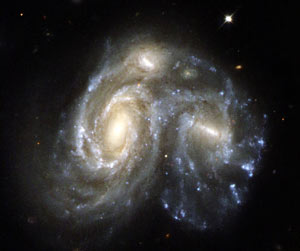
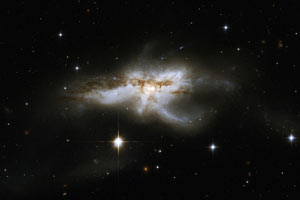
Hubble Photos: Galactic Collisions
(quote)
To celebrate the 18th anniversary of the Hubble Space Telescope launch, the Space Telescope Science Institute has released 59 beautiful images of galaxies spinning and colliding into each other.
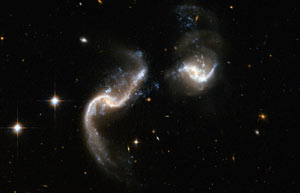
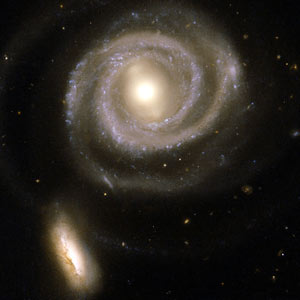
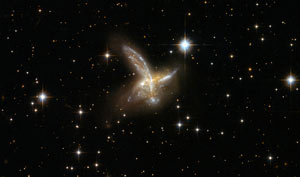
About Hubble
The Hubble Space Telescope is a collaboration between ESA and NASA. It's a long-term, space-based observatory. The observations are carried out in visible, infrared and ultraviolet light. In many ways Hubble has revolutionised modern astronomy, by not only being an efficient tool for making new discoveries, but also by driving astronomical research in general.
The mission
The Universe is gloriously transparent to visible light over journeys lasting billions of years. However, in the last few microseconds before light arrives at telescope mirrors on Earth it must travel through our turbulent atmosphere and the fine cosmic details become blurred. It is this same atmospheric turbulence that makes the stars appear to twinkle on a dark night. read more »
Honda's ASIMO Robot to Conduct Detroit Symphony Orchestra

"Honda will also partner with the Detroit Symphony Orchestra over the next five years to offer training in string instruments, a scholarship program, an educational concert series, support for live classical performances and a fundraiser."
Photo courtesy Wired
Indian Rocket Launches 10 Satellites Into Space
The Indian Space Research Organization (ISRO) has set a world record, launching 10 satellites in a single mission.
"It is carrying two Indian and eight foreign satellites. They are expected to provide data to enable India to plan rural and urban development. The satellites were deployed in orbit within minutes of each other and the entire operation lasted 20 minutes."
Image courtesy of BBC News

Contact Us

RSS feed


