You are hereArchive
Archive
None are so old as those who have outlived enthusiasm. - Henry David Thoreau
None are so old as those who have outlived enthusiasm.


Sydney. Surf Lifesaving: voluntary lifeguard services and competitive surf sport originated in Australia in 1906

(quote)
Surf lifesaving originated in Australia in 1906 in response to drownings at local beaches in Sydney. It comprises key aspects of voluntary lifeguard services and competitive surf sport and has expanded globally to other countries including New Zealand, Ireland, South Africa, and the United States. Such groups became necessary following the relaxing of laws prohibiting daylight bathing on Australian beaches. Volunteer groups of men were trained in lifesaving methods and patrolled the beaches as lifesavers looking after public safety.

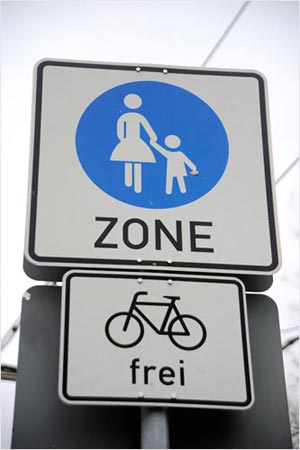
Vauban's streets are nearly "car-free": on outskirts of Freiburg, Germany - suburban pioneers give up their cars
(quote)
VAUBAN, Germany - Residents of this upscale community are suburban pioneers, going where few soccer moms or commuting executives have ever gone before: they have given up their cars.
Street parking, driveways and home garages are generally forbidden in this experimental new district on the outskirts of Freiburg, near the French and Swiss borders. Vauban’s streets are completely “car-free” - except the main thoroughfare, where the tram to downtown Freiburg runs, and a few streets on one edge of the community. Car ownership is allowed, but there are only two places to park — large garages at the edge of the development, where a car-owner buys a space, for $40,000, along with a home. As a result, 70 percent of Vauban’s families do not own cars, and 57 percent sold a car to move here. Vauban, completed in 2006, is an example of a growing trend in Europe, the United States and elsewhere to separate suburban life from auto use, as a component of a movement called “smart planning.”
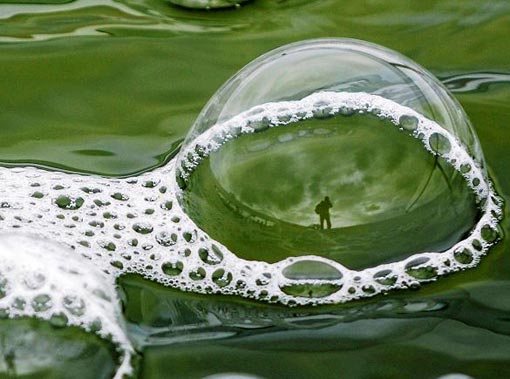
Le Vigeant, southern France: green reflections - photographer reflected in seaweeds at a plant which produces green fuel
(quote)
A photographer is reflected in micro seaweeds in a basin at the Seche environmental plant in Le Vigeant, southern France. Seche Environnement, which specializes in the treatment and storage for all types of non-radioactive waste, produces green fuel from seaweeds.
(unquote)
Photos courtesy of Alain Jocard/AFP/Getty Images
Original Source: Times Online
"Up" by Disney/Pixar becomes the first animated movie ever to open the Cannes Film Festival (2009)

(quote)
The tenth Pixar movie, "Up", has the honor of being the first animated picture ever to open a Cannes festival. Carl Fredricksen (voiced by Ed Asner) is a 78-year-old widower who has always longed to visit the mythical lost worlds of South America. When developers conspire to pack him off to a nursing home, he ties up thousands of balloons to the roof of his house and flies away to fulfill that dream. Alongside him, rather unexpectedly, is an 8-year-old Wilderness Explorer named Russell (Jordan Nagai), a peppy naïf who offsets his grousier temperament.
It's utterly delightful, certain to appeal to audiences young, old and all points in between. Cannes audiences are notoriously vocal. They'll whistle if they're unhappy -- a French version of a boo -- and a movie that doesn't meet the audience's high standards will be treated to the repeated "whop" sounds of theater seats banging shut as patrons leave. "Up," on the other hand, received little but cheers.

The human spirit needs places where nature has not been rearranged by the hand of man. - Author Unknown
The human spirit needs places where nature has not been rearranged by the hand of man.
Brief History of Hubble Space Telescope - undergoing final maintenance-and-repair mission before retiring in 2014

(quote)
The $1.5 billion Hubble rocketed to space aboard the space shuttle Discovery on April 24, 1990. It's named after Edwin Hubble, a pioneering American astronomer who furthered our understanding of other galaxies and demonstrated that the universe is continually expanding.
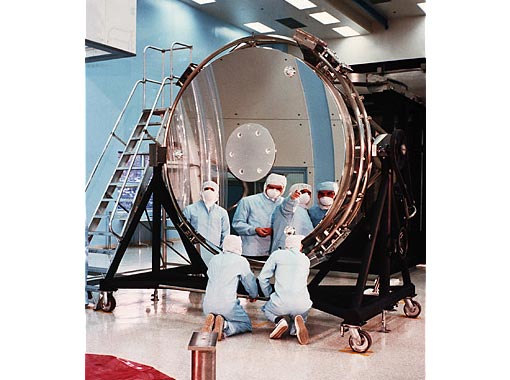
The Hubble's primary mirror, nearly eight feet across. A flaw in the mirror was discovered after the Hubble was in space; thanks to miscalibrated equipment, its glass had been ground slightly too finely at the edges. Though the imperfection measured just one-fiftieth of the thickness of a piece of paper, it distorted the Hubble's images. Astronauts fixed the problem in 1993.
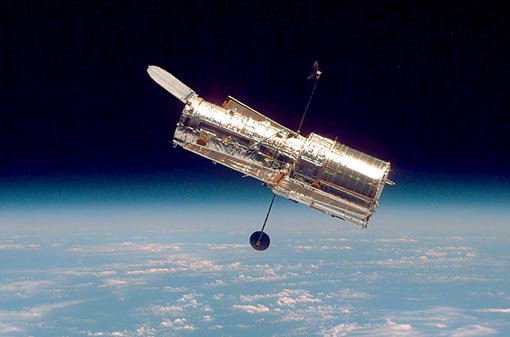
About the size of a large school bus, the Hubble orbits at a speed of five miles per second, 353 miles above Earth. At that velocity it can cross the United States in about 10 minutes and circle the globe in an hour and a half. read more »
Contact Us

RSS feed