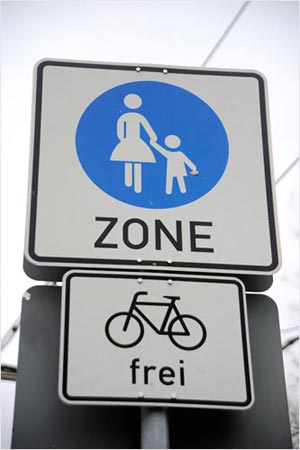
You are hereBlogs / WcP.Tomorrows.History's blog / Nearly carless suburb of Vauban, Germany an example of "smart planning" - separating suburban life from auto use

Nearly carless suburb of Vauban, Germany an example of "smart planning" - separating suburban life from auto use


By WcP.Tomorrows.H... - Posted on 20 May 2009

many residents of Vauban, Germany have carts that attach to bicycles for hauling toddlers and groceries

(quote)

VAUBAN, Germany - Residents of this upscale community are suburban pioneers, going where few soccer moms or commuting executives have ever gone before: they have given up their cars.

Street parking, driveways and home garages are generally forbidden in this experimental new district on the outskirts of Freiburg, near the French and Swiss borders. Vauban’s streets are completely “car-free” - except the main thoroughfare, where the tram to downtown Freiburg runs, and a few streets on one edge of the community. Car ownership is allowed, but there are only two places to park — large garages at the edge of the development, where a car-owner buys a space, for $40,000, along with a home. As a result, 70 percent of Vauban’s families do not own cars, and 57 percent sold a car to move here. Vauban, completed in 2006, is an example of a growing trend in Europe, the United States and elsewhere to separate suburban life from auto use, as a component of a movement called “smart planning.”
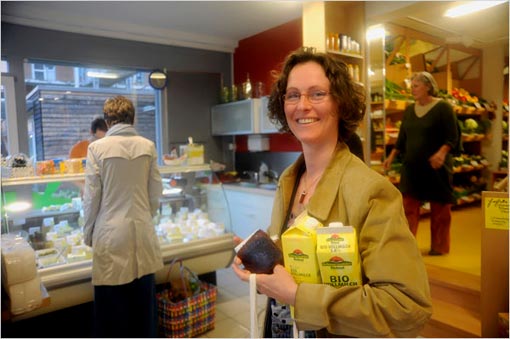
To make sure that residents can live in Vauban without a car, it is a ‘mixed use’ community: stores, banks and restaurants are sprinkled along the main street of Vauban, and that street is within walking distance of all homes

Automobiles are the linchpin of suburbs, where middle-class families from Chicago to Shanghai tend to make their homes. And that, experts say, is a huge impediment to current efforts to drastically reduce greenhouse gas emissions from tailpipes, and thus to reduce global warming. Passenger cars are responsible for 12 percent of greenhouse gas emissions in Europe - a proportion that is growing, according to the European Environment Agency - and up to 50 percent in some car-intensive areas in the United States.

While there have been efforts in the past two decades to make cities denser, and better for walking, planners are now taking the concept to the suburbs and focusing specifically on environmental benefits like reducing emissions. Vauban, home to 5,500 residents within a rectangular square mile, may be the most advanced experiment in low-car suburban life. But its basic precepts are being adopted around the world in attempts to make suburbs more compact and more accessible to public transportation, with less space for parking. In this new approach, stores are placed a walk away, on a main street, rather than in malls along some distant highway.
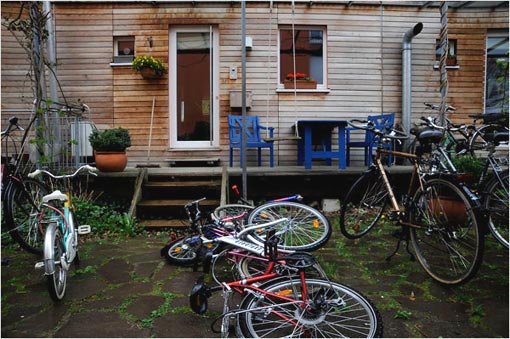
Biking and walking are the principal means of transport within the community. A tram that runs down the spine of the district connects Vauban to the train station and downtown Freiburg

“All of our development since World War II has been centered on the car, and that will have to change,” said David Goldberg, an official of Transportation for America, a fast-growing coalition of hundreds of groups in the United States - including environmental groups, mayors’ offices and the American Association of Retired People - who are promoting new communities that are less dependent on cars. Mr. Goldberg added: “How much you drive is as important as whether you have a hybrid.”

Levittown and Scarsdale, New York suburbs with spread-out homes and private garages, were the dream towns of the 1950s and still exert a strong appeal. But some new suburbs may well look more Vauban-like, not only in developed countries but also in the developing world, where emissions from an increasing number of private cars owned by the burgeoning middle class are choking cities.
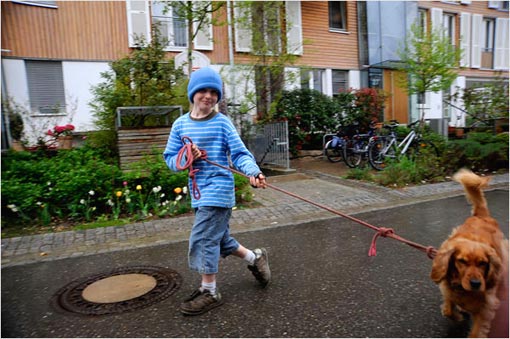
Many people move to Vauban not for environmental reasons, but because they feel that a car-free environment is far better for children. Indeed, children are everywhere! With no cars on the streets, many residents call Vauban a children's paradise, where youngsters wander from a young age in safety. Even some residents who say they miss the convenience of a car at their doorstep have concluded that it is worth the tradeoff

In the United States, the Environmental Protection Agency is promoting “car reduced” communities, and legislators are starting to act, if cautiously. Many experts expect public transport serving suburbs to play a much larger role in a new six-year federal transportation bill to be approved this year, Mr. Goldberg said. In previous bills, 80 percent of appropriations have by law gone to highways and only 20 percent to other transport.

In California, the Hayward Area Planning Association is developing a Vauban-like community called Quarry Village on the outskirts of Oakland, accessible without a car to the Bay Area Rapid Transit system and to the California State University’s campus in Hayward. “People in the U.S. are incredibly suspicious of any idea where people are not going to own cars, or are going to own fewer,” said David Ceaser, co-founder of CarFree City USA, who said no car-free suburban project the size of Vauban had been successful in the United States.
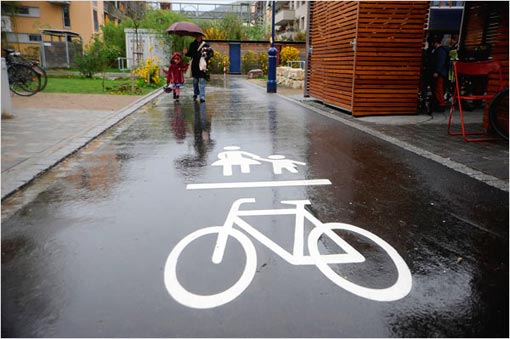
Though Vauban is extreme in its policies to discourage driving, other places are beginning to adopt some of the same principles: disallowing new malls that are not accessible to public transportation, for example, and limiting the number of parking spaces in new developments

In Europe, some governments are thinking on a national scale. In 2000, Britain began a comprehensive effort to reform planning, to discourage car use by requiring that new development be accessible by public transit. “Development comprising jobs, shopping, leisure and services should not be designed and located on the assumption that the car will represent the only realistic means of access for the vast majority of people,” said PPG 13, the British government’s revolutionary 2001 planning document. Dozens of shopping malls, fast-food restaurants and housing compounds have been refused planning permits based on the new British regulations.

(unquote)

Photos courtesy of Martin Specht / The New York Times

Original Source: NY Times

RSS feed

Subscribe to WcP Blog RSS feed

Twitter

WcP Blog on Twitter

Facebook

WcP Blog on Facebook

Custom Search


Random image

ThinkAhead™ Calendar "To Health of Earth" 201001-201012 (Forest)

Search the Web

Custom Search

Archive Calendar

February 2012
SunMonTueWedThuFriSat
1234
567891011
12131415161718
19202122232425
26272829

Featured Videos

Latest Quote

What is evil? Killing is evil, lying is evil, slandering is evil, abuse is evil, gossip is evil: envy is evil, hatred is evil, to cling to false doctrine is evil; all these things are evil. And what is the root of evil? Desire is the root of evil, illusion is the root of evil.

— Founder of Buddhism

Featured Ads & Links

Recent comments

Reader Reviews

  • "It must be very rewarding to have a long term project like this and too see the progress being made! Thanks for sharing it." - Mika (Jan. 18, 2012)
  • "This was a very eye opening video. It's made an impact on me. We're so unaware of the things that we do every day can destroy our ecosystem. The statistics are mind blogging especially the fact that 90% of big fish are gone. We need to stop this somehow. I'm going to spread this page to my mutual friends. Thanks for this." - Joseph (Jan. 15, 2012)
  • "I enjoy this blog a lot." - Liz (California, USA; Oct. 17, 2011)
  • "Keep up the good work you're doing." - Casper (Melbourne, Australia)
  • "Thanks for sharing some great content through your blog. It has been a sincere pleasure to read." - Anonymous
  • "Always fresh and fascinating." - Anonymous
  • "Cool bio[mission statement]." - Darin (California, USA)
  • "You have some beautiful images. Love your site!" - Susan (Washington DC, USA)
  • "I love your Blog." - Kate (Ireland)
  • "A great site highlighting many important issues." - Bob (New Zealand; Feb. 20, 2010)
  • "Love the images on this blog..there are some interesting articles about health I noticed...we tend to run a 50/50 risk of a heart attack...I noticed when in the USA recently everyone seemed huge..they ate massive meals...I reckon that is one cause of heart failure...just my opinion..but yeah these articles can be worrying to some folk so just heed the advice...I know I will." - Mick (The Sunshine Coast, Australia; Aug 29, 2009)
  • "Excellent blog." - Bill (Vancouver Island, Canada)
  • "Fantastic blog and educational articles, much enjoy visiting...Thank you!" - Lotus1150 (Alberta, Canada; Aug 28, 2009)
  • "Great site and awesome photos." - David (Washington DC, USA)
  • "I loved your website. Even finding some news about Turkey made me surprised." - Anonymous (Turkey)
  • "Gorgeous site ... the kind of place you could lose yourself for hours (suppose that was intentional?). Also, cartoons, commentary on the events of the times, etc. Great stuff." - Daniel (Nevada, USA; Jan. 03, 2009)
  • "...may your blog, ideas and efforts help many more people." - Anonymous (New Mexico, USA)
  • "Very cool site..." - Anonymous
  • "Amazing site, worth the visit every time... enjoy." - Sam (Saudi Arabia)
  • "Easy to read and well-designed." - Colin (Arizona, USA; Apr. 22, 2009)
  • "Unique mix of news, photos and poetry." - Frasier (Virginia, USA)
  • "Worldculturepictorial.com/blog is an extremely interesting collection of news articles. It calls itself "A Window On the World". The site contains a wide variety of topics, all very informative and pertinent to life in today's world." - Cynthia (Massachusetts, USA; Aug. 07 2008)
  • "Wow. Cool." - Christopher (Melbourne, Australia; Dec. 10 2008)
  • "An interesting way to check out the wonders of our world." - Anthony (Ohio, USA)
  • "Nice site, especially the rss icon." - Daniel (California, USA; Sep 10, 2008)
  • "Good blog - Everything from news to photography. Very informative." - "explicitmemory" (Texas, USA)
  • "Very informative site by prose and picture..." - Jeff (Michigan, USA)