You are hereBlogs / WcP.Movie.Critic's blog / 23,000 dolphins slaughtered each year in hidden COVE in Japan. In US? $1500-3500 reward to get the one who killed a dolphin
23,000 dolphins slaughtered each year in hidden COVE in Japan. In US? $1500-3500 reward to get the one who killed a dolphin

(quote)
2009 documentary The Cove.
For nearly 10 years, Ric O'Barry trained dolphins playing "Flipper" on the popular '60s TV show, and, in the process, popularized dolphins as entertainment. For the last 35 years, he's tried to undo all of that. Wherever dolphins are held captive, O'Barry is there -- protesting, cutting nets and getting arrested. He's a longtime critic of Florida attractions that feature captive dolphins, including Key Biscayne's Seaquarium, "like these dolphins volunteered to be in this concrete box."
His biggest splash may be the new documentary The Cove, a nail-biting film about dolphin slaughter in Japan. The movie, opening Friday in South Florida, has snagged a slew of festival awards, including the Sundance Audience Award, and has created Oscar buzz in its wake.

O'Barry, 69, of Coconut Grove, leads an unusual cast of daredevils to a secluded cove in Taiji on Japan's coast. Here, capturing and killing dolphins is legal. But trespassing isn't.
Armed with gee-whiz equipment, including an infrared camera for night photography, and fake rocks designed by George Lucas' Industrial Light & Magic to disguise cameras, the crew looked more like insurgents than documentary filmmakers. Throughout the $2.5 million film, O'Barry and crew, who faced arrest and jail if caught, dodged determined police and belligerent fishermen. In the dead of night, world-class free divers hid cameras tucked into the submerged rocks. The goal: to capture the annual killing of thousands of dolphins.
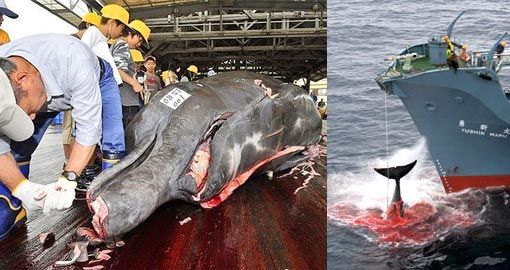
"I'm in Japan five, six times a year, and I see this slaughter every day for weeks on end," says O'Barry, a marine mammal specialist for Earth Island Institute, a nonprofit environmental group. "Words just fail me." The film, directed by famed photographer Louie Psihoyos, was financed by Netscape founder and Palm Beacher Jim Clark, whose only edict was this: "Make a difference."
The group, including expedition director Simon Hutchins of Fort Lauderdale, headed to the small town of Taiji, the largest supplier of dolphins to marine parks and swim-with-dolphin programs around the world. Each dolphin sells for up to $150,000, according to the film. After dolphin trainers make their selections, the remaining mammals are killed. Over several months, fishermen herd thousands of dolphins into an isolated cove and stab them with spears. The flesh, sold for food in Japan, is contaminated with mercury, accumulated from the smaller fish they eat.

The film took seven attempts to get the forbidden footage, shot over three years. In one attempt, Hutchins, in the black of night, climbed a cliff solo in an attempt to hide cameras. "I just grabbed two cameras and jumped out of the van," Hutchins says. "Up on that cliff, that was the only moment when I thought, 'Is this really smart to be in here by myself?' "
The documentary isn't pure thriller. Interspersed in the film is footage that instructs on dolphin intelligence and the ineffectiveness of the International Whaling Commission because of Japanese lobbying. There's also footage of wild dolphins swimming with Mandy-Rae Cruickshank, a record-holding free diver. "We were filming wild dolphins when they started interacting with Mandy," says Greg "Moondog" Mooney of Fort Lauderdale, a marine technician on the film. "They were doing these twists and turns," he says. "It looked like an underwater ballet and I was just blown away."

O'Barry hopes those moments, juxtaposed with the dolphin slaughter, will make people rethink their treatment of dolphins and end the slaughter. And he hopes that dolphin shows will disappear. "When people realize the dolphin show is just a spectacle of dominance, they'll think twice about buying a ticket", and may think trice before order whale (or dolphin) sushi.
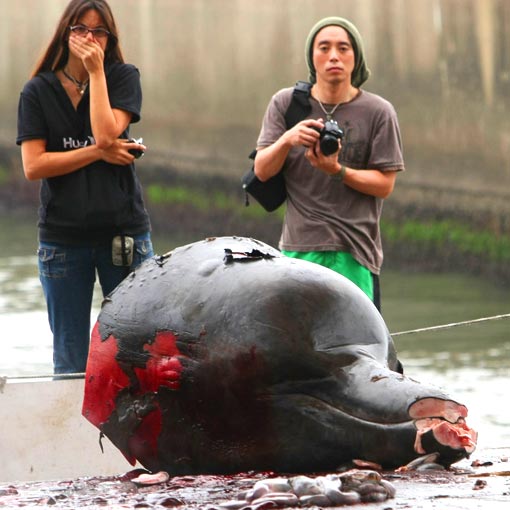
The dolphin's body was found Saturday on the state refuge just west of Grand Isle. It had been shot on the right side just behind its blowhole, and the bullet was found in its lung.
Mark Kinsey, enforcement supervisor for Texas, Louisiana and Mississippi, said it is the first dolphin shooting he has investigated in 12 years as an enforcement agent, but a dolphin was stabbed in the head with a screwdriver this summer.
The stabbed animal's body was found June 22 near Dupont Point, Ala., and had been reported swimming in Perdido Bay near the Alabama-Florida state line for days before that, Amendola said. Investigators don't have a single good lead in spite of a $3,500 reward from the Whale and Dolphin Conservation Society, Amendola said.
People can get close enough to stab a dolphin because feeding the marine mammals is all too common even though it's been illegal since 1993, said Jeff Radonski, acting deputy special agent in charge of the Gulf, South Atlantic and Caribbean.
Other attacks on dolphins have been successfully prosecuted.
A Panama City, Fla., man was sentenced in 2009 to two years in prison and three on supervised probation for throwing pipe bombs at dolphins. The prison time was because he also was convicted of carrying a gun after being convicted of a felony, Amendola said.
Charter boat captains were convicted in 2006 and 2007 of shooting at dolphins: one because dolphins had grabbed his clients' hooked fish; the second because a dolphin was approaching his boat.
"Their own clients turned them in," Amendola said. Tips can be left anonymously about unsolved cases such as the stabbing and the most recent shooting. Anyone with information is asked to call 1-800-853-1964.
The Marine Mammal Protection Act of 1972 forbids harassing, harming, killing or feeding wild dolphins. Violations can be prosecuted either civilly or criminally, with maximum penalties of a year in jail and $100,000 in fines.
(unquote)
Photos courtesy of Junko Kimura / Getty Images, Greenpeace, BBC, AFP, Kate Davison / Greenpeace, Koichi Kamoshida / Getty Images, and William West / AFP / Getty Images
Original Source: South Florida Sun Sentine and Foreign Policy


Contact Us

RSS feed


I read your article you shared are more article like this having good knowledge.