You are hereBlogs / WcP.Story.Teller's blog / Rescue flight in blue sky. Guiding young whooping cranes to winter nesting grounds: birds follow ultralight plane
Rescue flight in blue sky. Guiding young whooping cranes to winter nesting grounds: birds follow ultralight plane

(quote)
It was the first Friday in December, 23 degrees at dawn and nearly windless. Everyone was looking up. Operation Migration’s four ultralight planes floated into view over some oak and maple trees, then passed over the small, white chapel. An ultralight is powered by a massive rear propeller. In the sky, it looks like a scaled-down Formula 1 car dangling under the wing of a hang glider. Because the little planes taxi on three wheels, pilots call them trikes.
At 200 feet, the first pilot, Chris Gullikson, was perfectly visible in his trike’s open cockpit. He was wearing his whooping-crane costume, a white hooded helmet and white gown that looked like a cross between a beekeeping suit and a Ku Klux Klan get-up. Gullikson and the other trike pilots were going to pick up the 14 juvenile whooping cranes that they were, little by little, leading south for the winter. Traditionally, and for many millenniums, cranes learned to migrate by following other cranes. But traditions have changed. Outside the church, a plucky, silver-haired woman named Liz Condie was explaining to the spectators why, exactly, her team has had to dress up and step in.

For the last eight years, Operation Migration has been one of several organi- zations collectively trying to bring whooping cranes back to the eastern part of the continent. The whooping crane is reclusive and headstrong — it demands a square mile around its nest to itself — and consequently was one of the first birds to suffer as humans crowded into North America. In a 1946 article in The New York Times, a spokesman for the U.S. Wildlife Service, which was then going through considerable trouble on the species’ behalf — much of it for naught — called the whooping crane “intolerant of civilization.” The article went on to blame the crane’s “lack of cooperation” for its looming extinction.
But the birds’ uncompromising wildness “is part of their majesty,” Joe Duff, Operation Migration’s co-founder and a trike pilot, told me not long ago. Thus, re-establishing the species presents a challenge: how can humans intervene to breed and teach the birds what they’ll need to survive without also wearing away those birds’ natural apprehension of people; without inadvertently building a race of whooping cranes that feels comfortable hanging out on golf courses and in schoolyards and the fetid little ponds around retirement communities? How do you restore wildlife without simultaneously taming it? One way is to do it in disguise.
From the time Operation Migration’s cranes hatch at the federal government’s Patuxent Wildlife Research Center in Maryland, and for the rest of their lives, every effort is made to keep them from acclimating to humans or encountering even the slightest sign of them. Workers never speak around the cranes, and they always wear the same white costumes. They use a small crane-head puppet slipped over one hand to teach the chicks how to peck and forage. Gradually, the cranes “imprint” on the costume, accepting whoever is wearing it as the dominant bird in their cohort.
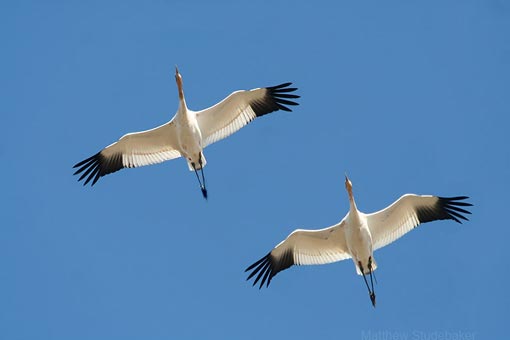
The chicks are then shipped to the Necedah National Wildlife Refuge in Wisconsin for “flight training.” Like many species, whooping cranes learn to migrate only by following their parents. They have no inborn understanding of where to go, and if no older birds are around to show them, they’ll just stay put. So the ultralight and its costumed pilot are introduced as a proxy. While still in their eggs, these cranes were played recordings of a trike engine, attuning them to it as a pseudo-parental presence. Now in Wisconsin, they spend their first summer learning to run, then fly, behind the aircraft. By fall, the whole entourage sets off for Florida, and Operation Migration takes its stage-managed show on the road.
“You only have to show the birds the way once.” After following the trikes their first year, the cranes continue migrating back and forth on their own each spring and fall. That very morning, in fact, graduates of the team’s seven previous ultralight-led migrations — 73 cranes in all — were scattered up and down the eastern flyway, at various points on their passage to Florida. Also scattered up and down the flyway were biologists — lots of biologists — from Operation Migration’s many partner organizations, tracking the radio signals emitted from those birds’ leg bands. And now that Operation Migration’s current class of cranes were airborne, its crew would hit the road, too, chasing the migration to its next stop in two motor homes, two pickups towing campers, and two vans, one towing a 50-foot supply trailer with a spare aircraft. All told, seven state and federal agencies and two nonprofits with an annual collective budget of $1.7 million in public and private funds were hard at work, fulfilling humankind’s responsibility to a bird that we’ve defibrillated out of near-certain extinction and gotten breathing again, if not yet absolutely saved.
(unquote)
Read more at original source: NY Times
Photos courtesy of Mark Peterson/Redux / The New York Times, Laura's Birding Blog, and Matthew Studebaker / rarebird.org
Official Site: Operation Migration


Contact Us

RSS feed