You are hereBlogs / WcP.System.Thinker's blog / Greenland ice melting 3 times faster, loss of vast ice sheet & weight which affects Earth gravitational pull
Greenland ice melting 3 times faster, loss of vast ice sheet & weight which affects Earth gravitational pull
(quote)
Greenland ice cap melting at triple the rate of just a decade ago
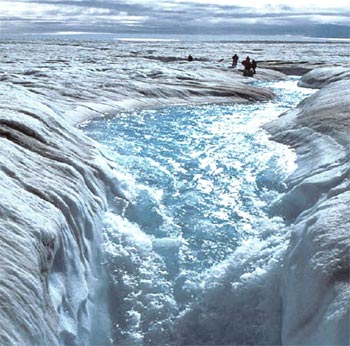
Greenland ice cap is disappearing at the rate of 300 Lake Windermeres a year. More than 273 gigatons of water is now pouring into the oceans annually, raising sea levels by nearly a millimeter every year, satellite imaging has shown. Such is the change in the vast ice sheet that the loss of weight is actually changing its affect on the earth's gravitational pull, the study in Science claims. One gigaton could provide enough water for 17 million people in Britain and is the volume of Lake Windermere, Britain's biggest water mass.
The melting rate has been accelerating over the last decade and has more than tripled since the early 1990s - this is "very, very compelling evidence" that man-made global warming is affecting the world's ice sheets.
Professor Jonathan Bamber, the lead author at Bristol University, said: "When you put it into context how much ice is melting each year, it is very alarming. "One gigaton is the same as a billion tonnes of water. Four of them could provide the domestic water supply for the whole of the UK. What is very worrying is that the speed of melting is increasing. Ice caps are like supertankers. Once they start moving in one direction is takes a lot to stop them." Professor Bamber used satellites to calculate the difference between the amount of inflowing ice – mainly from snowfall - compared to the amount of outflowing ice – from surface melt and glacier rivers, to make the calculations. He also looked at satellite data on the contribution the huge ice mass has on the earth's gravitational pull.
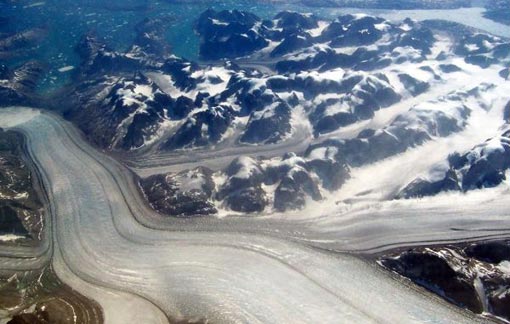
He said both records had shown that the ice sheet had gone from roughly a state of equilibrium in the 1950s and gradually accelerated to its current rate of melting. He said at the current rate seas would rise approximately half an inch a decade which could have devastating effects on lowland areas. Professor Bamber also said that if the entire 2.5 million gigatons of the Greenland ice cap were to melt then global sea levels would rise by seven meters.
"Flooding that it is currently a once every hundred year even could happen every five years," he said. "And that would obviously have a devastating effect on the 1.2 billion people who live in coastal regions. Not just losing their homes, but much worse."
Greenland Losing Glaciers at Increasing Rates. Their complete loss would be catastrophic
In spite of looking like a giant stretch of ice in the Northern Pacific, Greenland fulfills a number of functions in the region, not the least important of them being the fact that it helps keep the North Pole cool. The way it manages to accomplish that is by being large and white, in the purest of senses. Light coming in from the Sun simply bounces off the large, white glaciers, and is redirected back into the atmosphere, without reaching the ice shelves in the Arctic. But the fact that the glaciers on the island are currently melting at an increasingly faster rate is nothing but bad news.

In addition to keeping the Arctic cool, Greenland's ices also help keep more water out of the ocean. If all the ices on the island melted, then the level of the world's oceans would increase considerably; such a catastrophe would also ignite a vicious circle, in which the lack of ice would allow more sunlight at the North Pole, accelerating the melting process at that location as well. Already, the situation is tense: in a war from two sides – warm water and more sunlight – floating ice sheets cannot win.
Sea levels highest near the equator; rising sea levels threaten Caribbean region
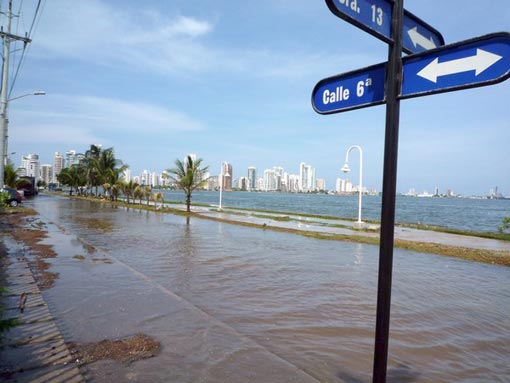
The Colombian city of Cartagena is trying to plan ahead as scientists say cities nearer the equator, where temperatures are already higher, are at greater risk if global warming isn't checked. The effect of climate change is anything but hypothetical to retired naval officer German Alfonso. Just ask him about the time his neighborhood in the historic coastal city of Cartagena, Colombia, became an island. For the last five years, Alfonso, 74, has watched tides rise higher and higher in the Boca Grande section of Cartagena. This month, ocean tides briefly inundated the only mainland connection to his neighborhood, a converted sandbar that has seen the construction of 60 high-rise condo and hotel towers in the last decade or so. “Before, people thought it a normal phenomenon. But we’re becoming more conscious that something is going on,” Alfonso said. “If the sea keeps rising, traffic could just collapse.”
Climate Change: Small Islands Fear Going the Way of Atlantis
The world's small island states, most of which are painfully vulnerable to the ravages of climate change, have put the United Nations on notice. Dramatizing the plight of Pacific Small Island Developing States (PSIDS), Ambassador Stuart Beck of Palau warns that the 192-nation world body, which progressively kept growing from its original membership of 51 in 1945, is in danger of shrinking because some of its members may be wiped off the face of the earth. "This chilling conclusion means that for the first time in the history of the world, we are contemplating the loss of states," he told the General Assembly Monday. The countries most vulnerable to the hazards of climate change include the Maldives, Timor Leste and the Pacific Small Island Developing States of Fiji, Kiribati, Marshall Islands, Micronesia, Nauru, Palau, Papua New Guinea, Samoa, Solomon Islands, Tonga, Tuvalu and Vanuatu.
S.O.S.: Global Warming Will Submerge My Country, President of the Republic of Kiribati Says
Anote Tong the president of the Republic of Kiribati, a chain of tiny Pacific islands near the equator, and he is alarmed about global warming for good reason. The highest point in Kiribati is only two meters above sea level; if the gravest scientific predictions are correct, Tong says, Kiribati will be underwater by the turn of the next century. Last week he spoke at a World Environment Day event in New Zealand, in an attempt to get the world’s attention.
(unquote)
Photos courtesy of Capt. Julian Reyna / Colombian Navy, Green Thoughts, Flickr / basheertome, Justin McManus, and Greenland.com
Original Source: Telegraph, Softpedia, LA Times, IPS, and Discover Magazine


Contact Us

RSS feed


The developed country should come first to reduce the effect of melting ice, otherwise the low geographical countries will be submarged. The https://www.bestessays.cc">bestessays com will let you know the details.