You are hereBlogs / WcP.Life.Coach's blog / "Do I really want that CT scan?" Study shows increased radiation exposure, cancer risks, tests often unnecessary
"Do I really want that CT scan?" Study shows increased radiation exposure, cancer risks, tests often unnecessary

(quote)
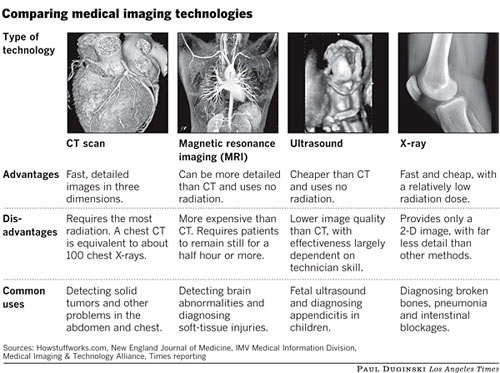
CT scans can be better medicine for doctors than for patients - they provide detailed views of internal organs, but the price is increased doses of radiation. A chest CT scan is equivalent to about 100 X-rays.
When Maureen Scanlan had a painful kidney stone episode four years ago, she was pleased that her doctor ordered an annual regimen of CT scans to monitor her condition. The scans involved hundreds of razor-thin X-rays of her innards stitched together by a computer into stunningly detailed 3-D images showing the size and location of the stone, down to the millimeter. What she didn't realize was that the perfection of the images was a result of a radiation dose equivalent to more than a dozen standard abdominal X-rays -- all for a condition that though painful is relatively mundane.
Scanlan is part of an explosion in the use of one of the most revolutionary medical technologies of the last half century. Introduced in the 1970s, computed tomography scans have become a standard procedure for such common problems as kidney stones, persistent headaches and appendicitis. Doctors in the U.S. ordered 68.7 million CT scans last year, more than triple the number in 1995, according to IMV Medical Information Division, a medical market research group in Des Plaines, Ill. Generating tens of billions of dollars in billing each year, CT scanning has become an economic engine for hospitals and doctors, and the once-exotic million-dollar devices are starting to be found in private practices. "It's gotten into the culture of doctors," said Geoffrey Rubin, a Stanford University radiologist.
But with the boom has come a rising concern that the abundant use of radiation is beginning to have a subtle effect on the health of the nation. Although the risk of a single CT scan to an individual is minuscule, even a tiny increase in radiation exposure spread over a large population can eventually add up to tens of thousands of cancer deaths a year. A controversial study published last November in the New England Journal of Medicine estimated that CT scans administered today could cause up to 2% of cancer deaths in two or three decades.

Some researchers estimate that up to a third of scans could have been avoided or replaced by safer technologies, such as ultrasound or magnetic resonance imaging. "In 20 or 30 years, the radiation debate will be like the smoking debate today," Goldin said. "People will say, 'Why did I get this imaging in the first place?' "
The images are created using a revolving X-ray beam that clicks on for a few seconds, scanning the human body slice-by-slice as if it were a loaf of bread. The scans can cost from a few hundred dollars for a single organ to a few thousand dollars for a full-body image. Since the first CT scanner in the United States was purchased in 1973 by the Mayo Clinic in Rochester, Minn., the U.S. total has grown to 24,000 machines. That amounts to 81 CT scanners in the U.S. for every million people -- almost three times the average for the rest of the industrialized world, according to a 2007 report from the McKinsey Global Institute, an economic research group. Only Japan has a higher density of machines at 93 per million people. About 70% of the scanners are in hospitals. But with declining prices, a growing number are being installed in private practices and imaging centers.
Today, scanner manufacturers, including Siemens and General Electric Co., tout the ease of making money with the devices. Just two scans a day can pay for a machine and its operation over a five-year period, according to a Siemens sales brochure. Ten scans a day can bring in more than $400,000 a year in profit. Today, CT scans of nearly every body part are increasing swiftly as doctors have embraced the technology to conduct virtual colonoscopies, lung cancer screenings, blood vessel inspections and a host of other procedures.

Every so often, scientists believe, a CT scan unleashes the following chain of events: Radiation knocks loose an electron from an atom, creating an ion that damages a cell's DNA. Although the damage is not big enough to kill the cell, it is too big to repair. Over the next two or three decades, the cell divides and multiplies, spreading the faulty genetic instructions. The result is cancer. The increased risk varies with age but, at most, adds about a tenth of a percent to a person's 42% lifetime chance of getting cancer. Still, even the small amount of radiation from a CT can compound over time as the number of scans adds up.
Although individual doctors may believe ordering a scan is justified, they often have no idea how many scans a patient has already had. The numbers can quickly slip out of control, repeatedly exposing patients to added radiation. Dr. Thomas Dehn, chief medical officer for National Imaging Associates Inc., which manages health plans for private insurers, reviewed more than 800,000 imaging claims over a four-year period and found 11,535 patients who had received more than 50 millisieverts, mostly from CT scans. "The patients should be asking the physicians, 'Should I be getting this exam?' " Dehn said.

CT scans have become the primary driver of the nation's rising radiation exposure. Medical tests are now the biggest source of radiation exposure, recently surpassing background radiation, according to the National Council on Radiation Protection & Measurements. Of particular concern is the rising use of CT scans for children and pregnant women. Children -- who account for 11% of CT scans -- face significantly higher risks than adults because they are more sensitive to radiation and have more years ahead for a cancer to develop. For example, an abdominal scan in a 5-year-old carries a 0.10% risk of triggering a fatal cancer, nearly 10 times the risk in adults older than 35, according to the New England Journal study.
Studies over the last few years have begun to question whether all the scans are actually needed. In 2000, when the number of scans was half of today's total, Highmark Blue Cross Blue Shield of Pennsylvania reviewed 162,000 claims for CT scans and other imaging procedures and deemed at least 30% either inappropriate or not contributing any useful information. Even some routine uses have been called into question. For example, one study found that a radiation-free ultrasound may be just as good as a CT scan at diagnosing appendicitis in children. Other research found that in children with chronic headaches, a normal neurological examination made scanning unnecessary.
Doctors concede that the realities of modern medicine -- a complex mix of business, law and expediency -- have exerted a subtle pressure that pushes up the number of scans. In a 2003 survey of 824 doctors published in the Journal of the American Medical Assn., more than half of the emergency room doctors, orthopedic surgeons and neurosurgeons said they ordered CT scans and other imaging tests just to protect themselves from lawsuits. "Patients come in with a headache," said Dr. Scott Lederhaus, a neurosurgeon in Pomona. "If they don't get scanned and something gets missed, they can sue. If they are persistent about it, I will just order a scan," he said. "I don't care. It's just not worth the aggravation."
As medicine has become less profitable, CT scanners have also become a potential source of income, allowing doctors to offer additional services they can bill for instead of referring patients elsewhere. There is a natural inclination for doctors to use machines they've bought or have some financial stake in. Studies have shown that doctors with their own equipment are two to seven times more likely to order tests than those who send their patients to other facilities. A recent report by the Government Accounting Office suggested that financial incentives for doctors were a major factor in the rising number of scans.
(unquote)
Images courtesy of Paul Duginski / LA Times, TriVascular Inc., ducksportsnews.com, and Dept. of Clinical Radiology, Salisbury District Hospital/Science Photo Library/Photo Researchers
Original Source: LA Times


Contact Us

RSS feed


The scans involved hundreds of razor-thin X-rays of her innards stitched together by a computer into stunningly detailed 3-D images sho
The technology increasing day by day in medical field at the same time the side effects like radiation are also increasing. These companies who manufacture the medical scanning machines use electromagnetic wave to detect the problem in our body. Those waves create radiation and cause others problems to patient in their body.
I read in some article online that people working in medical laboratories has more chances for getting cancer. It is due to the frequent exposure to radiations. It is better not to conduct scans on you until you think something is seriously wrong. http://www.cwspirits.com">george t stagg
nice research
Your music is amazing. You have some very talented artists. I wish you the best of success.
https://easyyoutubedownload.com/" target="_blank">Mp3 download
These are some really significant information about ct scans. We have heard about the radiation exposure we are getting when subjected to such scans. This post clearly describes the health issues could be faced due to the exposure of radiation. http://www.kaplanmd.com/product/perfect-pout-lip-mask-balm-duo">lip mask
It is shocking to hear about the health issues related to undergoing a CT scan. The two info graphic clearly demonstrates the working of these medical technologies and also their possible health risks associated with high doses of radiation which is typical of a CT scan. http://www.nuggbeauty.com/products/nugg-exfoliating-face-mask">face exfoliator
You have shared a very informative blog about the advantages and disadvantages of CT scan. It helped me a lot to understand about the harmful effects of CT scan. The radiations are very harmful to our body. There will be the risk of cancer. https://www.garagedoorinmyarea.com">garage door opener repair
I like your all post. You have done really good work. I appreciate your working style at the end just my request is please share with us some more great post...
https://gmailsignlogin.com">gmail sign login
Many of us are confused about this CT scan things and this article really helped a lot in making decisions. There are lot of things explained her in this wonderful piece of writing about the CT scan and I am really thankful to the blog for this.
https://www.yyzmiles.net/sell-points/">sell miles
Your music is amazing. You have some very talented artists. I wish you the best of success.
http://ladadate.com/" target="_blank">international dating sites
I too have such doubts on CT scan and here in this article it is clearly explained about the matters on ct scan. I am really satisfied after reading this article and I would like to thank the blog for sharing such wonderful piece of writing.
Great job for publishing such a beneficial web site. Your web log isn’t only useful but it is additionally really creative too. There tend to be not many people who can certainly write not so simple posts that artistically. Continue the nice writing
The EZ Battery Reconditioning
i am for the first time here. I found this board and I in finding It truly helpful & it helped me out a lot. I hope to present something back and help others such as you helped me.
Piano For All
A lot of doctors are using CT scans for lung cancer screenings and blood vessel inspections, however the patients are advised to make a CT scan and take such dose of radiation only once an year. My niece is involved in the https://incentahealth.com/">incentaHEALTH program, she is traveling a lot and tries to stay away from the scans at the airports. There are a lot of studies about the effects of computer tomography scans and unfortunately a lot of doctors won`t admit that CT scans are harmful because they have become a potential source of income.
"... CT scans have become the primary driver of the nation's rising radiation exposure." I think we are to blame for that! You don't need to take a CT scan for every little niggle.
This is the website that has helped me to know more on the global culture. The posts that are shared here on the site are so interesting and informative. Keep on sharing more and more posts like this.