You are hereBlogs / WcP.Story.Teller's blog / On 2 donkeys: Columbian library "Biblioburro" with 4800 books - schoolteacher Luis Soriano brings books to villagers
On 2 donkeys: Columbian library "Biblioburro" with 4800 books - schoolteacher Luis Soriano brings books to villagers
(quote)
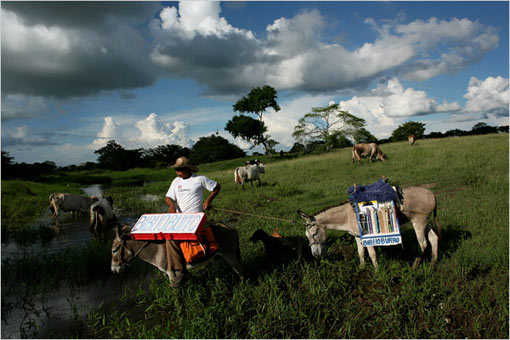
In a ritual repeated nearly every weekend for the past decade here in Colombia’s war-weary Caribbean hinterland, Luis Soriano gathered his two donkeys, Alfa and Beto, in front of his home on a recent Saturday afternoon. Sweating already under the unforgiving sun, he strapped pouches with the word “Biblioburro” painted in blue letters to the donkeys’ backs and loaded them with an eclectic cargo of books destined for people living in the small villages beyond.
“I started out with 70 books, and now I have a collection of more than 4,800,” said Mr. Soriano, 36, a primary school teacher who lives in a small house here with his wife and three children, with books piled to the ceilings. “This began as a necessity; then it became an obligation; and after that a custom,” he explained, squinting at the hills undulating into the horizon. “Now,” he said, “it is an institution.”

A whimsical riff on the bookmobile, Mr. Soriano’s Biblioburro is a small institution: one man and two donkeys. He created it out of the simple belief that the act of taking books to people who do not have them can somehow improve this impoverished region, and perhaps Colombia. In doing so, Mr. Soriano has emerged as the best-known resident of La Gloria, a town that feels even farther removed from the rhythms of the wider world than is Aracataca, the inspiration for the setting of the epic “One Hundred Years of Solitude” by Gabriel García Márquez, another of the region’s native sons.
The idea came to him, he said, after he witnessed as a young teacher the transformative power of reading among his pupils, who were born into conflict even more intense than when he was a child. The violence by bandit groups was so bad when he was young that his parents sent him to live with his grandmother in the nearby city of Valledupar, near the Venezuelan border. He returned at age 16 with a high school degree and got a job teaching reading to schoolchildren.
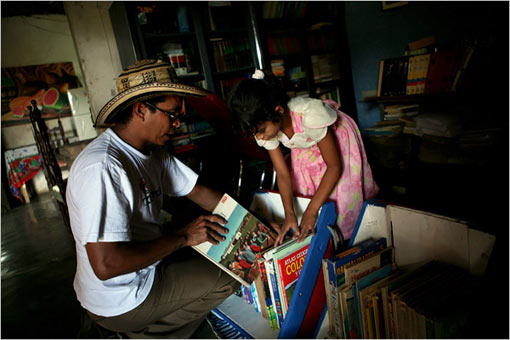
Into that violence, which has since ebbed, Mr. Soriano ventured with his donkeys, taking with him a few reading textbooks, encyclopedia volumes and novels from his small personal library. At stops along the way, children still await the teacher in groups, to hear him read from the books he brings before they can borrow them.
A breakthrough came several years ago when he heard excerpts over the radio of a novel, “The Ballad of Maria Abdala,” by Juan Gossaín, a Colombian journalist and writer. Mr. Soriano wrote a letter to the author, asking him to lend a copy of the book to the Biblioburro. After Mr. Gossaín broadcast details of Mr. Soriano’s project on his radio program, book donations poured in from throughout Colombia. A local financial institution, Cajamag, provided some financing for the construction of a small library next to his home, but the project remains only half-finished for lack of funds.
There is little money left over for such luxuries on his teacher’s salary of $350 a month. Already the family’s budget is so tight that he and his wife, Diana, opened a small restaurant, La Cosa Política, two years ago to help make ends meet. Even among the restaurant’s clientele, mainly ranch hands and truck drivers with little formal education, the bespectacled Mr. Soriano sees potential bibliophiles. On the wall above tables laid out with grilled meat and fried plantains, he posts pages from Hoy Diario, the region’s daily newspaper, and prods diners into discussions about current events.
“We can take political talk only so far, of course,” he said, referring to the looming threat of retaliation from the paramilitary groups, which have effectively defeated the guerrillas in this part of northern Colombia. “I learned that if I interest just one person in reading a mundane news item — say, about the rising price of rice — then that’s a step forward.”
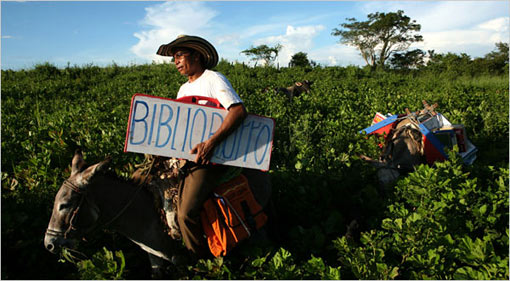
And there are dangers inherent to venturing into the backlands around La Gloria. Two years ago, Mr. Soriano said, bandits surprised him at a river crossing, found that he carried almost no money, and tied him to a tree. They stole one item from his book pouch: “Brida,” the story of an Irish girl and her search for knowledge, by the Brazilian novelist Paulo Coelho. “For some reason, Paulo Coelho is at the top of everyone’s list of favorites,” said Mr. Soriano, hiding a grin under the shade of his sombrero vueltiao, the elaborately woven cowboy hat popular in Colombia’s interior. At times, on the remote landscape dotted with guayacán trees, it was hard to tell whether beast or man was in control. Once, Mr. Soriano lost his patience, trying to coax his stubborn donkeys to cross a stream. Still, it was clear why Mr. Soriano does what he does.
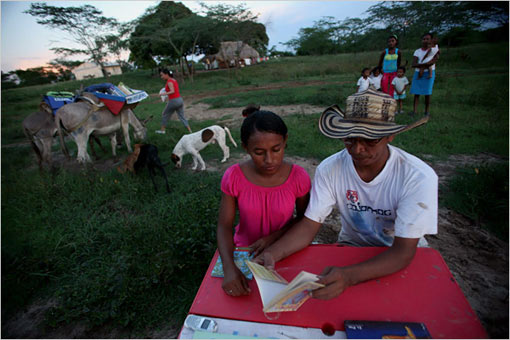
In the village of El Brasil, Ingrid Ospina, 18, leafed through a copy of “Margarita,” the classic book of poetry by Rubén Darío of Nicaragua, and began to read aloud.
She went beyond where the heavens are
and to the moon said, au revoir.
How naughty to have flown so far
without the permission of Papa.
“That is so beautiful, Maestro,” Ms. Ospina said to the teacher. “When are you coming back?”
(unquote)
Photos courtesy of Scott Dalton / The New York Times
Original Source: NY Times
Related Article: Colombia Battles Illiteracy With Books and Donkeys


Contact Us

RSS feed


very nice
Much thanks for composing such an intriguing article on this point. This has truly made me think and I plan to peruse more. http://wordmasters.co.uk/">Essay Writers UK
Education is the best way to improve life style and now a days there are very few schools who have different and unique type of study process. http://www.happy-newyear2017-wishes.com/english-poetry/alfred-lord-tennyson/">Alfred Lord Tennyson Biography and http://www.happy-newyear2017-wishes.com/jokes-in-english/lawyer-jokes/">Lawyer Joke of the Day. Love to read fantastic articles.
Very informative articles and I really want to know new things which can help us a lot in life.http://www.worldentertainmenthub.com/signs-symptoms-stress-women/">Signs and symptoms of stress in women. Keep sharing such an amazing articles.
Hello, But some schools in the U.K. are removing the old school clocks from test rooms because http://getschoolsupplieslist.com/school-attendance/">students are having a hard time reading. That's shameful.
Yeah, it's pretty interesting story about two donkey... Very funny... Not so funny when you are 20, but you are eager to hang out and don't have id...http://idhurry.com">buy fake id
Very good initiative by the Columbian library. This will help us to make educational society. And many good wishes to the teachers who accompany the management in this regard.
Informative blog with good useful information.
the picture and the post you shared is nice dear.
I'm 27 and this is now my 5th year. I got my teaching licence when I was 21. I've spent my first three years of teaching in the Philippines and now I am in Japan, still teaching. I love everything about teaching! I couldn't think of me being in a different field. http://www.domyessays.co.uk/">Do My Essays
Its inspiring or very motivation for students teacher always help student like http://www.ukessaysexperts.co.uk/">Essay Writers UK
I like the valuable info you provide in your articles. I’ll bookmark your blog and check again here regularly. I am quite certain I’ll learn a lot of new stuff right here! Good luck for the next! http://sharkspeed.se/pCategory-1203-MC-CROSS-HJALMAR"> mc hjälmar
I would like to appreciate this man who is really working hard to bring some innovation in education and making children able to learn the best things. http://www.theacademicpapers.co.uk/">The Academic Papers
Nice Post, keep sharing like this.
This is very nice article according to my judgment. I truly inspired with this story.
Great post. The school teacher give education to villagers its great work. http://www.lawessayshelp.co.uk/">Essay Writers UK
Admiring the time and effort you put into your blog and detailed information you offer!.
Sweating effectively under the unforgiving sun, he strapped pockets with the word Biblioburro painted in blue letters to the jackasses backs and stacked them with a diverse payload of books bound for individuals living in the little towns past.
There is little money left over for such luxuries on his teacher’s salary of $350 a month. Already the family’s budget is so tight that he and his wife, Diana, opened a small restaurant, La Cosa Política, two years ago to help make ends meet. https://www.domyessayuk.com">For More Information Visit us