You are hereArchive - Jun 2008
Archive - Jun 2008
History in less than 2 minutes in Olympic sport - Natalie Coughlin snatches back the world record of 100-meter backstroke

(quote)
OMAHA - Call it the one-heat world record. For about two minutes, Hayley McGregory was on the top of the world. Swimming in the second-to-last heat of the preliminaries for the 100-meter backstroke at the United States Olympic Trials, the 22-year-old from Texas clocked a 59.15, breaking the world record by .06 seconds.
When McGregory made the turn at 50 meters on world-record pace, the Qwest Center crowd got firmly behind her, cheering loudly. Natalie Coughlin, whose record McGregory broke, was standing over McGregory’s lane as she finished, getting ready to race in the final heat. The plan was for Coughlin, who this year has recorded three of the five all-time fastest times in the event, to conserve her energy and deliver a nice, easy performance, maybe a second or so faster than her personal best.
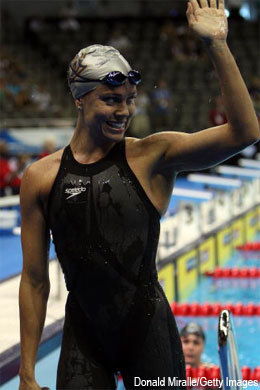
When Coughlin saw McGregory’s time, she switched gears. Swimming with a sense of urgency seldom seen from a top swimmer early in the day’s heats, the 25-year-old Coughlin one-upped McGregory with a time of 59.03. McGregory will go down as the world-record holder for less than two minutes. "Not even a whole minute, really," McGregory said with a chuckle. "It’s still awesome." Looking ahead to Monday night’s semifinal, she said, "I’m really excited to race next to her."
The top 16 finishers will race again Monday night, after which the field will be pared to eight finalists, who will compete Tuesday for the two berths to Beijing. "I was planning on going a lot easier this morning," said Coughlin, the gold medalist in the 100 backstroke at the 2004 Olympics with a time of 1:00.37. McGregory’s swim, she said, "gave me motivation to swim a little faster than I was originally planning." Coughlin, a Californian who came into the race with five of the 10 fastest swims in the event, looks at the 100 backstroke as her baby. She wasn’t going to let somebody take it from her without putting up a fight. "I didn’t really want her to have it long," Coughlin said. After all, Coughlin had held the mark uninterrupted since 2002 when she became the first woman to break the minute barrier in this event, going 59.58 six years ago.
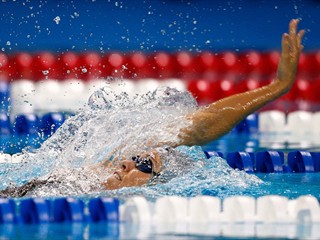
Either Coughlin or McGregory, or both, could conceivably take the record down even more in the semifinals later tonight. McGregory may have popped up on Coughlin's radar in a big way, but the 22-year-old from Longhorn Aquatics in Texas is no pretender, having shown sub-minute speed in the event, going 59.46 at a meet in Austin earlier this month. She started her career at the University of Texas, transferred to USC and found herself a bit adrift when the program changed hands from Mark Schubert to Dave Salo when Schubert joined USA Swimming.
The rest of morning preliminaries went to form. Jessica Hardy (1:06.85) of Trojan Swim was the fastest qualifier in the 100 breaststroke, edging her teammates Rebecca Soni, who went 1:06.90. In the men's 100 backstroke, Randall Bal had the fastest time in 53.28. World-record holder and Nike endorser Aaron Peirsol, who experimented with Speedo's LZR Racer, was sixth in the 100 backstroke, going 54.14. "The way everyone's swimming, it looks like it's not that big a deal anymore," Peirsol said, joking of the four world records set here in less than two days.
(unquote)
Photos courtesy of Al Bello, Donald Miralle/Getty Images, and KCRA
Original Source: NY Times and LA Times


Fuel change breakthrough: biodiesel-powered speedboat Earthrace, around world in 60 days, beats record set in 1998 by 14 days

*Update Jan 6 2010* - Blue Roses to Earthrace Ady Gil: 100% biofuel, spirit of ocean, stands for life, saves crew, sunk by whaler, rests in sea...
(quote)
Team Earthrace, led by New Zealand Skipper Pete Bethune, has smashed the world circumnavigation record for a speedboat by almost 14 days. Almost five years of preparation, planning and two record attempts have paid off leaving the bio-diesel powered Earthrace team to claim the round the world speedboat record.
Possibly the coolest powerboat on the planet, the space age, wave piercing trimaran Earthrace took bio-fuel into history as the 78 foot, (24 metre) boat crossed the 'Round the World' finish line in Sagunto, Spain. In just 60 days Earthrace has powered almost 24,000 nautical miles around the world. Earthrace left Spain on Sunday April 27th at 14:35 local time (1325 GMT) and headed west on the long voyage around the world. The previous record for a powerboat to circumnavigate the globe was 74 days 20 hours 58 minutes 30 seconds, set by the UK boat ‘Cable & Wireless Adventurer’ in 1998.

"Necessity, who is the mother of invention." - Plato
Necessity, who is the mother of invention.
Livelihood. Alternative energy / commute when price is unaffordable? German man to give up job, torch own BMW in protest

(quote)
A man who said he had to give up his job because he couldn't pay for the gasoline required for his commute set fire to his own BMW car in front of the German city of Frankfurt's most iconic skyscraper Friday to protest soaring fuel costs. Police said the man, who identified himself only as Michael, parked the car in a grassy area near the tower, poured a canister of gasoline over it and set it alight. Lettering painted on the car said "Gas Profiteering" and showed the address of his protest site on the internet.
By the time police and fire crews arrived, the car had been gutted. Police detained the man, 30, who lives in neighboring state of Bavaria. They said the damage, including the loss of the car, totaled about 10,000 euros ($15,700 dollars). The man had said he had wanted to burn the car in Berlin, but it had been too far to drive.
He said he had left his job 23 days earlier because he had had to pay 250 euros ($394) a month for fuel to drive to his place of employment located 80 kilometers (50 miles) from his home. Police spokesman Karlheinz Wagner said the protester would probably be charged with pollution and would receive a hefty invoice from the fire brigade. "The guy was quite lucky because the gas tank did not explode," he added.
(unquote)
Original Source: Deutsche Welle
Robot with heart of gold falls in love: Wall-E, a beautiful Pixar vision, full of charm, humor, suspense, romance, and magic

(quote)
Groundbreaking yet familiar, part romance, part sci-fi, Pixar's latest work is wonderful and full of wonder. - Kenneth Turan, Times Movie Critic
If Pixar Animation Studios has an enviable record of consistent success -- and with a worldwide box-office gross of $4.3 billion from its eight films, it certainly does -- it's because the company has an uncanny gift for pushing things further without pushing too far. Pixar's adventurous new film, the one-of-a-kind "Wall-E," shows how it's done. Daring and traditional, groundbreaking and familiar, apocalyptic and sentimental, "Wall-E" gains strength from embracing contradictions that would destroy other films. Directed by Pixar stalwart Andrew Stanton, who co-wrote and directed the Oscar-winning "Finding Nemo," "Wall-E" is the latest Pixar film to manage what's become next door to impossible for anyone else: appealing to the broadest possible audience without insulting anyone's intelligence.

The origins of "Wall-E's" story, as related in the film's teaser trailer, go back to 1994, when Pixar honchos held a now-celebrated lunch to spitball story ideas, which became "A Bug's Life," "Monsters, Inc." and "Finding Nemo." "Wall-E" is the last of that group to get made, in part because elements of it are so unconventional. For one thing, the film's exceptional first half hour or so lives and breathes on screen with just about zero human dialogue. But with the storied Ben Burtt, who did the job on "Star Wars," creating all kinds of noise as the film's sound and character voice designer, as well as music by Thomas Newman, you won't miss those words at all. You also won't miss them because the world of "Wall-E," created by production designer Ralph Eggleston and his team, with the advice of high-powered cinematography consultants Roger Deakins and Dennis Murren, is so remarkable. The time is 800 years in the future and the setting is our own Earth, but it's not an Earth anyone would want to recognize.
Not to put too fine a point on it, our planet is a disaster, a bleak and disheartening ruin where every available surface is covered by towering skyscrapers of trash. It got so bad that Buy n' Large, the conglomerate that has somehow taken charge of the planet, leaned on the entire human population to leave with a "space is the final fun-tier" campaign that featured slogans such as, "Too much garbage in your face? There's plenty of space out in space." Though not likely the main reason the film was made, "Wall-E" can't help but send out a powerful and even frightening environmental message. Though G-rated, its dystopian vision (shot by Jeremy Lasky and Danielle Feinberg) of what the perils of consumer excess have in store for the planet is unnerving without trying too hard.
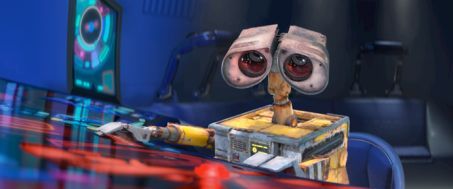
One reason "Wall-E" is as audience-friendly as it finally is is the presence of the endearing title character, whose name is an acronym for Waste Allocation Load Lifter -- Earth Class. What that means in practical terms is that Wall-E is a robotic trash compactor who has been quietly doing his job attacking Earth's endless mountains of refuse for 700 years. Unless you count his pal, a nameless but convivial roach, Wall-E is the only thing still moving on the entire planet. Given all that, it's to be expected that Wall-E, whose large binocular eyes and narrow neck turn him into a squat, mechanical E.T., has developed a few personal eccentricities over the years. For one thing, he's quite the collector, squirreling away everything from old Rubrik's Cubes to light bulbs to an actual living plant.

More than that, this set-in-his-ways old bachelor robot has developed a fixation with the movies. Not really the movies, but one movie in particular, the only video he's got. It is, of all things, "Hello, Dolly!" and screenwriters Stanton and Jim Reardon had the shrewd idea of opening the film with the jaunty lyric, "Out there is a world outside of Yonkers," as the camera somberly pans both the universe and the ruins of Earth. What really entrances "Wall-E" about "Hello, Dolly!" is the spectacle of people expressing emotion and connection by holding hands. Not a word is spoken, but we understand that this lonely Robinson Crusoe, like so many movie creatures before him, would like nothing better than to hold hands with another entity. And then it happens. A spaceship lands in Wall-E's neighborhood and leaves behind a sleek white oval-shaped probe-droid with bewitching blue eyes named Eve (for Extra-terrestrial Vegetation Evaluator), sent to Earth to find signs of life. High tech and armed with a laser weapon that pulverizes anything in sight, Eve fascinates Wall-E and he nervously scuttles around after her, fearful but intoxicated by her every move.

Though this wordless section of the film, punctuated only by Wall-E's frequent and idiosyncratic croak of "Eve," is in some ways merely a set up for the second half, it is easily the most memorable and distinctive part of the film. This segment, a kind of song without words, is a world-creating work of pure imagination that has been thought out to the nth degree.
"Wall-E's" second half involves the dauntingly overweight humans who have sent the probe (and who are shrewdly not pictured in any publicity material.) They've lived for centuries on a cruise liner-type spaceship called the Axiom run by a barely functional captain (Jeff Garlin) in thrall to a Hal-type eminence called Auto, voiced, in a nod to "Alien," by Sigourney Weaver. This part of the story gets increasingly familiar and sometimes borders on the predictably sentimental. But along with these inevitable elements of calculation, "Wall-E" never loses its sense of wonder: wonder at life, wonder at the universe, and even wonder at the power of computer animation to create worlds unlike any we've seen before. How often do we get to say that in these dispiriting times?
(unquote)
Images courtesy of Disney/Pixar, mlive.com, hamptonroads.com
Original Source and Video: LA Times
Special Gallery:Showbiz 7s: Movies that inspired 'Wall-E'
Related Article: :'Wall-E' draws design inspiration from Apple
Alarming charts: oil price spike since 2003. Solar & wind become vital to industrialized civilization, global economy as a whole
(quote)
Petroleum is also the raw material for many chemical products, including pharmaceuticals, solvents, fertilizers, pesticides, and plastics. The industry is usually divided into three major components: upstream, midstream and downstream. Midstream operations are usually included in the downstream category. Petroleum is vital to many industries, and is of importance to the maintenance of industrialized civilization itself, and thus is critical concern to many nations.
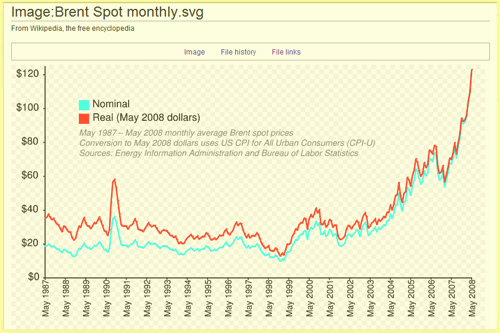
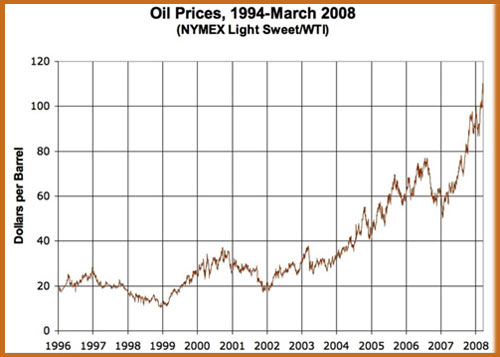
From the mid 1980s to September 2003, the inflation adjusted price of a barrel of crude oil on NYMEX was generally under $25/barrel. During 2004 the price rose above $40, then $50. A series of events led the price to exceed $60 by August 11, 2005, briefly exceed $75 in the middle of 2006, fall back to $60/barrel by the early part of 2007, then rise steeply to $92/barrel by October 2007 and $99.29/barrel for December futures in New York on November 21, 2007[1] Throughout the first half of 2008, oil regularly reached record high prices. On February 29, 2008, oil prices peaked at $103.05 per barrel,[2] and reached $110.20 on March 12, 2008,[3] the sixth record in seven trading days.[4] [5] The most recent price per barrel maximum of $140.05 was reached on June 26, 2008.[6]
(unquote)
Images courtesy of Wikipedia
Original Source: Wikipedia
United Airlines opens Red Carpet Club, airport lounges with food, beverages and business-facilities: T-Mobile Wi-Fi HotSpot

(quote)
CHICAGO, June 25 /PR Newswire-First Call/ -- United customers traveling through Chicago O'Hare may receive red carpet treatment this summer with United's first new Red Carpet Club® to open since 2000. The enhanced club that has more than doubled in size and has new furniture and a modern design now offers travelers a more pleasant environment to work or relax.
"Our guests tell us they want to be comfortable and productive when traveling, and United's new Red Carpet Club at O'Hare offers both -- more personal space and additional work areas with complimentary Wi-Fi service," says Graham Atkinson, United Airlines - executive vice president and Chief Customer Officer. "Whether our guests want to relax or finish a presentation, the Red Carpet Club will now give them more ways to get the most out of their travel experience."

The new club includes power outlets accessible from nearly every seat and creatively designed work stations, enabling business travelers to be productive in a more casual environment and reflecting the current trend blending leisure and work. Enhanced food and beverage options in the club will include two serving areas, a bar, and two self-service juice and soda stations.
The club is adjacent to gate B18 in O'Hare's Terminal 1, and customers will be conveniently located near many of the international flights operated by United and Star Alliance® partner Lufthansa. The club is available to Red Carpet Club members and customers traveling internationally in United First® and United Business®, and any United customer may purchase a one-time pass for $50.  These customers and members also receive complimentary Wi-Fi service powered by T-Mobile® HotSpot. Press Release Source: United Airlines
(unquote)
Images courtesy of United Airlines
Original Source: Yahoo Finance and United Airlines
Contact Us

RSS feed