You are hereBlogs / WcP.Movie.Critic's blog / Pollack produced over 44 movies, directed more than 20 films, 10 television shows, and acted in over 30 movies/shows
Pollack produced over 44 movies, directed more than 20 films, 10 television shows, and acted in over 30 movies/shows
(quote)
If Mr. Pollack, who died on Monday at 73, could be compared to a major figure from the Old Hollywood, it would not be to one of the great individualists like Howard Hawks or John Ford, but more like William Wyler: highly competent, drawn to projects with a certain quality and prestige and able above all to harness the charisma of movie stars to great emotional and dramatic effect.
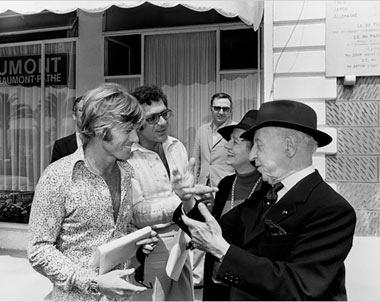
Just about any film by Robert Altman or Martin Scorsese, for instance, will be immediately and primarily identifiable as such, no matter who’s in it. But if you think of “They Shoot Horses, Don’t They?,” you’ll remember Jane Fonda, so desperate and defiant and sad as she pushes herself through a Depression-era dance marathon. “Tootsie” is Dustin Hoffman’s movie. “This Property Is Condemned” will conjure up Natalie Wood and Robert Redford, oddly cast but nonetheless generating Southern Gothic heat in an overripe Tennessee Williams scenario. And it is Mr. Redford who defines Mr. Pollack’s oeuvre nearly as much as the director himself. Over nearly 25 years, from “This Property Is Condemned” to “Havana,” they worked together on westerns (“Jeremiah Johnson,”); love stories both sweeping (“The Way We Were”) and intimate (“The Electric Horseman”); paranoid thrillers (“Three Days of the Condor”); and high-toned literary adaptations (“Out of Africa.”)
Mr. Pollack was an exemplary mainstream filmmaker, which is not to say that he was a timid or unimaginative director. As a producer, he was certainly prolific and eclectic, with projects as varied in scale and style as “The Fabulous Baker Boys,” “The Talented Mr. Ripley” and “Forty Shades of Blue.” In both capacities he worked, comfortably and with conviction, within the parameters of the Hollywood “A picture” tradition, turning out high-quality commercial entertainments that did not shy away from ethical and political engagement.
The kind of movie he made, which used to be the kind of movie everyone wanted to make (and to see), may be slipping into obsolescence. The blend of big stars with meaty, serious themes; lavish production values; and unstinting professionalism that once would have seemed foolproof looked downright anachronistic. The old A pictures, made for mass appeal and Oscar glory, no longer have the industry cachet or cultural impact they used to. The studios send their specialty divisions out in search of awards on the relative cheap, while action franchises, raunchy comedies and family-friendly animation bring in the big money and attract the heavy investments.
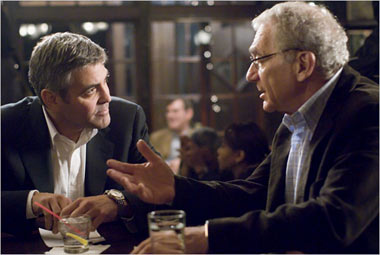
There are exceptions, from time to time, movies that try to steer between the art house and the lowest common denominator in the great Hollywood middle-brow tradition. Tony Gilroy’s “Michael Clayton,” a tale of corporate malfeasance with a smart script, a few murders and George Clooney’s charisma, may be the best recent example. It’s hardly an accident that Mr. Pollack’s name appears in the credits twice, as a producer and as a member of the cast. It would be nice if “Michael Clayton” turned out not to be an anomaly but rather a sign that the old mainstream has not entirely run dry.
A box office success, "The Way We Were" was nominated for several awards and won the Academy Award for Best Original Dramatic Score and Best Original Song for the theme song, "The Way We Were," It ranked at number 6 on AFI's 100 Years...100 Passions survey of the top 100 greatest love stories in American cinema. The Way We Were is considered one of the greatest romantic movies ever. The soundtrack album became a gold record and hit the Top 20 on the Billboard 200 while the title song became a million-selling gold single, topping the Billboard Hot 100 respectively, selling more than two million copies. Billboard named "The Way We Were" as the number 1 pop hit of 1974. In 1998, the song was inducted into the Grammy Hall of Fame and finished at number 8 on AFI's 100 Years...100 Songs survey of top tunes in American cinema in 2004. It was also included in the list of Songs of the Century, by the Recording Industry Association of America and the National Endowment for the Arts.
(unquote)
Photo Courtesy Myles Aronowitz/Warner Brothers Pictures, Columbia Pictures, and Levy/Associated Press



Contact Us

RSS feed


