You are herescience
science
We'll be judged tomorrow by what we do today. Unicorn whales help humans..humans hunt whales & seals. Planet needs more Eco hero

(quote)
Warmer Arctic spells colder winters. 'Unicorn' whales do scientists favor by taking Arctic temp
It's no secret that the proverbial canary in the climate change mine is the Arctic. As National Oceanic and Atmospheric Administration (NOAA) administrator Jane Lubchenco noted when her organization launched its annual Arctic Report Card last week,“To quote one of my NOAA colleagues, ‘whatever is going to happen in the rest of the world happens first, and to the greatest extent, in the Arctic.’”
But, even as the Arctic warms, seemingly irrevocably, it is still a formidable environment in which to operate, particularly in the winter. The coasts of Greenland, in particular, act as pathways for ice from the Arctic Ocean, as a result of which winter research expeditions can require icebreaking vessels that cost millions of dollars to charter.
Consequently, in some areas, such as Baffin Bay, a large area between northeast Canada and southwest Greenland, winter data have been scarce -- or, in the words of Mike Steele of the University of Washington, "there was this gigantic, embarrassing hole."
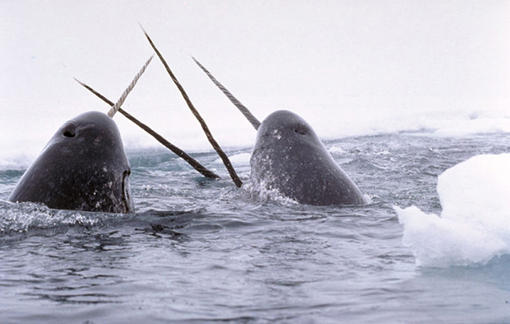
Narwhal_satellite That hole is now being filled - thanks to narwhals, medium-size whales, endemic to the Arctic, known as unicorns of the seas because of the single, spiralling tusk found in males. read more »


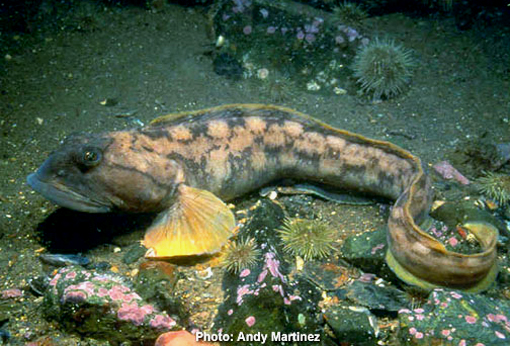
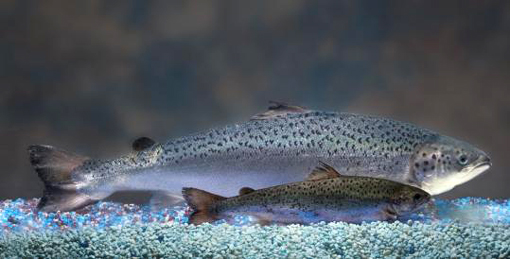
Fishing industry & 39 lawmakers' concerns: modified salmon with gene from eel-like ocean pout..seafood's highly allergenic


(quote)
Senator Mark Begich (D-Alaska): Serious health and environmental questions regarding the fish cannot be adequately evaluated by the public, Begich wrote. Led by Sen. Mark Begich (D-Alaska), the senators complained to FDA Commissioner Margaret A. Hamburg that the agency is using the wrong process for evaluating the safety of the modified fish and that the public is being left out. read more »
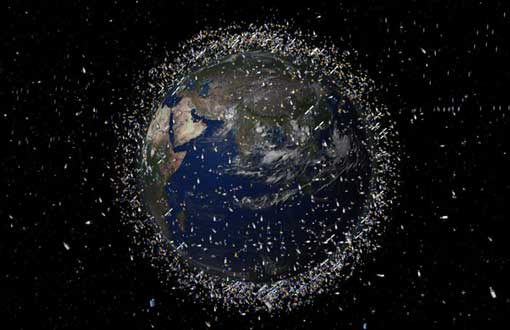
What goes up... Space junk: how to clean up the Space Age's mess; > 4 million pounds of trash orbiting Earth
(quote)
The Trouble With Trash
It's been 53 years and over 4,500 launches since the dawn of the space age, and Earth's orbit is a junkyard. Our orbit is littered with spent rocket stages, lens caps, broken-up satellites, frozen urine, the odd glove, bits of foil, and the tool kit dropped by astronaut Heide Stefanyshyn-Piper during a spacewalk in 2008. You name it; the low Earth orbit has probably got it.
Millions of pieces of this space debris orbit the globe at break-neck speeds, and the spacecraft that pass through orbit are in jeopardy from even the smallest objects. But while the problem is evident, the solution remains elusive. Will Earth's orbit forever resemble a scene from WALL-E? Many scientists have now turned their attention to cleaning up the clutter.
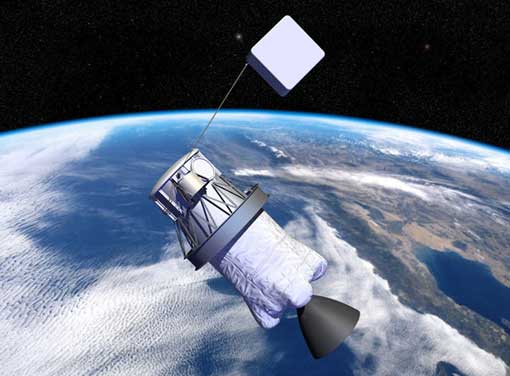
Every satellite that goes up to orbit is the pride and joy of some company, lab, or nation. But once it has outlived its purpose, it's nothing but junk. read more »
Scottish scientists develop whisky biofuel: more environmentally sustainable & 30% more power output than ethanol
(quote)
It gives a whole new meaning to the phrase "one for the road". Whisky, the spirit that powers the Scottish economy, is being used to develop a new biofuel which could be available at petrol pumps in a few years.
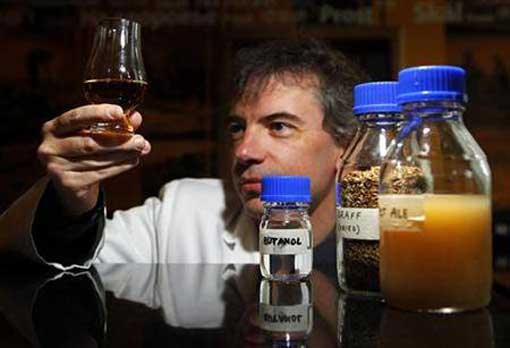
Using samples from the Glenkinchie Distillery in East Lothian, researchers at Edinburgh Napier University have developed a method of producing biofuel from two main by-products of the whisky distilling process – "pot ale", the liquid from the copper stills, and "draff", the spent grains.
Copious quantities of both waste products are produced by the £4bn whisky industry each year, and the scientists say there is real potential for the biofuel, to be available at local garage forecourts alongside traditional fuels. It can be used in conventional cars without adapting their engines. The team also said it could be used to fuel planes and as the basis for chemicals such as acetone, an important solvent.
The new method developed by the team produces butanol, which gives 30% more power output than the traditional biofuel ethanol. It is based on a 100-year-old process that was originally developed to produce butanol and acetone by fermenting sugar. The team has adapted this to use whiskey by-products as a starting point and has filed for a patent to cover the new method. It plans to create a spin-out company to commercialise the invention. read more »
Nature runs away from human pollution into deep sea to sustain its mysterious miracles - unidentified marine life.
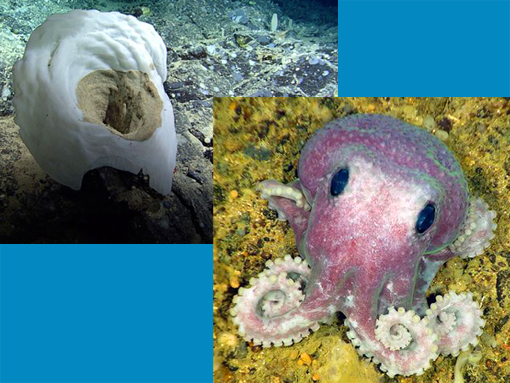
Spectacular deep-sea species: newly discovered purple octopus and species of vase sponge was one of the bottom dwellers.
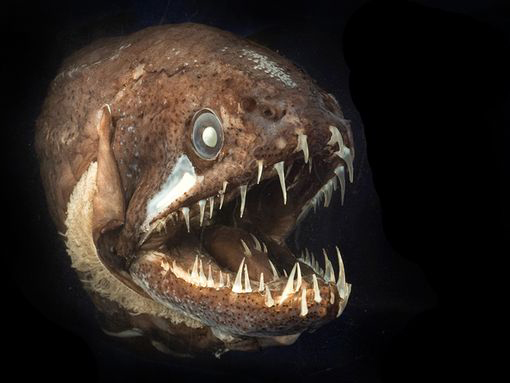
Australia's dragonfish uses many fangs to hook hard-to-find prey in the cold, dark depths.
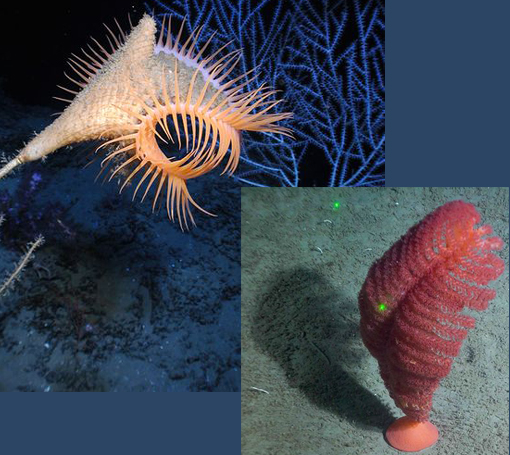
Top left: Gulf of Mexico's Venus flytrap anemone acts much like its terrestrial namesake, stinging its prey with an array of tentacles. Bottom right: an unidentified sea pen discovered on Atlantic coast off Newfoundland.
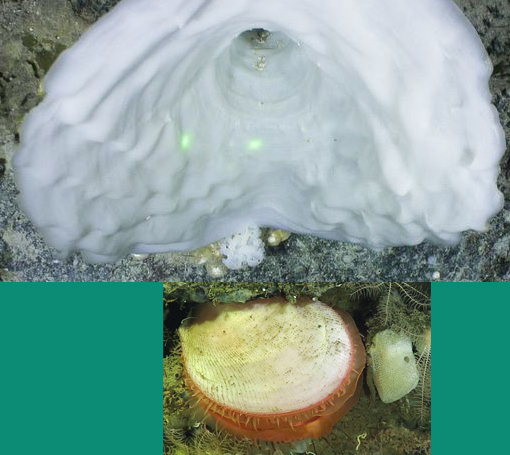
Top: unrecognizable sponge species found on volcanic mounds off Newfoundland. Bottom: recently identified species of bivalve mollusk was also discovered in survey of Newfoundland depths.
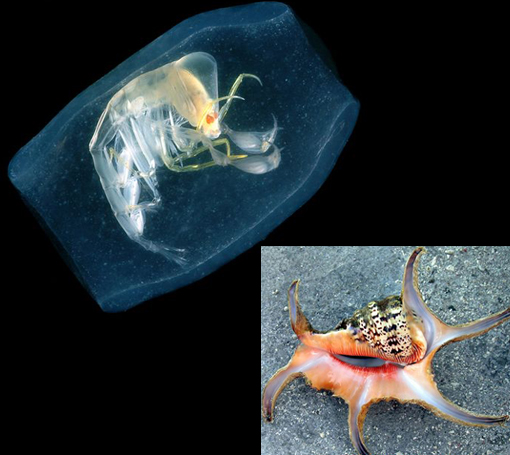
Phronima sedentaria sets up house by attacking and then hollowing out a transparent jellyfish-like animal called a salpa. Inset: Found in China, the spider conch a mollusk, one of the most common groups of species in the new Census of Marine Life inventory.
(quote) read more »
Plastiki, 20x60ft boat from 12,500 plastic bottles, sails 130 days & 8,000 nautical miles across Pacific Ocean, reaches Sydney
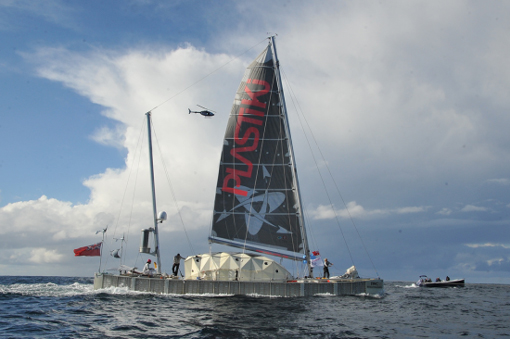

Epic Voyage
The Plastiki and crew have reached the end of their epic voyage which has taken them through the Pacific Ocean on an 8,000 nautical mile adventure lasting over 130 days. On Jul 26, 2010, 'plastiki' reached its final destination, sailing its way into Sydney Harbour, bringing with it a warning on pollution & on plastic waste in the oceans.
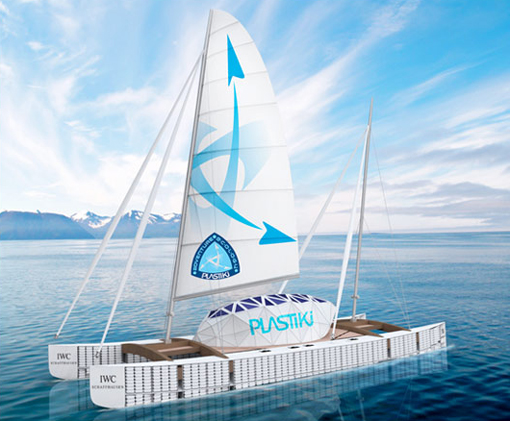
quote)
The Plastiki is a distinctive, one-of-a-kind 60-foot (20m) catamaran made out of 12,500 reclaimed plastic bottles and other recycled PET plastic and waste products.The craft was built using cradle to cradle design philosophies and features many renewable energy systems, including solar panels, wind and trailing propeller turbines, and bicycle generators.
On March 20, 2010, the sailing vessel set off from San Francisco, California with a six-man crew, including David de Rothschild, to sail across the Pacific Ocean. The expedition projected landfall in Sydney, Australia and included plans to visit several sites en route of ecological importance or which were susceptible to environmental issues caused by global warming, for instance the current sea level rise, ocean acidification and marine pollution. read more »
Zephyr, unmanned plane doubled 30-hour record set in 2001 - significance: solar powered, hand-launched, non-stop 82-hour flight

(quote)
Bertrand Piccard - "The pioneer is not always the one who succeeds, but the one who is not scared to fail." 'Zephyr is the world's first and only truly persistent aeroplane,' said Neville Salkeld, MD of QinetiQ's UK Technology Solutions Group. This amazing aircraft, launched by hand, can provide low-cost, non-stop surveillance over persistent surveillance and communications capability measured in terms of weeks, if not months. Not only is Zephyr game-changing technology, it is also significantly more cost effective to manufacture and deploy than traditional aircraft and satellites.'

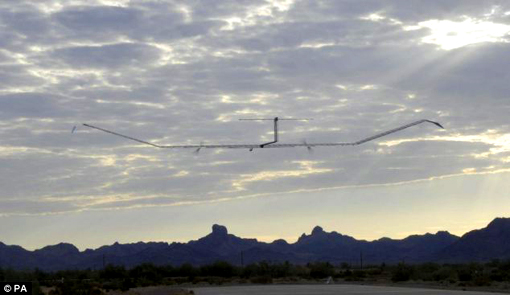
British solar-powered unmanned drone finally lands after flying non-stop for two weeks: It has more than doubled the unofficial record of more than 82 hours already held by Zephyr and has smashed the official record of more than 30 hours set in 2001 read more »
Contact Us

RSS feed


