You are hereUS & World
US & World
US Navy Ship, USS Farragut, lets 11 Somali pirates go after sinking pirate ship in Indian Ocean

The guided missile destroyer USS Farragut passes by the smoke from a suspected pirate skiff it had just disabled in this March 31, 2010 photo. USS Farragut is part of Combined Task Force 151, a multinational task force established to conduct anti-piracy operations in the Gulf of Aden.
(quote)
A U.S. Navy ship has sunk a pirate "mother ship" in the Indian Ocean and captured 11 pirates, and then promptly let them go. It was the second time within 24 hours that U.S. forces captured Somali pirates. Earlier Thursday, five pirates were taken into custody after they attacked a U.S. warship.
While those five pirates remain in custody, the 11 captured Thursday were allowed to leave in small skiffs after the mother ship was sunk. The action prompted a Pentagon spokesman to deny that the Navy had a "catch and release" policy regarding pirates.
A Naval official told ABC News that the practice of releasing pirates is not unheard of. While piracy is illegal according to international maritime law, it is considered a criminal issue, not a national security one.
(unquote)
Photos courtesy of Wikipedia and U.S. Navy / Mass Communication Specialist 1st Class Cassandra Thompson


Sushi-cide tragedy. Eat bluefin tuna (97% gone) to extinction? Oceans at our mercy. We have a choice...


(quote)
The Economist magazine calls CITES suppress- ion of debate on bluefin tuna dis- honorable: IT WAS a moment of some drama when delegates assembled in Doha came to vote on a ban in the trade in bluefin tuna on March 18th. The previous evening many represent- atives of the 175 member nations of the Convention on International Trade in Endangered Species of Wild Fauna and Flora (CITES) had been at a reception at the Japanese embassy. Prominent on the menu was bluefin tuna sushi. On the agenda the next day at the CITES meeting was a proposal to list the bluefin tuna as sufficiently endangered that it would qualify for a complete ban in the trade of the species (The Economist supports such a ban). read more »
Hoping Earth Hour visits often. Percy Bysshe Shelley: "Poet in darkness" "Leaves closed beneath kisses of night"

"A poet is a nightingale,
who sits in darkness and sings
to cheer its own solitude with sweet sounds."
~Percy Bysshe Shelley
"A Defence of Poetry," 1840
A sensitive plant in a garden grew,
And the young winds fed it with silver dew,
And it opened its fan-like leaves to the light,
and closed them beneath the kisses of night.
~Percy Bysshe Shelley
"The Sensitive Plant," 1820
Photo courtesy of WWF / geoffwilson2010 - Earth Hour before & after: The Westminster Palace. On each side of the palace rise the Victoria Tower and the Clock Tower, which shelters Big Ben, universally famous bell.
Talks failed. War on extinction.150 wardens died..SAS veterans use guns to save elephants, rhinos & tigers from poachers


(quote)
At least one British organisation, Care for the Wild International (CWI), is buying military-style field equipment and supporting the deployment of armed guards, while the US-based International Fund for Animal Welfare (IFAW) has bought night-vision supplies, ammunition and light aircraft.
WWF, formerly known as the World Wildlife Fund, has hired former SAS soldiers to train African wildlife wardens, and the Zoological Society of London is funding elephant-mounted patrols to protect rhinos in Nepal. The trend towards militarisation follows an estimated 150 deaths among game wardens in Africa in gunfights with poachers.
The disclosures coincide with a meeting of the Convention on International Trade in Endangered Species in Qatar, which has dismissed proposals to protect bluefin tuna, and this week likely to approve plans to restart sales of ivory taken from African elephants. read more »
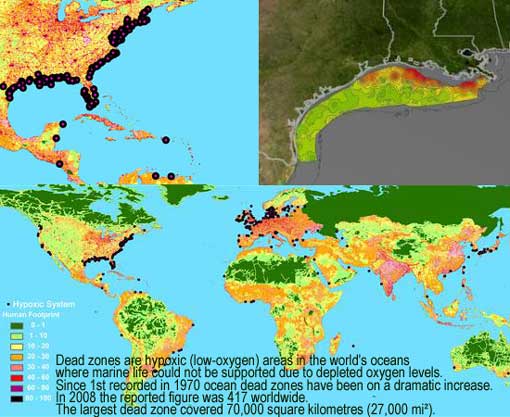
Ocean pollution. Sea "dead zones", oxygen-deprived, fishless: 1st recorded in 1970, 417 in 2008, largest covers 70,000 sq km

A new global study of Earth’s oceans shows a rapid rise in the number of “dead zones” - areas of seafloor with too little oxygen to sustain most marine life. The oxygen-starved waters have proliferated since the 1960s and now rank as one of the world's most pressing environmental problems.

Clocking in at over 8000 square miles (21,000 km2) this year, probably the largest dead zone today stems from the Mississippi River delta in the Gulf of Mexico. This is a site at the confluence of significant farming in the midwest and significant fishing (and shrimping) in the Gulf area. The dead zone spans east to west along the Louisiana and Texas coasts.

Several visible sites with expanding dead zones. Mississippi Delta at the top, with Yangtze River in the bottom left and Pearl River in the bottom right. The dead zones are the tinted clouds swirling at the coastal edge.
 read more »
NZ to honor law of citizen's arrest and denounce Japan's arrest of Pete Bethune? Experts: Bethune's boarding not illegal

Top L: killing whales. Top R: Arrested... New Zealander Peter Bethune is shielded from view. Bottom L: Japanese protesters rallied against Pete Bethune in Tokyo. Bottom R: Whale meat sashimi dish is served at a restaurant near Wada Port in Minamiboso, Chiba, Japan.

Humans drive extinction faster than species can evolve; diversity loss due to destroyed habitats & climate change

Threatened. L: the red squirrel will be lost within the next 20-30 years unless effective action is taken. This poor fella's just heard the news. R: the pine marten. One of England’s rarest, & cutest, mammals.

A pair of giraffes nuzzle as they stand in the bush near Koure, Niger. The IUCN lists west African giraffes as an endangered species.
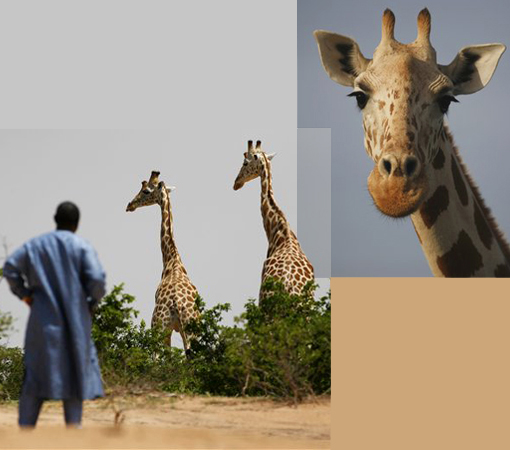
A giraffe from Africa's most endangered giraffe subspecies. Their numbers have quadrupled to 200 since 1996, an unlikely boon experts credit to the impoverished government keen for revenue that has enacted laws to protect them, a conservation program that encourages people to support them, and a rare harmony with humans who have accepted their presence.

Climate change is robbing polar bears of their habitats, & is the greatest threat to their survival.

Polar bear products are used for furs, rugs and taxidermy. Melting sea ice in Arctic will kill thousands of bears in coming years; US says commercial trade must not be allowed to make the situation worse. read more »
Contact Us

RSS feed