You are herephilosophy
philosophy
Rowling urges graduates to Imagine a Better World at Harvard Commencement, challenging them to use their gifts for greater good

(quote)
CAMBRIDGE - Acclaimed author J.K. Rowling, whose boy wizard captured the interest of countless readers with the "Harry Potter" series, urged Harvard graduates yesterday to use their imaginations to create a better world. In an earnest, personal speech, the British author reminded students that their talents and opportunities carry "unique status and unique responsibilities," and challenged them to use their gifts for the greater good.
"That is your privilege and your burden," she said. "If you choose to use your status and influence to raise your voice on behalf of those who have no voice, if you choose to identify not only with the powerful, but with the powerless, if you retain the ability to imagine yourself into the lives of those who do not have your advantages, then it will not only be your proud families who celebrate your existence, but thousands and millions of people whose reality you have helped transform for the better." "We do not need magic to change the world," she continued. "We carry all the power we need inside ourselves already: We have the power to imagine better."


Pollack produced over 44 movies, directed more than 20 films, 10 television shows, and acted in over 30 movies/shows
(quote)
If Mr. Pollack, who died on Monday at 73, could be compared to a major figure from the Old Hollywood, it would not be to one of the great individualists like Howard Hawks or John Ford, but more like William Wyler: highly competent, drawn to projects with a certain quality and prestige and able above all to harness the charisma of movie stars to great emotional and dramatic effect.
Just about any film by Robert Altman or Martin Scorsese, for instance, will be immediately and primarily identifiable as such, no matter who’s in it. But if you think of “They Shoot Horses, Don’t They?,” you’ll remember Jane Fonda, so desperate and defiant and sad as she pushes herself through a Depression-era dance marathon. “Tootsie” is Dustin Hoffman’s movie. “This Property Is Condemned” will conjure up Natalie Wood and Robert Redford, oddly cast but nonetheless generating Southern Gothic heat in an overripe Tennessee Williams scenario. And it is Mr. Redford who defines Mr. Pollack’s oeuvre nearly as much as the director himself. Over nearly 25 years, from “This Property Is Condemned” to “Havana,” they worked together on westerns (“Jeremiah Johnson,”); love stories both sweeping (“The Way We Were”) and intimate (“The Electric Horseman”); paranoid thrillers (“Three Days of the Condor”); and high-toned literary adaptations (“Out of Africa.”) read more »
If at first, the idea is not absurd, then there is no hope for it. - Albert Einstein
If at first, the idea is not absurd, then there is no hope for it.
We are made wise not by the recollection of our past... - George Bernard Shaw
We are made wise not by the recollection of our past, but by the responsibility for our future.
We learn from history that we learn nothing from history. - George Bernard Shaw
We learn from history that we learn nothing from history.
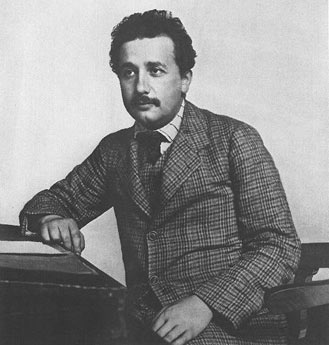
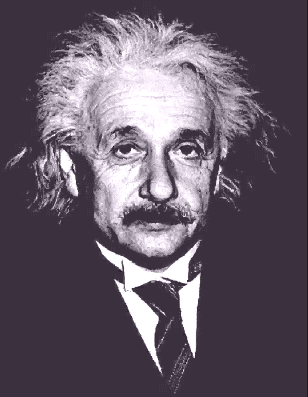
Albert Einstein - Emblem of Reason, Icon of Wisdom
(quote)
Bob Dylan came up with one way to remember Albert Einstein: “Now you would not think to look at him/But he was famous long ago/For playing the electric violin/On Desolation Row.”
This is the pure distillate of celebrity. Dylan’s folk-rock vision of “Einstein, disguised as Robin Hood” is one in which the original man has disappeared into a symbolic fog where more or less any meaning may be found. Nowadays, such content-less fame has become common, though there aren’t many out there who match Einstein for resonance. But when he first exploded into public view, there were no precedents. No scientist before or since has so completely transcended the role of expert to become a universal emblem of reason.
...
Photographers caught that wit as well as the gravitas. It helped that he was astonishingly willing to play along. No one made him ride that bicycle or stick out his tongue straight into the barrel of an oncoming lens. Whatever weariness he felt at the crush of the public gaze, he was almost always willing to pause for the shot. There is a story that he was once asked—by perhaps the only person on earth who did not recognize him—what he did for a living. He replied that he was a photographer’s model.
He was just as open to sharing his ideas. Einstein took seriously questions about his science, up to the point of writing one of the best introductions to relativity for the lay reader. (Called Relativity, it’s still in print.) He handled the ridiculous questions, too, with humor and enormous stamina. He told his interrogators what he thought of Prohibition (against, though he didn’t drink), the death penalty (against, at least some of the time), and abortion (for, up to a certain point in the pregnancy). No scientist before Einstein had been so willing to stand before his public.
(unquote)
Images courtesy of NASA

Common sense is instinct. Enough of it is genius. - George Bernard Shaw
Common sense is instinct. Enough of it is genius.
Contact Us

RSS feed