You are herephilosophy
philosophy
I hope our wisdom will grow with our power and teach us that the less we use our power the greater it will be - Thomas Jefferson
I hope our wisdom will grow with our power, and teach us, that the less we use our power the greater it will be.


"Be practical as well as generous in your ideals. Keep your eyes on the stars, but remember to keep your feet on the ground."
Be practical as well as generous in your ideals. Keep your eyes on the stars, but remember to keep your feet on the ground.
Wisdom consists of the anticipation of consequences. - Norman Cousins
Wisdom consists of the anticipation of consequences.
Knowledge is a process of piling up facts; wisdom lies in their simplification. - Martin Fischer
Knowledge is a process of piling up facts; wisdom lies in their simplification.
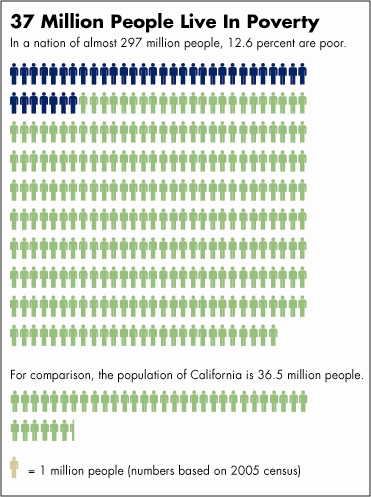
"These truths to be self-evident, that all men are created equal". $656 bil. for Iraq War? or for 37 mil. Americans in poverty?

(quote)
Today marks the birth of a notion as well as a nation
July 4, 2008
By Jerry Davich Post-Tribune metro columnist
"We hold these truths to be self-evident, that all men are created equal, that they are endowed by their Creator with certain unalienable rights, that among these are life, liberty and the pursuit of happiness."
When in the course of human events, it becomes necessary for a pampered, privileged, and not-so-patriotic newspaper columnist to finally take the time to read his nation's most hallowed document, it must seem like a sad state of affairs, I agree. Yet here I am, a 46-year-old Yankee Doodle Davich who not once has read every word in the Declaration of Independence, arguably the most masterfully written political prose of Western civilization. Oh, sure, I can be a patriotic pretender and regurgitate its revolutionary highlights, such as "self-evident truths," "unalienable rights," and "all men are created equal." But what does that all mean in 2008, in a country that went from 2.5 million people in 1776 to 305 million today, with who knows how many here illegally or what that really means?

In a country that riveted its global identity to become the economic leader, only to predictably lose that title to China. Or which has so far allocated $656 billion for the war in Iraq while millions of Americans go without food, health care, and proper education. And a country which only recently experienced its first "mountaintop moment" regarding civil rights, and possibly the not-so-self-evident truth that all men are created equal.
On June 28, 1776, Thomas Jefferson finished drafting the first version of the Declaration of Independence. On June 28, 2008, I began studying the final version in earnest. On July 4, 1776, the Continental Congress adopted the document, and it later served as an autographed preamble for the birth of a nation. On July 4, 2008, I'd like to use this space as a preamble for the birth of a notion: Between the cookouts, parades, and fireworks, how about we pause to reflect how the Declaration has stood the test of time. And what better time, on the nation's 232nd birthday, to spark a conversation of sovereign thought among free people.
What would they think?
I can't help but wonder what our founding fathers would think of America the Bountiful in the 21st century, in all its hope and hype, gore and glory, fakeness and flag-waving.
Would they condemn, condone, or celebrate a racially mixed presidential candidate? Or a middle-aged woman for that matter? Would they embrace or be aghast over the proliferation of guns? Or the recent Supreme Court ruling on the right to bear arms? Would they be surprised or surly over our global trade agreements with other countries, including the $107 billion of trade each year with the United Kingdom, our adversary in 1776, but our sixth-leading trading partner today? These are the questions I asked myself while reading the Declaration and its 56-signature endorsement.
Also, it seems our founding framers' clear, concise, and candid public declaration in 1776 has been replaced by red, white and often untrue political decoration in 2008, an election year. Rhetoric has replaced reasoning. Sound-bites have replaced sound thinking. Image has replaced imagination. Maybe my star-spangled skepticism seems un-American, but I feel there's a thin line between how we praise a "patriot" versus how we torment a "traitor."
Isn't it still our duty to be the watchdog of government, to secure our life, liberty, and pursuit of happiness, and if necessary to indict our leaders, just as the Declaration indicted King George III? Isn't it our duty to question whether our personal freedoms are being protected, protracted, or politically pawned away? Isn't it our duty to reconsider exactly what defines our so-called unalienable rights? Two centuries later, does the term still adhere to our basic human rights, or do we view them as more national than natural?

Who's a patriot today?
And where does the "Creator" still fit into this 232-year-old marriage between church and state? A recent poll showed an overwhelming majority of Americans are "absolutely certain" that God exists, but many of them don't believe in worshipping on a regular basis. Is there a parallel with those same Americans who genuinely believe in democracy but are not absolutely certain about our government?
And what defines a patriot these days, "a person who loves, supports, and defends his or her country and its interests with devotion," according to my dictionary. Or someone who must symbolically wear an American flag pin to prove it?
On the morning of July 4, 1776, church bells rang out when the Declaration was finally, and formally, adopted. But, I discovered, two statesmen ended up not signing it. John Dickinson clung to the idea of reconciliation with Britain, and Robert R. Livingston thought the Declaration was premature. Today I can only wonder about all the statesmen in 21st century America who would have joined Dickinson and Livingston, refusing to put their necks on the line for the birth of a notion, and a nation.
(unquote)
Images courtesy of Getty Images and Center for American Progress, and paintings by Gilbert Stuart and Arnold Friberg
Original Source: Post-Tribune and Center for American Progress
Golden Globes award goes to Angelina Jolie and Brad Pitt and they are expecting twins!
(quote)
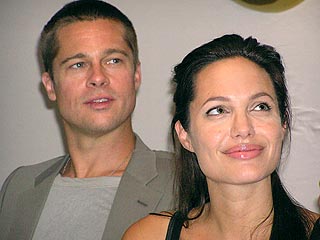
Brad Pitt and Angelina Jolie's love for children is by no means limited to their own: The couple has donated $1 million to help kids affected by the war in Iraq, the Education Partnership for Children of Conflict announced.
The organization will distribute the donation, made through the couple's Jolie-Pitt Foundation, to four organizations working on behalf of children who have lost parents, homes and schools in Iraq. Children in the U.S. who have lost parents in the conflict will also benefit.
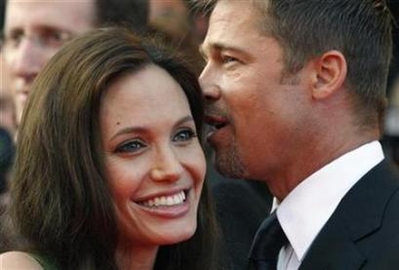
"These educational support programs for children of conflict are the best way to help them heal," said Jolie in a written statement from Education Partnership for Children of Conflict, which she co-chairs.
"We hope to encourage others to give to these great organizations," Pitt added in the statement.
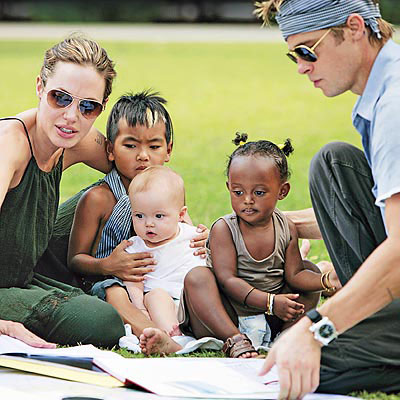
The Jolie-Pitt Foundation has given $500,000 to three groups in the war-torn country which will provide aid for some 5,700 children, said the Education Partnership for Children of Conflict. read more »
Robot with heart of gold falls in love: Wall-E, a beautiful Pixar vision, full of charm, humor, suspense, romance, and magic
(quote)
Groundbreaking yet familiar, part romance, part sci-fi, Pixar's latest work is wonderful and full of wonder. - Kenneth Turan, Times Movie Critic
If Pixar Animation Studios has an enviable record of consistent success -- and with a worldwide box-office gross of $4.3 billion from its eight films, it certainly does -- it's because the company has an uncanny gift for pushing things further without pushing too far. Pixar's adventurous new film, the one-of-a-kind "Wall-E," shows how it's done. Daring and traditional, groundbreaking and familiar, apocalyptic and sentimental, "Wall-E" gains strength from embracing contradictions that would destroy other films. Directed by Pixar stalwart Andrew Stanton, who co-wrote and directed the Oscar-winning "Finding Nemo," "Wall-E" is the latest Pixar film to manage what's become next door to impossible for anyone else: appealing to the broadest possible audience without insulting anyone's intelligence.
The origins of "Wall-E's" story, as related in the film's teaser trailer, go back to 1994, when Pixar honchos held a now-celebrated lunch to spitball story ideas, which became "A Bug's Life," "Monsters, Inc." and "Finding Nemo." "Wall-E" is the last of that group to get made, in part because elements of it are so unconventional. For one thing, the film's exceptional first half hour or so lives and breathes on screen with just about zero human dialogue. But with the storied Ben Burtt, who did the job on "Star Wars," creating all kinds of noise as the film's sound and character voice designer, as well as music by Thomas Newman, you won't miss those words at all. You also won't miss them because the world of "Wall-E," created by production designer Ralph Eggleston and his team, with the advice of high-powered cinematography consultants Roger Deakins and Dennis Murren, is so remarkable. The time is 800 years in the future and the setting is our own Earth, but it's not an Earth anyone would want to recognize.
Not to put too fine a point on it, our planet is a disaster, a bleak and disheartening ruin where every available surface is covered by towering skyscrapers of trash. It got so bad that Buy n' Large, the conglomerate that has somehow taken charge of the planet, leaned on the entire human population to leave with a "space is the final fun-tier" campaign that featured slogans such as, "Too much garbage in your face? There's plenty of space out in space." Though not likely the main reason the film was made, "Wall-E" can't help but send out a powerful and even frightening environmental message. Though G-rated, its dystopian vision (shot by Jeremy Lasky and Danielle Feinberg) of what the perils of consumer excess have in store for the planet is unnerving without trying too hard.
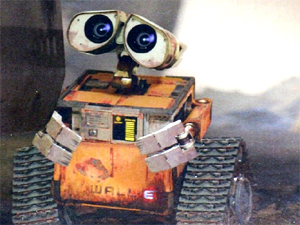
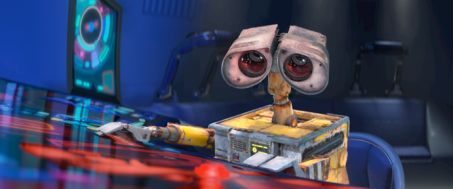
One reason "Wall-E" is as audience-friendly as it finally is is the presence of the endearing title character, whose name is an acronym for Waste Allocation Load Lifter -- Earth Class. What that means in practical terms is that Wall-E is a robotic trash compactor who has been quietly doing his job attacking Earth's endless mountains of refuse for 700 years. Unless you count his pal, a nameless but convivial roach, Wall-E is the only thing still moving on the entire planet. Given all that, it's to be expected that Wall-E, whose large binocular eyes and narrow neck turn him into a squat, mechanical E.T., has developed a few personal eccentricities over the years. For one thing, he's quite the collector, squirreling away everything from old Rubrik's Cubes to light bulbs to an actual living plant.
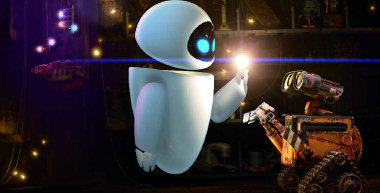
More than that, this set-in-his-ways old bachelor robot has developed a fixation with the movies. Not really the movies, but one movie in particular, the only video he's got. It is, of all things, "Hello, Dolly!" and screenwriters Stanton and Jim Reardon had the shrewd idea of opening the film with the jaunty lyric, "Out there is a world outside of Yonkers," as the camera somberly pans both the universe and the ruins of Earth. What really entrances "Wall-E" about "Hello, Dolly!" is the spectacle of people expressing emotion and connection by holding hands. Not a word is spoken, but we understand that this lonely Robinson Crusoe, like so many movie creatures before him, would like nothing better than to hold hands with another entity. And then it happens. A spaceship lands in Wall-E's neighborhood and leaves behind a sleek white oval-shaped probe-droid with bewitching blue eyes named Eve (for Extra-terrestrial Vegetation Evaluator), sent to Earth to find signs of life. High tech and armed with a laser weapon that pulverizes anything in sight, Eve fascinates Wall-E and he nervously scuttles around after her, fearful but intoxicated by her every move.

Though this wordless section of the film, punctuated only by Wall-E's frequent and idiosyncratic croak of "Eve," is in some ways merely a set up for the second half, it is easily the most memorable and distinctive part of the film. This segment, a kind of song without words, is a world-creating work of pure imagination that has been thought out to the nth degree.
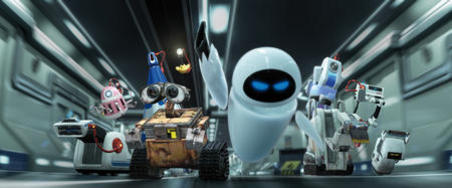
"Wall-E's" second half involves the dauntingly overweight humans who have sent the probe (and who are shrewdly not pictured in any publicity material.) They've lived for centuries on a cruise liner-type spaceship called the Axiom run by a barely functional captain (Jeff Garlin) in thrall to a Hal-type eminence called Auto, voiced, in a nod to "Alien," by Sigourney Weaver. This part of the story gets increasingly familiar and sometimes borders on the predictably sentimental. But along with these inevitable elements of calculation, "Wall-E" never loses its sense of wonder: wonder at life, wonder at the universe, and even wonder at the power of computer animation to create worlds unlike any we've seen before. How often do we get to say that in these dispiriting times?
(unquote)
Images courtesy of Disney/Pixar, mlive.com, hamptonroads.com
Original Source and Video: LA Times
Special Gallery:Showbiz 7s: Movies that inspired 'Wall-E'
Related Article: :'Wall-E' draws design inspiration from Apple
Contact Us

RSS feed